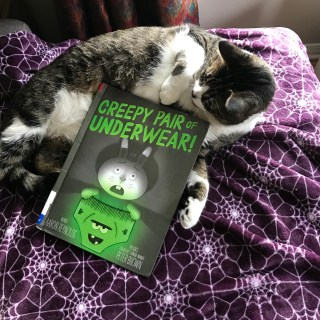
Creepy Pair of Underwear

img_2154Creepy Pair of Underwear by Aaron Reynolds

What a perfect mix of fun and spooky! While shopping at the underwear store, Jasper Rabbit convinces his mother that he needs something more than just “plain white”– he needs the cool green underwear in the special display. His mother is worried that they are a little creepy, but he assures her that he’s not a little bunny anymore, and the underwear are not too creepy for a big rabbit. That night, he proudly wears his new underwear to bed. But then, after the lights are out, he realizes they might be a little creepier than he thought: the underwear are giving off a ghoulish green glow that he cannot get out of his head. Jasper stuffs them in the bottom of his hamper and goes back to sleep. Then the next morning… they are back! Jasper makes several attempts to rid himself of the underwear, but they continue to show back up in his drawer. When Jasper finally finds a way to keep the underwear away, he has another realization… he has become accustomed to that gentle green glow, his bedroom is awfully dark without the creepy glowing underwear.

This book is super silly, with just the right amount of spookiness twisted in. There is a nice, creepy aesthetic to the illustrations, all in black and white with dark backgrounds, except for the green glow of the creepy underwear. I can see this one enjoyed by kids off all ages, with an engaging story and ridiculous premise. A story about underwear is going to be funny to kids, and the idea of being haunted by creepy underwear is obviously hysterical to anyone under the age of 10 (and probably a lot of us adults too).

Boris’s thoughts: “Okay, it’s funny… but don’t get any ideas. If you start stringing glowing underwear around the house, I’m leaving. 2 paws.”

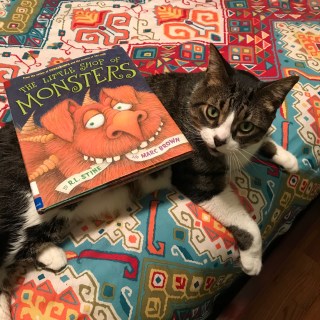
The Little Shop of Monsters

img_2171The Little Shop of Monsters by R.L. Stine and Marc Brown

This picture book is the combined effort of a seemingly unlikely pair– every young person’s favorite horror author R.L. Stine, and the creator of everyone’s favorite anthropomorphic aardvark Arthur, Marc Brown! The narrator takes the reader on visit to the Little Shop of Monsters, where you will find every type of monster that you can imagine. This spooky, but not too spooky, tale intersperses text blocking and illustrations to guide you through the shop. Along the way, you are introduced to several aptly named monsters, with tons of great adjectives and descriptors.

Much of the book is written as a conversation between the narrator at the reader, making this perfect for a read aloud text. There are ample opportunities for the reader to “respond” to the narrator, via questions, comments, and a few well-place parenthetical statements. I grabbed this book off a shelf in the library on a whim, as I was looking for potential children’s books to span the month of October. After reading through it, I am planning to add it to my list of books to share with my nephews and niece. The pictures and descriptions will definitely impress the younger kids, but I think some of the more horror-esque aspects of the story will appeal to slightly older readers as well.

Boris and Bella

img_2141Boris and Bella by Carolyn Crimi

Happy October! I am so excited for the turn of the weather, and all the spookiness that comes along with October. In the spirit of the season, I plan to keep things spooky for my next few posts! I saw this book on display in the library, and it immediately caught my eye– the cover is a bit creepy-chic, and one of the title characters has a great name (coincidentally, my mother also has a dog named Bella to pair with my Boris).

As it turns out, this is not just an eye catching cover with a personal connection in the title– it is a cute story about friendship with a Halloween-ish theme.  Bella Legrossi and Boris Kleanitoff are neighbors, who are not particularly fond of one another. Bella is the messiest monster, and Boris is a neat freak who goes as far as polishing his pythons daily! Neither of them are popular with the other monsters in Booville, which only complicates things when they try to show each other up by throwing competing Halloween parties– which nobody attends because of Boris and Bella’s tiresome personal habits. As often happens in children’s books, Boris and Bella are able to find some common ground: first in their anger about the party everyone attended instead, and second in a shared love of dancing. While neither of these characters give up their ways, they do ease up enough to become friends.

Although the story does feature a Halloween party, this is not exactly a Halloween book. Halloween-ish? Halloween-lite? Despite monstrous characters, the story itself is about the ability to look beyond differences to find friendship in unlikely places. Nonetheless, the monster theme does make this a nice fit for the season. The illustrations are very detailed and compliment the story, with a color scheme that maintains a spooky mood to the setting. There is also some pun-ny humor for those who appreciate that sort of thing, and some really great kid humor– Baggo Bones connects his hipbones to his neckbone just for fun!

Boris’s thoughts: “I hope you’re not trying to suggest that I am persnickety like this other Boris. 1 paw.”

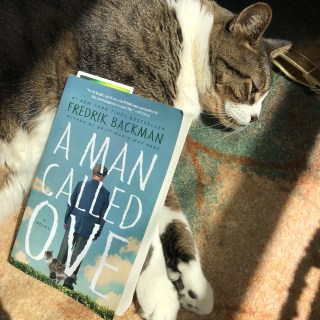
A Man Called Ove

img_1921A Man Called Ove by Fredrik Backman

Date Read: August 8 to 31, 2019

Rating: 5 (of 5) stars

This was my book for The Unread Shelf Project prompt for August: a book voted for you to read by Bookstagram. Since I do not have a large following, I decided that it was easier do this as a poll with two options. It was actually my first ever Instagram poll! I only had 6 participants, but enough to give a slight majority to this grumpy old man. I loved this book, so I am happy that it turned out as it did!

To those around him, Ove appears to be just a cranky old man. They aren’t wrong—he is one of the most cantankerous characters I have ever read. However, as the back cover states, there is more to Ove than meets the eye. Of course there is; we would not have much of a story otherwise. We meet Ove shortly after the death of his wife, Sonja, although this is not entirely clear in the first few chapters. He has been struggling to cope with the loss, as he views Sonja as the bright spot in an otherwise bleak existence. Throughout the novel, we jump back and forth between past and present, allowing us to see how the story of Ove’s youth, and Sonja, has influenced his attitudes: strong principles, irritability, and all. Sonja certainly brought out the best in him, and continues to do so even after her passing. Whenever faced with doing something that is inconvenient, but the right thing to do, he considers what Sonja would say to him when he joins her in the afterlife—whether that decision is about caring for a stray cat or taking in a youth who was kicked out of his home.

The two main themes that stood out here for me were Ove’s ability to find new purpose in life through his connection to others, as well as what Backman calls “time optimism”—the tendency we all have to assume that there will always be enough time with other people, until suddenly that time runs out. It’s a funny concept to think about, because I think it is a characteristic that we all share, to an extent. I know I am guilty of time optimism still, despite having several experiences to call on of time run out. I would like to say that it is something I am working on—and it is—but I think it is something hardwired in us that we may only be able to escape temporarily.

In addition to falling in love with the story of Ove, there were some literary devices the author used here that I really enjoyed. The first, and the most apparent, is the liberal use of ridiculous and hilarious similes. Things like when Ove “nods irritably, like someone squeezing an avocado and finding it overly ripe.” I can see why some readers might think the similes are overdone—but I love it. Second, and a bit subtler, is the change in narration that coincides with Ove’s shifting attitudes. At the beginning of the novel, Ove refers to nearly everyone around him by a nickname, oftentimes a rude one. His new neighbors are the Pregnant One and the Lanky One, and their children are referred to only by their ages. There is a full cast of characters in the neighborhood who have all earned Ove’s contempt. Gradually, as Ove begins to soften toward some of these characters, he begins to refer to them by their proper names; beginning with Parvaneh, the pregnant one who pushes his buttons but also pushes him to be better.

Boris’s thoughts: “He was kind of a jerk to that cat… but I’m not sure I can blame him. I think I relate more to the man than the cat. 3 paws.”

Lovecraft Country

img_1914Lovecraft Country by Matt Ruff

Date Read: July 24 to August 8, 2019

Rating: 3 (of 5) stars

This was definitely an interesting read, although I wanted to enjoy this book so much more than I did. I suspect that part of the problem may be my lack of background knowledge—I have never read anything by H.P. Lovecraft, and my reading of classic science fiction is admittedly lacking. However, I am not fully convinced this would have made a drastic difference in my feelings on the book, although it may have at least increased my appreciation of what Ruff was doing here.

Lovecraft Country falls somewhere between a novel and a collection of short stories, chronicling the lives of an extended African American family living in 1950s Chicago. Each chapter is written as a story centered on a different member of the family, each of them connecting to the main narrative. It includes horrors of two primary varieties: elements of classic horror fiction inspired by Lovecraft and others; the perhaps even more terrifying daily horrors of racism in America. The stories of the struggles encountered in their everyday lives, as well as their research for the “Safe Negro Travel Guide,” paints a picture of that period in American history that many may not realize existed—a bit scary considering that time is not so far back in our history. I am a generally well-read and well-informed person, and this is a perspective of America that I have never had to face myself. Although I know that side of our past exists, I have not previously encountered it in the perspective taken here. Perhaps that is my own fault.

I wish I could find more to say about this book, especially considering my unusually low (for me) rating. (You’re right, three stars is not a bad rating; however, if you have read any of my previous reviews, you know that I tend to give 4-5 stars to most of what I read. I really cannot help myself; I love books too much). With the style of the book I mentioned—the chapters that feel more like individual stories—I felt like there was something missing somewhere. There is some resolution to the overall narrative, but it feels like there is something lacking, although I cannot quite put my finger on what that is. Perhaps there could be more to the story from here? Perhaps something more is needed to fill in the gaps between each of these tales? I am not sure, but it left me feeling a bit unenthused.

Boris’s thoughts: “Curious. You lost me after that scary dog in the second story though. No thank you. 1 paw.”

Shout

img_1034Shout by Laurie Halse Anderson

Date Read: July 18 to 22, 2019

Rating: 5 (of 5) stars

I went to a small high school. There were two English teachers in the school my freshman year, and by the time I graduated that had only increased to three. We had no library, just the small collection of books each teacher had in their classroom. By my junior year, I had read them all. One of the teachers started bringing in books from home for me to read, and that was when I discovered Laurie Halse Anderson. I was so taken with her story and her writing that I bought up her other novels as soon as I saw them, without even taking the time to read the description on the back cover. It was this practice that led me to scoop up her latest book without realizing what it was—which I am considering serendipitous, as I would have likely passed on this incredible work because I thought it was “not my style.”

Shout is a novel-length memoir, told through a series of poems. Although each poem as its own subject, and there is variety in style, they combine to form a loose narrative. I was impressed with how Anderson was able to convey her troubled childhood without judgment. She acknowledges the hardships of her family life, but does not condemn her family nor ask for sympathy. The poems are divided into three sections, labeled simply: One, Two, and Three. One, which covers more than half of the book, deals with her early life into her early writing career, ending with Speak, her first successful novel (and the book that I had originally discovered back in high school). Two gets more involved in life as an author, and as a speaker. Dealing with the unexpected success, but also the controversy surrounding sexual assault and speaking about it in schools. Three was a bit less organized, but had some reflections and other pieces that did not quite fit into the rest narrative.

Overall, I was really impressed with this book. I usually am not a fan of poetry, but something about these poems really drew me in. The story was captivating and I found myself enjoying it much more than I had expected when I started.

Boris’s thoughts: “I think poetry just goes over my head. It was hard enough to learn to read human, how am I supposed to understand this? 2 paws.”

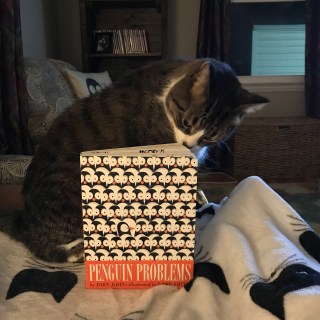
Penguin Problems

img_2058

Penguin Problems by Jory John

To kick off September, I have one more book to add to my collection of children’s books featuring penguins. There is something undeniably delightful about these silly little black and white waddling creatures. Of course, even penguins have problems—it’s always cold, they can’t fly, and everyone looks so much alike! Our lead penguin is having a rough day, and there is no end to his list of complaints about the world. However, he gets some advice from a wise walrus who reminds him that if you are looking for something to complain about, you will always find it. Life not always perfect, but that does not mean that you cannot find joy in what you have.

While this does not top my list for children’s literature, the book is cute, short, and easy to follow. There is not much of a story, but just enough to carry things through the pages. I can see this being popular with younger kids, which makes sense with this particular edition as a board book. The story has a touch of cynicism, which is good for at least a chuckle from adult readers, but likely would not be picked up by kids. This would be good as a read aloud story one-on-one with a younger child, who perhaps does not have the stamina to sit and attend to longer picture books.

Boris’s thoughts: “Interesting to learn about the problems of other species, but penguins couldn’t possibly have more problems than cats. Did you know I only had time for 5 naps today? 2 paws.”

Sisterhood of the Traveling Pants, Part 2

The Sisterhood of the Traveling Pants (Series) by Ann Brashares
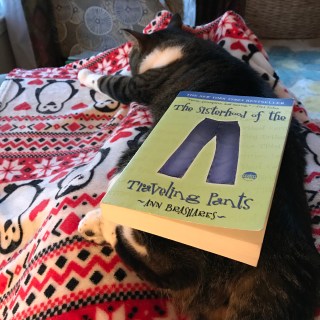
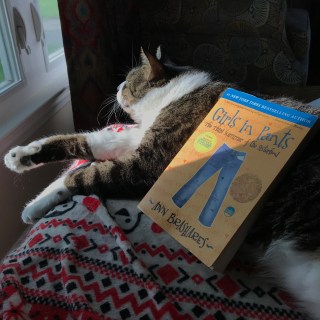
img_0927Girls in Pants

Although I gave all of the books in these series a similar overall rating, I felt book three of the Sisterhood was an improvement over book two. It starts out with what has now become a tradition to begin the summer: celebrating their friendship and bringing the pants out from their winter hibernation. In this case, three of the four are planning to be home for the summer, with Bridget off to coach at a soccer camp. Her story seems to come full circle here, with her experiences with the boys on her team as well as reencountering Eric from her past. Her story does well to highlight the growing up that she has done since the end of the first book.

Tibby’s story here was not as interesting as the ones in the previous books, but there was nothing that I specifically disliked. My feelings on Carmen’s story were similar to those from her book two plot, although a bit more balanced by adding in her caring for Lena’s grandmother. Carmen’s interactions with her mother seemed melodramatic, and sometimes borderline vindictive. While I would like to say that she made some growth by the end, I am not convinced that’s true. She seemed very aware that she was behaving badly, and acknowledged how she could be better, but was uninterested in making a change.

My favorite story here was Lena’s—and I was so happy to see that her story was not centered on Kostos! The prior books mentioned her art, but did not describe it as the passion that can be seen here. Lena’s struggle between following her dreams and following the rules of her family is captivating and relatable. I love that she is able to use her love for art as well as her talent to learn more about herself, and connect that to her relationships with her family.

img_1037

Forever in Blue

Book four of the Sisterhood, Forever in Blue, provides a perfect wrap up to this series full of ups and downs for this group of friends. It starts with some uncertainty for all of the girls—they are not together for their traditional kick off to summer, and since they have all been apart at college they never retired the pants as they did in previous winters. I was happy to see some personal growth for all of the girls, and was especially pleased with the stories for Lena and Carmen (finally!!!). The ending, with Carmen’s friends showing up to support her at her play, and then the four girls coming together to search for the lost pants in Greece was a fitting end to this series of adventures and growing up. The loss of the pants fits well with the “magic” element that I was not too crazy about: they have served their purpose for the girls, and so have moved on.

There were some unique insights on both finding and forgetting oneself that struck me here. For the first time in the series, I found myself jotting down quotes that I did not want to forget. To end the series, I’ll share two of the tidbits I chose to capture for myself, I believe both of them coming from Carmen’s narrative:

“You couldn’t always know what would matter to you.”

“When you belonged nowhere, you sort of belonged everywhere.”

Sisterhood of the Traveling Pants

The Sisterhood of the Traveling Pants (Series) by Ann Brashares

img_0803The Sisterhood of the Traveling Pants

July’s prompt for The Unread Shelf Project was a book from a series on your shelf. I did not have a ton of options for this one, as I usually read series books all together and tend not to buy a ton of them– it’s hard to get your “to read” list down if you add whole series at a time. However, I happened to be gifted this one awhile back from a book swap, and never quite got around to it. So to stick to my usual reading patterns, I opted to take on the whole series (with a little boost by starting the first book at the end of June).

This was a solid start to a series that I did mostly enjoy. The first book gives a nice introduction to the group: four friends who have been together for their whole lives, preparing to spend their first summer apart. It sets up an interesting structure that continues throughout the series, with four mostly separate narratives that overlap, intertwine, and eventually come together in the end. The “magic” element of the pants seems a little gimmicky, but using pants as the collective reminder of friendship works in a way that other items would not. Since it is something that they wear, it is something they each take with them as they experience life, not something that they simply look to as a token.

I found it noteworthy that in a book dedicated to friendship, the title object it centers on is not wholly positive—the first experience each of the girls has with the pants is negative, but they are also later able to draw strength from the reminder of their friendships to help them get through the tough parts of their summer lives. Although not a completely happy ending, there are positive turns for each character at the end of the book: Carmen has begun to make amends with her father, Lena finally connects with Kostos, Tibby begins to accept the loss of Bailey, and although Bridget is feeling of lost, she has found some solace in her return to her friends.

img_0817

The Second Summer of the Sisterhood

Book two picks up at the beginning of the following summer, with minimal reference to the time between. As before, the girls are preparing for a summer spent at least partially apart, and lay out their plans for the pants. Each of them has another storyline with some room for and elements of growth, although I saw some drastic differences in the quality of each characters narrative.

Bridget is still struggling, but seems to be at least a bit more self-aware. She is spending the summer with her grandmother in an effort to learn more about her mother, albeit under an assumed name and deceptive guise. I liked the duality of her re-finding herself here between glimpses of her family and a reconnection to the sport that she loves. I was a little irritated by the unreality of extent of her lie to her grandmother, but thought this was tempered by the admission in the end that her grandmother was suspicious and playing along. I liked Tibby’s journey of discovering and aligning her priorities through the development of her documentary.

Honestly, I found Lena’s story a bit lackluster. I can see the appeal in her story of teenage romance, but just could not get excited for her. Carmen’s difficulty with her mother beginning to date seems like an understandable issue for a teenage daughter, but her story comes off as annoying and melodramatic. In the first book, Carmen seemed justifiably angry with her father and his failure to tell her about his life until she was shoved into the middle of it. This anger with her mother feels different, and petty. I had a hard time sympathizing with her, which took away from the book as a whole.
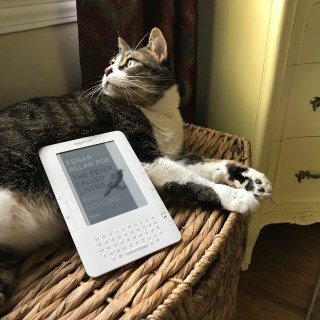
Edgar Allan Poe: The Fever Called Living

img_0643Edgar Allan Poe: The Fever Called Living by Paul Collins

Date Read: June 9 to 13, 2019

Rating: 4 (of 5) stars

I have had a bit of a fascination with Poe for quite some time. Although he is often sensationalized as the “troubled artist” and associated with the dark and macabre, there is so much more to him than that! Up until a few years ago, I had only read some of his more popular works, but in March 2017 I wrapped up a yearlong project of reading Poe’s complete works. I was so pleasantly surprised with what I found there! With a little bit of distance from that project, I thought a biography would be a nice supplement to my Poe repertoire.

Collins’ biography of Poe is a quick and concise general accounting of Poe’s life, beginning with his childhood and school experiences. While giving a factual accounting of Poe’s life, the narrative is well balanced so that it does not feel like a passage in a history book. Poe is presented alongside his significant publications, though many were not recognized as such at the time. This is not only a biography of Poe the man, but also a biography of his literary works. Some present day analysis of his work is included, with some emphasis on the widespread influence of his work in the world of literature. It is certainly impossible to touch on all of the work that Poe created in his lifetime, but there was a nice balance of what are considered his great achievements along with reference to many lesser and even un-credited publications. (Boris and I particularly liked the reference to his writing of the exploits of his house cat for a family publication when he was particularly poor and in need of work.)

Perhaps the more ardent fans of Poe did not need this, but I also enjoyed the added context given to his work as well as some well-known quotes. I have seen reference to his statement on how he “became insane, with long intervals of horrible sanity” in many places, but this is the first I have seen comment on his intention with these words—the cyclical nature of his poverty and drinking, combined with the prolonged illness of his much loved wife.

This is a great starting place for anyone interested in knowing more about Poe and his work. Collins’ portrayal of Poe is sympathetic, but without romanticizing the hardship he endured throughout his life.

Boris’s thoughts: “So if someone wrote a book about a guy who wrote about his cat… do you think someone will write a book about us one day?”