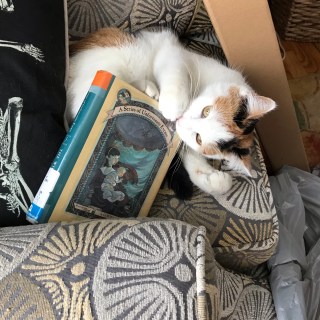
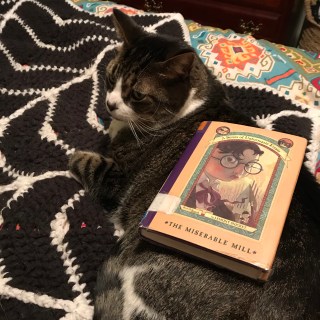
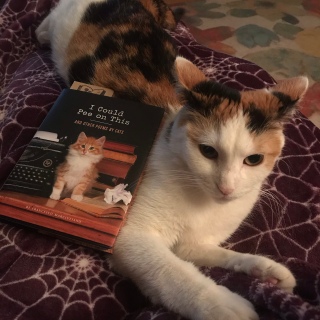
Dead is the New Black

img_4346Book: Dead is the New Black by Marlene Perez

Date Read: December 9 to 17, 2019

Rating: 3 (of 5) stars

I read this back in December, as part of a mad rush to finish as many books as possible by the end of the year. This was a book that I had gotten as a daily deal on Kindle quite some time ago, and it was the perfect fit for a reading spree: short and something that does not require a ton of mental energy.

This supernatural detective novel is written as if it were realistic fiction. There is no real world building here—this book takes place in a normal town in California, just with the understanding that fictional creatures like werewolves and vampires are real. Our protagonist, Daisy Giordano, is the daughter of a psychic who is known to assist the local police. Her sisters have similar abilities, but Daisy reports herself to be a “normal.” Daisy is determined to help her mother solve a case that she is stuck on: all while navigating life as a high school student. There is high school romance, girl drama, cheerleaders, and every other young adult cliché you can think of.

Despite the clichés, I thought this was well done for what it is. The story was interesting, the writing reasonable. There were a few predictable developments, but also some surprises along the way. I discovered while reading that this is the first book in a series, and while I did enjoy this first book, it is not something that I feel I need to run out and read the rest. That said, I am happy to report that this was serviceable as a standalone novel. I can definitely see where there is room left open for further development with the characters, but the main plot of the story is wrapped up well.

Boris’s Thoughts: “Cheerleaders and girl drama? Can’t you make the new cat read these ones from now on? 1 paw.”

Harbor Me

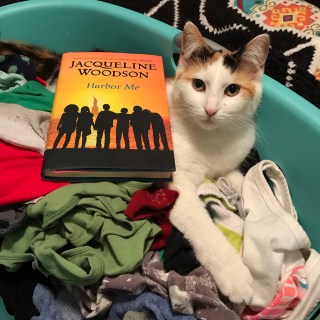
img_3633Book: Harbor Me by Jacqueline Woodson

Date Read: March 19 to 21, 2020

Rating: 5 (of 5) stars

Every year, I make an effort to read the book that is chosen for the One Book, One City program in Grand Rapids. Grand Rapids Public Schools and Grand Rapids Public Library partner on the project that provides a copy of the book to all 5th grade students in the city, as well as classroom resources for teachers and an online community for students to participate in. The program makes an effort to choose diverse books, and books that lend themselves to engagement and discussion from students. Honestly, they have outdone themselves with their choice for 2020.

Unlike previous years, I almost missed my opportunity to read this book. In the past, we have received at least one additional copy of the book that I have been able to borrow from the librarian. However, this year we only received exactly the number we needed for students and classroom staff. I was disappointed, but heard talk around the school: this was shaping up to be the best year yet for the program. Students were connecting with the book in ways that they have not in the past; classrooms were having open and honest discussions about real issues, initiated and lead by students. And then—COVID-19 reached our state. Within days, schools were shut down and teachers were left lamenting the cancellation of their wonderful plans. Me being the optimist, I am trying to be grateful for the fact that the school closures landed an abandoned copy of the book in my hands before I headed home.

The story focuses on six students from different backgrounds, who are all in the same small class at school. One Friday afternoon, their teacher takes them to an empty classroom, and leaves them to use the space to talk to each other without direction or interference from adults. Over time, each of the students opens up to their friends, as they start to recognize that although they are each living their own stories, their lives overlap with the stories of others. Although there are a couple ongoing storylines, this book is not heavily plot driven—the focus is more on the feeling and memories associated with a group of friends.

While I think I would have enjoyed this one any time, I think the time that this book fell into my hands amplified how I felt about it. There is an immense sense of community here; a sense of recognizing oneself as a part of something larger. At the same time, there is a recognition of each individual’s one story: a realization that everyone around us is living a life full of its own complications, and while we may be center stage in our own minds, we may only be a background character in the life of someone else. In a time of solidarity through solitude, I find something comforting about this.

Minka’s Thoughts: “I’m center stage in your mind though, right? 3 paws.”

Extra Yarn

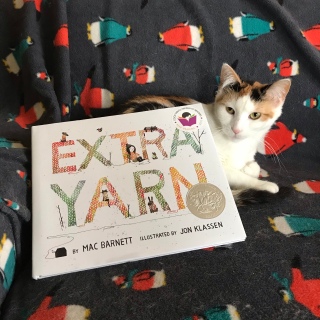
img_4077Book: Extra Yarn by Mac Barnett

A few years ago, a group came to my school to read a book to all of the First Grade students. They really hyped up the guest coming to read to them, and then when the story was over, each student received a copy of the book to take home with them. This was that book, and such a lovely choice for a project like that!

Annabelle is walking outside one day in her cold, grey town, when she finds a box of brightly colored yarn. She makes herself a sweater, but finds that she still has extra yarn. So she makes a sweater for her dog. And then she makes one for her friend. And eventually there are sweaters for the whole town. She seems to always have some extra yarn to make something for someone. That is, until the evil archduke comes to town demanding that she sell him her box of yarn. When she refuses, he steals the box and runs away. Unfortunately for him, when he returns to his castle he finds that there is no yarn in the box for him!

This is a great book for a younger age group. The text is fairly easy without a ton of words on each page, and the story is easy to follow. The pictures are simple, yet interesting: most illustrations are a watercolor mixture of blacks and browns on a white background, with some bright contrast for the rainbow of colors in Annabelle’s yarn. This is a cute, simple story is pretty straightforward story about kindness. There is a clear “good guy vs. bad guy” dynamic, with a victory for good without a ton of conflict. Annabelle is able to continuously give to others from her magic box of yarn, but there is no yarn left for the selfish archduke who wants it all for himself. I’m sure if he had asked nicely for a sweater, she would have made him one. But I suppose that was not likely to happen—who makes a better villain than an archduke anyway?

Minka’s Thoughts: “Do you think she would make me a sweater to play with? 3 paws.”

The Lola Quartet

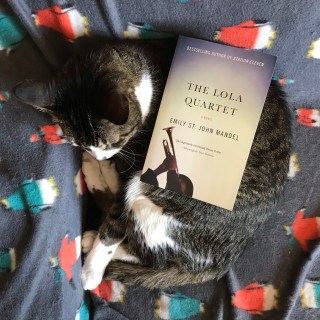
img_3865Book: The Lola Quartet by Emily St. John Mandel

Date Read: April 1 to 8, 2020

Rating: 5 (of 5) stars

April’s prompt for The Unread Shelf Project was to read your most recently acquired book. Unlike some of the other prompts, this one was fairly easy and straightforward for me! At the beginning of March, I spent a couple days in Ann Arbor for work picked up this book (and one other) at the Literati Bookstore there. Since I read the other book at the end of March, I was left with The Lola Quartet as my clear choice!

This book was super intriguing, and I feel like I was able to really fly through it. The main story starts with Gavin, a reporter in New York whose life seems to be slowly unraveling. A slow downward trend starts to spiral out of control after a trip back to his hometown, when his sister shows him a picture of a girl named Chloe who bears a strong resemblance to their family—and happens to share the last name of his high school girlfriend. Gavin becomes obsessed with the idea of tracking down his old girlfriend Anna, and finding out about his possible daughter. This leads down an intricate rabbit hole of events, with simultaneous storylines: Gavin’s search for Anna in the present, and the story behind Anna’s disappearance beginning back when they were in high school. Anna’s story is twofold: the story of what happened 10 years ago, melding into a personal crisis for her in the present.

This is the second book I have read from Emily St. John Mandel, and I have to say that I love her writing style. While the main plot of the book centers on Gavin, she weaves in multiple story lines to bring the reader along. Throughout the book, the reader seems to be only a step or two ahead of Gavin in piecing together what happened. There is some perspective shifting, telling pieces of the story as it centers around multiple characters at different points in time. At some point, almost every character gets their time in the spotlight, shifting the dynamic of the book so that each feels like a “main character” for a moment. The reader is able to see how the action of each person impacts the others, and ultimately the outcome of the story.

At the end, each of the stories culminate in the present: Gavin tracks down Anna, where he is finally able to put together the final pieces of the puzzle. Anna has been involved in multiple criminal acts, which ultimately led to a death. While Gavin initially views himself as outside of Anna’s problems and the crisis that played out in the present, he realizes that he played an unintentional role: his sister taking the photo of Chloe was the impetus for the string of events. He grapples with what is the “right thing” to do with his knowledge, possibly with the realization that if he had been more upfront about his own actions, he could have altered the outcome.

Boris’s Thoughts: “Too much thinking for me to follow this one. 2 paws.”

Unread Shelf Progress for April

  • Books Read: 4
  • Books Acquired: 0
  • Total Unread Books: 255

A Series of Unfortunate Events, Part 3

Book: A Series of Unfortunate Events by Lemony Snicket

Date Read: December 12, 2019 to February 5, 2020

Rating: 4 (of 5) stars

img_3185The Slippery Slope

While not the first time the orphans are separated from one another, this is the first time our story begins that way. At the end of The Carnivorous Carnival, Olaf sent Violet and Klaus tumbling down a mountain inside the freak caravan, while he made off with Sunny. Violet and Klaus are forced to use their skills to save themselves, and then begin to track down their sister. While the two meet up with an unexpected accomplice and make progress toward solving the mystery of V.F.D., Sunny is left to her own wits in dealing with the group of villains. This is our first real opportunity to see some real development in Sunny’s character, as up until this point she has been very much treated as a baby. However, she is starting to talk more in actual words, and is smart enough to take advantage of the fact that the villains do not realize she is starting to grow up. The older Baudelaires visit the line between nobility and villainy again, when they develop a plan to kidnap Esme Squalor in order to trade her back for Sunny, but find they feel guilty about considering the plan and cannot follow through. Although I would not quite call their results a “win,” the children are able to be reunited and headed off on their next adventure, away from Olaf.

I feel like the main focus of this book was on piecing together more of the puzzle to V.F.D. While there are some important events here, it is much lighter in plot than some of the previous books, with more focus on gathering information. We get a bit more on the Quagmires—discovering that Quigley, the remaining triplet, survived the fire and has been on a quest to find his siblings. He seems to have been a step behind the Baudelaires in their travels, and they are able to combine their knowledge to make some more sense of the schism and how it relates to Count Olaf’s schemes. We also get to meet two new villains, who are apparently so awful that even Count Olaf fears them and will not say their names: the man with a beard but no hair, and the woman with hair but no beard. There is also the reintroduction of a character that I, personally, could have done without any more of: Carmelita Spats. She presents as her spoiled and rotten self, of course endearing herself to Esme and Count Olaf.

img_3189

The Grim Grotto

Although I suppose it could be argued that this entire series is fairly dark, it takes an even darker turn in The Grim Grotto. The whole of the book seems to hold a bit more air of danger. While the orphans have certainly been threatened before, everything here seems more precarious, as they join the crew of the submarine Queequeg. The submarine is run by Captain Widdershins, along with his step-daughter Fiona, who becomes a suggested love interest for Klaus. In a search for the mysterious sugar bowl, they search a remote underwater grotto where they suspect the currents lead and encounter the Medusoid Mycelium, a deadly mushroom that nearly overtakes Sunny.

There is also much more exploration here on the dark nature of life, and the confusion they have struggling with in the battle of good versus evil. For the first time since their parents’ deaths, Baudelaires are forced to call upon some not-s0-pleasant memories, remembering that although they loved their parents dearly, nobody is completely good all of the time. They are faced with this again after returning to the submarine to find Captain Widdershins has disappeared and encountering Count Olaf—where they discover that Fiona’s long lost brother has been a part of the Count Olaf’s troupe. Although the Baudelaires try to convince her to stay with them, Fiona’s loyalty lies with her family; which means joining with Count Olaf and her brother to search for her missing stepfather.

In this book is also the Baudelaire’s first encounter with The Great Unknown—a literal unknown entity that appears as a question mark like shape on the submarine’s radar. They first see it on the radar when attempting to hide from Count Olaf, realizing that he flees the area when it seems to begin following him. The orphans have a brush encounter near the end of the book, and it is mentioned again in the remaining books in the series.

img_3193The Penultimate Peril

The penultimate book in the series finds the Baudelaires taking a more active role in the action of V.F.D. While there are still many mysteries surrounding the organization, they consider themselves volunteers fighting on the side of nobility. They meet up with Kit Snicket, who does fill in some of the missing information for them before leaving them with a mission: to disguise themselves as concierges in order to spy on the guests at the Hotel Denouement. The hotel is the “last safe place” where there is to be a gathering of V.F.D. in a few days—assuming that the orphans can verify that the hotel still remains a safe location. This book includes the return of many from throughout the series, who all come as guests to the hotel. Some of these appear to have been invited by V.F.D., and others seem to be there at the invitation of Esme Squalor.

While most of the book feels like the orphans are making some progress toward a happy ending, overall this is more of a continued blurring of the lines between good and evil. We reenter the realm of ambiguity and uncertainty in actions, as the children perform their duties as concierges to assist both guests and the managers—identical twin brothers, one a volunteer and the other a villain. In order to maintain their cover, the children feel like they must follow the orders given to them, although they are unsure if these are in service of V.F.D. or to assist the villains. Like many of the other books, we end with a fire: this one larger than any previously, and with unknown consequences as the children try to warn others as they make their escape.

img_3248

The End

The End finds the Baudelaire orphans in a much different place than usual. After escaping from the Hotel Denouement on a boat with Count Olaf, they are caught in a storm and become stranded on an island surrounded by a large coastal shelf. The water is normally too shallow around the island for boats to sail, and it is only possible to leave the island once every year. The island is inhabited by many people who also became stranded there, many with names related to famous castaways. It is mentioned several times, that this is the place where everything ends up eventually. The island has some strange customs and routines, all of which are presented as being quite lax, but are held to extremely strictly. The leader of the island, Ishmel, prefaces all directives with the words “I won’t force you,” and the islanders comply. Although there is an undercurrent of rebellion, most are generally complacent. They have arrived in a place where they can no longer be troubled by the outside world.

The islanders find Count Olaf disagreeable, and so do not invite him to join their village. The Baudelaires are skeptical of the islanders’ way of life, suspecting that there is more going on than meets the eye. After another islander suggests that they explore another area of the island, the orphans discover that Ishmel has been keeping many secrets from the other islanders; he is living a life of luxury hoarding many items they have collected all to himself. They also make the surprising discovery that they are not the first Baudelaires to visit the island: their parents were the previous island leaders, having lived there for several years before the children were born. The find a large hand written book of records that tells the story of the island and the lives of those who have spent time there: A Series of Unfortunate Events.

When another storm brings an injured Kit Snicket to the shores of the island, the orphans attempt to help her and Count Olaf attempts to disguise himself as her to gain favor with the islanders. For the first time, his disguise does not work, and the islanders put him into a large cage on the coastal shelf. As the coastal shelf begins to flood, the orphans release Olaf from his cage, as they do not want to be the ones who leave him there to drown. This sets off a short series of events where Olaf threatens the island with the Medusoid Mycelium, leading the islanders to abandon their village with Olaf, Kit, and the Baudelaires left behind. The Baudelaires are able to find a way to dilute the poison, but Kit is unable due to her pregnancy. Kit gives birth to her daughter, dying shortly after. Olaf also succumbs to the deadly mushroom’s poison. This leaves the Baudelaires to live as their parents once had on the island: a simple life away from the dangers of the world. They spend time perusing their parents’ logs in the record book, and creating logs of their own. Eventually, they begin to wonder about what has happened to the world outside their small island, and so prepare to leave as the waters on the coastal shelf rise.

————-

Overall, I enjoyed the series quite a bit. Each book added new layers to the story, with the characters and plots becoming increasing complex and intricate throughout. There was great humor mixed in along the way, with narrative asides and cultural references. The double story with the narrator sharing some of his own history and involvement in events that lead to the story was interesting.

I have to say though, that I was not completely satisfied with the ending. At the same time, I cannot say that I am completely dissatisfied either. The conclusion, or perhaps lack of conclusion, is very fitting and appropriate for the series as a whole. There is much discussion through the final book about the beginning and end of stories, and the suggestion that there is no true beginning or end to anything in life. I suppose this is left to the reader to interpret. Despite this being a fitting end to the story as told here, I felt that there were too many mysteries left unsolved. Many characters were left to face the Great Unknown, and the fate of many characters is left unstated after the fire in the twelfth book. Most of the mysteries surrounding V.F.D remain a mystery, and we never really find out why the narrator, Lemony Snicket, is so committed to telling this story. I feel like the same type of ending could have been achieved with just a bit more closure for the readers—after dedicating the time to read 13 books in the series, I feel like we are owed just a little more.
A Series of Unfortunate Events, Part 1

Book: A Series of Unfortunate Events by Lemony Snicket

Date Read: December 12, 2019 to February 5, 2020

Rating: 4 (of 5) stars

I realized toward the end of November that I was not quite on track to meet my total book goal by the end of the year. As I often do at that time of year, I looked through my shelves for the shortest books on my to read list, hoping to give myself a little boost to end of the year and start 2020 on a positive note. I ended up settling on a book series that was on my mental to read list, if not my actual shelves: A Series of Unfortunate Events. It had been recommended to me several years ago, and I knew it was available for free from my school’s online library.

This series is aimed at late elementary or middle grade children, but has elements of wit and humor that would be more appreciated by adults. There were several moments that caused me to smirk, but would likely be skimmed over by younger readers. This includes references in characters and actions to other works, as well as some humor in interpretations of vocabulary. For the majority of the series, the youngest Baudelaire, Sunny, talks in baby talk which is interpreted by her siblings. While most of these are straightforward nonsense words, there are a few that include real words or other references that were clearly targeted for adult readers. These are worked in to the style of the story naturally, which perfectly expands the potential for enjoyment across age groups.

Each book works as a stand-alone story, although the later books in the series are more clearly linked together. Any references to events in previous books are given proper explanation at the time, which is nice for continuity. I liked that the stories became increasingly complex throughout the series, but still kept to a consistent style. Although I did enjoy reading these, I have to say that the series is aptly named: all of these books are quite unfortunate. Each one starts with a warning to the reader about the wretched lives of the Baudelaire orphans, suggesting that perhaps it may be a good idea to find something a bit less depressing to read. Although the story lines are brought to a conclusion with each book, and in many ways things work out in favor of the orphans, each “happy ending” is not quite happy.

img_3034The Bad Beginning

Where else to start, but with the bad beginning? This book sets up the misery in the lives of the Baudelaires, beginning with the death of their parents in a fire. We get an introduction to each of the main players here: Violet, Klaus, and Sunny Baudelaire, with their inventions, books, and teeth to add to their resourcefulness. And then of course our villain, Count Olaf. As their first guardian after the loss of their parents, Olaf makes it clear early on that he is more interested in the children’s inheritance than the children, and hatches his first scheme to get his hands on their fortune by forcing Violet into a marriage. Of course, the children are too clever to let him get away with it. We are just in sight of a happy ending when we get another twist, and Mr. Poe, the banker in charge of their parents’ will, sends them on to their next guardian.

This book sets the stage for the remainder of the series, as well as establishing some stylistic elements that carry throughout. The narrator tells a parallel story, focusing on the Baudelaires, but giving occasionally hints as to his own misery and questionable situation. The book uses some vocabulary that would be somewhat advanced for the target audience of these books, but does a nice job of explaining terms with a bit of humor. These start quite reasonably, but become a bit more grandiose and absurd as the series progresses. I felt this was a solid start for the series, as it left me wanting to know what happens next, but satisfied with the conclusion.

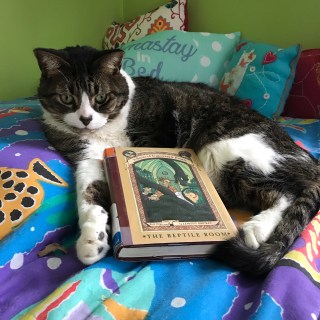
img_3142The Reptile Room

After their experience with their first guardian, the Baudelaires are understandably reluctant to meet their next guardian: their Uncle Monty, a herpetologist whom they have never met. Things go well for a while, with the children’s talents put to good use with Uncle Monty’s collection of pythons, vipers, and other reptiles. For the first time since the death of their parents, they find some happiness in their new home and are excited to accompany Monty on an expedition to search for new reptile species. That is, until Uncle Monty’s new assistant arrives—whom the children immediately recognize as Count Olaf in disguise. Despite their efforts to warn Uncle Monty, Olaf always seems a step ahead in threatening them to keep quiet. He launches another scheme to get their fortune, beginning with murdering Uncle Monty, making the death appear accidental.

This kicks off a theme that remains through most of the series: adults being oblivious to the treachery that is obvious to the Baudelaires. I think this is a theme that resonates with younger readers: adults seem unaware of what it is like to be children, and because the Baudelaire orphans are children, much of what they say is dismissed. This is especially prevalent with Mr. Poe, who begins to use the excuse that the Baudelaires “see Olaf everywhere” after their first traumatic experience, despite the fact each time they claim to see Olaf, they turn out to be correct.

img_3146The Wide Window

The third book in the series follows the same pattern as the previous, beginning with the Baudelaires on their way to meet a new guardian, Aunt Josephine. This guardian turns out to be another kind, but imperfect, guardian: since the death of her husband, she has become fearful of nearly everything. She is fanatical about grammar, but excited about little else. The children fall into a routine until, as expected, Count Olaf shows up in disguise as a Captain Sham. As usual, their guardian does not initially believe the children, although she does eventually realize Olaf’s plot. The problem, of course, is that she is too afraid to do anything about it.

In this book, we get a clearer glimpse into Klaus’s particular talents: reading and research. When Aunt Josephine discovers Olaf’s plot and flees, she leaves a coded message in the form of a purported suicide note. Klaus recognizes the code from the many grammatical errors included, and uses this information to find where she has hidden herself. As with previous books, we come to our not quite happy ending: Olaf’s plot is foiled, but with the loss of Aunt Josephine and the children are sent on their way to another guardian.

img_3022The Miserable Mill

With the miserable mill, there is a slight break from the typical guardian routine. The Baudelaires are sent to a new guardian, who is the owner of the Lucky Smells Lumber Mill. Rather than take an interest in the children, their guardian, Sir, puts them to work at the mill and has them living in the quarters with the other employees. Even without the issues of child labor here, the mill is run in a fashion of borderline slave labor, with the employees paid in coupons rather than money and provided with only one meal per day. As always, Olaf is lurking just around the corner, but this particular plot is a bit more convoluted and relies on several of Olaf’s henchman. The guardian Sir is much more concerned about the smooth operation of his mill than anything else, and with the help of a hypnotist, Olaf attempts to monopolize on their guardian’s ambivalence to the orphans.

One theme that had been introduced in the previous book is continued here: the presence of helpful adults who fall short of expectations. Aunt Josephine had been concerned for the children, but too fearful to act. In The Miserable Mill, the children meet Charles, their guardian’s business partner, who is kind and seems to want the best for them. He offers help when able, and quietly advocates for the children, but is too afraid to speak up too adamantly in their defense. As usual, the children are able to defeat Olaf in his plot with little help from the adults around them, ending the book with the need for a new guardian.

I Could Pee On This

img_3692Book: I Could Pee On This by Francesco Marciuliano
Date Read: March 23, 2020

In honor of my first post for the month being on April Fools’ Day, I decided to mix things up a bit with a novelty book rather than a children’s book. For the remainder of the month I will be featuring a children’s series, so I thought it would be fitting to start a little differently.

This book of cat-penned poems was given to me by my Secret Santa, along with a pair of socks featuring Boris’s face. It’s so nice when your Secret Santa truly gets you.

As I said above, this is a novelty book. It is the kind of thing you keep around for a quick laugh, but generally would not plan to read straight through. The book is separated into a few sections, each with a different theme for the poems. This is not high quality poetry; after all, how much can you expect from a cat? Most of them are silly, with an appropriate amount of cat-attitude. A few are a little difficult to get through, despite being short in length. I can roll with stupid humor, but sometimes it just does not click for me. And then, of course, there are a few that are spot on hilarious and made the whole book worth reading.

I submit for your review, a selection from this collection:

I could lie by your side for the rest of our lives

I think I’ll walk away right now

I could let you pet me for a hundred years

I think we need some time apart

I could be kissed a thousand thousand times

I think I’m needed somewhere else

I could sit on your lap forever

I said I could sit on your lap forever

Don’t you even think about trying to get up

Well, you should have gone to the bathroom beforehand

Because forever is a very, very long time

Minka’s Thoughts: “I’m confused. Is this what I’m supposed to be doing?”

I Know Why The Caged Bird Sings

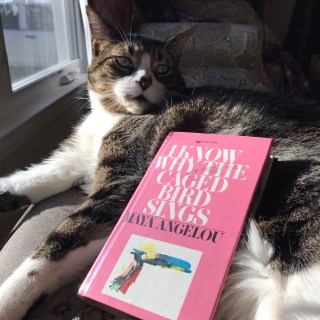
img_3594Book: I Know Why The Caged Bird Sings by Maya Angelou
Date Read: March 1 to March 18, 2020

Rating: 4 (of 5) stars

For March, the Unread Shelf Project challenged everyone to read the book that has been on your shelf the longest. Technically, I did the same last month, when I chose a book that was gifted to me, but also at the “bottom of my pile.” I suppose now is a perfect time to give that a little more context. I joined Goodreads some time in 2010, but only listed books that I had recently read. On January 1, 2o11, I decided to add my list of books to read, which was already quite hefty at that point in time. I added them all to my online to read list within the next couple days, in approximate alphabetical order. This is the bottom of my stack. I no longer have any idea what order I actually obtained these in, so I do not prioritize further. I try to make a point to choose at least a few books specifically from that group every year. There are currently 45 books still remaining from those that I initially added.

When I browsed through the list, I decided on Maya Angelou for a few different reasons. It seemed appropriate for the time of year, as we are transitioning from Black History Month to Women’s’ History Month. Maya Angelou is an author that I know immediately by name, but one that I had never read up to this point. I also have a peculiar and nostalgic back-story to go along with my particular copy: I quite literally found it in an abandoned building. For several years, my primary friend group consisted of a few photographers and other interesting characters that spent a good amount of our free time in urban exploration. We all lived near Detroit, and visited many sites around the city that were no longer in use: churches, schools, apartments, hotels, hospitals, and of course, the well known Michigan Central Station. While we had a fairly strict policy of making as little impact as possible, we did collect a few treasures along the way (no breaking in, no vandalism, and nothing else that could be considered destructive of the spaces). However, the number of unused and forgotten books found inside the old Cass Tech High School hurt my soul, and I had to give at least a few of them a new home. My soul still aches to think of all that remained inside that school when it was torn down in July 2011.

I know this seems a long introduction with little connection to the book that I am supposed to be writing about. However, something about my memories of that time fit too perfectly with my feelings reading this book, and I could not let the opportunity to share my story pass by. While the overall story of Maya Angelou’s early life is intriguing, this book is about her the journey. Born in California, Maya and her brother were sent to live with their grandmother in rural Arkansas. They were raised there, then brought to St. Louis to live with their mother, returned to Arkansas, and eventually returned again to their mother’s care in California. While the places are not essential, the experiences in each of these locations shaped her character and spirit. I Know Why the Caged Bird Sings is a memoir told in snippets; each chapter captures a memory or a moment in time. While any one of these moments might not seem significant in the grand scheme, each is an important piece of the puzzle that has shaped the life of this woman. The story is told beautifully from the perspective of a child, but tempered with honesty and perspective gained from reflecting as an adult. Angelou’s language is vivid, but not graphic, as she tackles her experiences of discrimination, violence, rape, and others.

Boris’s Thoughts: “So… where is this bird? I’m confused. 2 paws.”

Unread Shelf Progress for March

  • Books Read: 5 (plus 1 started)
  • Books Acquired: 3
  • Total Unread Books: 260

Because of Winn-Dixie

img_2719Book: Because of Winn-Dixie by Kate DiCamillo
Date Read: December 2 to 9, 2019

Rating: 4 (of 5) stars

I was prompted to finally get this book off my to read list by two things. I happened to be sitting in on a Fifth Grade class when they started to read this as a group, and was at least a little intrigued. It happened to work out that this also fit into the December prompt for the Unread Shelf Project, which suggested reading the shortest book on your shelf. Until this, I had avoided reading this one for quite some time, as I had been told that it was sad. Considering that I knew this was a book about a dog, I made some assumptions about why it might be sad, and decided to pass—who really needs to read another book where the dog dies at the end? Well, spoiler alert: that’s not what happens. In fact, we actually get a happy ending! Of course, I did not know that going in. Perhaps the surprise of a happier than expected ending biased me some in favor of the book, but I am glad that I finally decided to pick up this quite popular children’s novel.

Our main character, Opal, has recently moved with her father, the Preacher, to a new town. Being new, she is unsure of her place in the town, and seems a bit withdrawn and certainly lonely. Enter Winn-Dixie, the stray dog she claims as her own after he has wreaked havoc in the produce section of the local grocery store. Opal’s father has taught her to help the less fortunate, and this dog certainly fits the bill: he is skinny, gangly, and generally appears to be in rough condition. Winn-Dixie quickly wins over Opal, her father, and then a large number of people throughout the town. With the help of the dog, Opal starts to meet and open up to various people around the town.

One of the things that I found interesting in Opal’s journey is that the lesson she learns through Winn-Dixie about opening up to others and not judging based on looks, is something that she already knew—sort of. Opal has a soft spot for the outsiders, which I suppose goes along well with her taking in a rough looking dog. Opal was quick to befriend Otis at the pet shop, despite being told that he had been in jail. She quickly accepted the woman whom the other children referred to as a witch. While she is willing to let these people into her world, she is quick to judge many of the others around her, especially other children and the people who belong to her father’s church.

This is a great middle and upper elementary novel, and works really well for classroom discussions. I imagine that is not a major revelation to anyone. There is good reason that this book is often taught in school. There can be a lot to unpack here, in Opal’s relationships to the town, to her father, and the catalyst for growing up a bit she finds when she brings home Winn-Dixie.

Boris’s Thoughts: “A book about a dog? Really? 1 paw.”

Fortunately, the Milk

img_3501Book: Fortunately, the Milk by Neil Gaiman

Date Read: December 14, 2019

Rating: 4 (of 5) stars

This book was a semi-random purchase as a Christmas gift for my cousin’s son. When my family was a bit smaller than it is now, I started the tradition of buying books for the kids that came for my family’s Christmas Eve celebration. It was easy at first. When I started this, there were three; we are now up to 12. I suppose there are worse things than being known as the family member to count on for a new book, but it has become increasingly difficult to find books that the kids will enjoy, and to try to remember which ones I have already given each of them! I usually go to my cousins for ideas for their kids, but both my cousin and I were stumped on this one. He loves adventure, but can be picky. He likes graphic novels, but has read most of the popular ones. I had a few ideas, but nothing I was too excited about, so I decided to browse a bit at the store. I ended up stumbling upon this one which I think was a perfect fit: a sort of adventure, but also a lot of goofiness; not quite a graphic novel, but definitely a nice balance of pictures interwoven into the story.

One day, while Mum is away, Dad is forced to run to the corner store to get some milk for breakfast. When he takes longer than expected, the children are suspicious about where he has been, but fortunately the milk was there to save him on his wild and wacky journey back home. It all starts with a strange noise as he steps out from the corner store, and then there is no stopping this ridiculous and fun tale from unwinding. There is something here to please everyone: aliens, time travel, dinosaurs, pirates, human sacrifice, hot air balloons… all seemingly random, but strung together into the perfect narrative to entertain young and old.

Based on reading level, I think this probably works best as an independent read for mid to upper elementary children. It is novel length, but not really separated out into chapters. There are many pictures incorporated throughout the text, along with interesting text blocking to make everything flow nicely. I can see the interest level on this extending a bit younger, but could see it being a bit difficult as a read aloud book. The length is certainly too much for a typical bedtime story, but without chapters, it’s not quite as easy to break it up for multiple reading sessions.

Boris’s thoughts: “You were supposed to take the picture before you wrapped it and put it in the Christmas bag.”