A Series of Unfortunate Events, Part 2

Book: A Series of Unfortunate Events by Lemony Snicket

Date Read: December 12, 2019 to February 5, 2020

Rating: 4 (of 5) stars
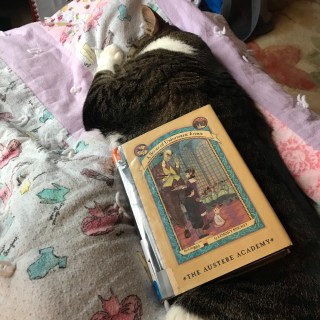
img_3027The Austere Academy

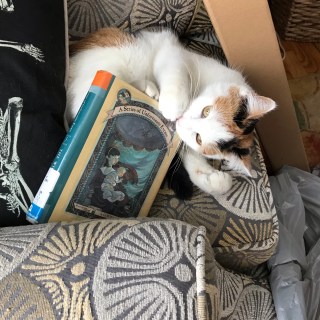
It is in the fifth book of this series where there is a variation from the pattern of previous books. The Austere Academy finds the Baudelaire orphans heading off to boarding school rather than to a new guardian. The apparently prestigious school is run by an unpleasant Vice Principal and with an enormous set of ridiculous rules. The two older Baudelaires are assigned to classes, but Sunny being too young is to become a secretary. This book really is mostly a collection of oddities: teachers that do not make sense, poor violin playing, and an orphan shack infested with crabs. Olaf arrives, of course, but even his plot to capture the orphans is a bit nonsensical: requiring them to run all night long in hopes of making them too tired to pass their courses.

Among the oddities, we are introduced to a handful of new characters that will continue into future books. The obnoxious Carmelita Spats, a bully who becomes the messenger of Count Olaf, has a small role here, but reoccurs in later books. On a more pleasant note, we finally have a bit of positivity for the orphans in the form of friends: two of the Quagmire triplets. The Baudelaires and the Quagmires find that they have quite a bit in common, both coming from rich families and having been orphaned after their parents were killed in a fire. The children work together to begin solving the mystery around “V.F.D.” – a recurring acronym that they believe to be linked to the mystery of their parents’ deaths. In the end, the children escape Count Olaf again, but the Quagmires are not so lucky. Although not quite a cliffhanger, the book ends with the Quagmires kidnapped by Olaf, kicking off a new plot line, as the Baudelaires deal with their miseries while simultaneously searching for their friends and seeking clues to the mystery of V.F.D.

img_3154The Ersatz Elevator

After the drama at the boarding school, the orphans move on their way to a new pair of guardians: Jerome and Esme Squalor. Esme is the sixth most important financial advisor in the city, and is overly concerned with what is “in” – which becomes a theme for the book. Luckily for the Baudelaire’s, orphans are in. While Jerome takes an interest in the children, Esme is much more concerned with her own affairs. There is a ton going on in this book: another Count Olaf plot, an effort to rescue the Quagmires, and more clues related to V.F.D. There is also a first here for the series, when the children tell an adult about Count Olaf’s disguise and plot, and are believed. Unfortunately, this is because they reveal their discoveries to Esme Squalor, who has secretly been working with Count Olaf all along. In the end, Esme leaves to join Count Olaf who is still at large with the captive Quagmires, and the orphans are left with another flawed guardian: Jerome Squalor, who despite good intentions feels that the orphans need to forget about the idea of rescuing their friends.

The characters and events in this book also give us a bit more insight into the narrator. Throughout the series we get glimpses of the life of the narrator, which become increasingly overt. Here, we see some additional connections with names and characters, allowing the reader to piece together the mystery of V.F.D. with information unknown to the children.

A final note on this book is that I finished part of this in a new format for me: an audiobook. I decided to try out the audio after I realized that I was behind in the series, and that I was going to be spending a large amount of time driving over the next few days. What a treat this turned out to be! The official audiobook is narrated by Tim Curry, who does a fabulous job at bringing the story to life. His voice is a perfect fit for the style of the story, and he is appropriately creative in giving voice to the dialogue of each character.
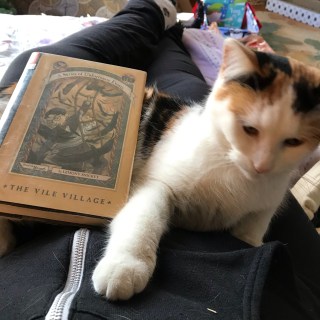
img_3106The Vile Village

In book seven, we get another slight variation on the guardian plot. Rather than being turned over to a single guardian, the orphans are taken in by an entire village. After all, it does take a village to raise a child, right? The children choose from a list of villages that are willing to take them, in hopes that the village V.F.D. relates to the mystery they have been trying to solve. Unfortunately for the children, the Village of Fowl Devotees is not only the incorrect V.F.D., it is a run by a council who is overly devoted to nonsensical rules and believes that the prime method of raising children is to make them complete chores. The children find themselves in the care of Hector, the town handyman, who turns out to be an amiable companion. He does not prescribe to the village’s rules, but is also afraid to stand up to anyone on the council. It appears briefly that the children may have found a way to escape their unpleasant lives: Hector is working on a self-sustaining hot air mobile home, and the children have found clues that allude to the Quagmires being hidden nearby.

The children hope to rescue the Quagmires and then escape with Hector in his mobile home. An unexpected twist occurs when the children hear that Count Olaf has been captured in the village, and will be imprisoned. In a reversal on the usual events, the children inform the village that the person they have captured is not Count Olaf, but are not believed. In an increasingly complicated turn of events, the captured person, Jaques Snicket, is killed, and the children are falsely accused of his murder. The story wraps up with quite a slew of exciting happenings, that set the stage for the remainder of the series: Count Olaf as a fake detective, a prison break, the daring rescue of the Quagmires, and additional mishaps that cause the Baudelaires to be separated from their friends again, leaving the village running for their lives as fugitives.

img_3130The Hostile Hospital

The second half of the series finds the Baudelaires venturing out on their own; after a series of misunderstandings has them fleeing as accused murderers. They attempt to contact Mr. Poe for help, but cannot reach him. The orphans stumble upon another incorrect V.F.D.—the Volunteers Fighting Disease—which leads them to Heimlich Hospital and its Library of Records. The orphans use their opportunity of volunteering that the hospital to search for clues about the correct V.F.D., leading them to engage in some of their own sneaky behaviors. While the orphans are wondering about the consequences of treacherous behaviors with good intentions, Count Olaf launches the next step in his scheme, which leads him to the same Library of Records in search of the “Snicket File.”

The orphans find themselves trapped in the Library of Records with Esme Squalor as she searches for the file, destroying much of the library and capturing Violet in the process. Klaus and Sunny find themselves needing to form a plan of their own to save their sister from Count Olaf, using some clever research along with some disguises and tricks they have picked up from Olaf himself. While the orphans are able to escape, they find themselves with an increasing list of false accusations reported in the newspaper and nowhere to go. The see Count Olaf about to leave the scene of the now burning hospital, and decide their best option is to stowaway in his car: at least this way they will be able to keep track of what he is up to.
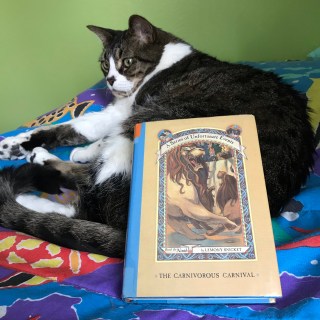
img_3144The Carnivorous Carnival

While I was personally less excited about this particular addition to the series than others, it does provide an ideal setting for a major turning point in the series. The Baudelaires follow Count Olaf to the Caligari Carnival, where he is meeting up with the fortuneteller Madame Lulu. The orphans disguise themselves as freaks in order to join the carnival freak show and find out more about what is going on. Through their investigation, the children discover that Madame Lulu is a fake—she has a mechanical device to produce thunder and lightning when she is asked a question, using this as a distraction to reference her research and provide answers. She has a strict policy of giving everyone what they want, which causes her to dwell in morally ambiguous territory. She is able to give the children some true information about the V.F.D. they have been looking for, telling them of a schism that has caused the organization to fragment into two factions: volunteers and villains. She agrees to help the orphans, but this agreement puts her at odds with her policy of giving everyone what they want: she will have to deny Count Olaf the information he wants.

There are a few interesting themes floating around in this one, the first being the presence of the freaks. To be honest, they are not very “freakish” at all: a hunchback, a contortionist, and a man who is ambidextrous. However, they are all so focused on their slight differences that they become magnified and are treated poorly because of it. This book also places stronger emphasis on some themes from earlier books: are villainous actions justified when you have noble intentions? Up to this point, the orphans have been portrayed villainously in the newspaper based on misunderstandings and accidents. Here, they begin to intentionally engage in some questionable behaviors. After a close call with a pit of lions, the orphans and other freaks agree to join up with Count Olaf’s troupe. They help him set the fire to burn the carnival to the ground, and then leave with the freak caravan tied to the back of Olaf’s car. It is here, with Violet and Klaus in the freak caravan, and Sunny in the car with Olaf and the other henchman, we make the discovery that leads to the series’ first cliffhanger: Madame Lulu was unable to keep her promise to the Baudelaires. She revealed their true identities to Olaf, who now has Sunny in his clutches, and cuts loose the freak caravan to send the others tumbling down the side of a mountain.

A Series of Unfortunate Events, Part 1

Book: A Series of Unfortunate Events by Lemony Snicket

Date Read: December 12, 2019 to February 5, 2020

Rating: 4 (of 5) stars

I realized toward the end of November that I was not quite on track to meet my total book goal by the end of the year. As I often do at that time of year, I looked through my shelves for the shortest books on my to read list, hoping to give myself a little boost to end of the year and start 2020 on a positive note. I ended up settling on a book series that was on my mental to read list, if not my actual shelves: A Series of Unfortunate Events. It had been recommended to me several years ago, and I knew it was available for free from my school’s online library.

This series is aimed at late elementary or middle grade children, but has elements of wit and humor that would be more appreciated by adults. There were several moments that caused me to smirk, but would likely be skimmed over by younger readers. This includes references in characters and actions to other works, as well as some humor in interpretations of vocabulary. For the majority of the series, the youngest Baudelaire, Sunny, talks in baby talk which is interpreted by her siblings. While most of these are straightforward nonsense words, there are a few that include real words or other references that were clearly targeted for adult readers. These are worked in to the style of the story naturally, which perfectly expands the potential for enjoyment across age groups.

Each book works as a stand-alone story, although the later books in the series are more clearly linked together. Any references to events in previous books are given proper explanation at the time, which is nice for continuity. I liked that the stories became increasingly complex throughout the series, but still kept to a consistent style. Although I did enjoy reading these, I have to say that the series is aptly named: all of these books are quite unfortunate. Each one starts with a warning to the reader about the wretched lives of the Baudelaire orphans, suggesting that perhaps it may be a good idea to find something a bit less depressing to read. Although the story lines are brought to a conclusion with each book, and in many ways things work out in favor of the orphans, each “happy ending” is not quite happy.

img_3034The Bad Beginning

Where else to start, but with the bad beginning? This book sets up the misery in the lives of the Baudelaires, beginning with the death of their parents in a fire. We get an introduction to each of the main players here: Violet, Klaus, and Sunny Baudelaire, with their inventions, books, and teeth to add to their resourcefulness. And then of course our villain, Count Olaf. As their first guardian after the loss of their parents, Olaf makes it clear early on that he is more interested in the children’s inheritance than the children, and hatches his first scheme to get his hands on their fortune by forcing Violet into a marriage. Of course, the children are too clever to let him get away with it. We are just in sight of a happy ending when we get another twist, and Mr. Poe, the banker in charge of their parents’ will, sends them on to their next guardian.

This book sets the stage for the remainder of the series, as well as establishing some stylistic elements that carry throughout. The narrator tells a parallel story, focusing on the Baudelaires, but giving occasionally hints as to his own misery and questionable situation. The book uses some vocabulary that would be somewhat advanced for the target audience of these books, but does a nice job of explaining terms with a bit of humor. These start quite reasonably, but become a bit more grandiose and absurd as the series progresses. I felt this was a solid start for the series, as it left me wanting to know what happens next, but satisfied with the conclusion.

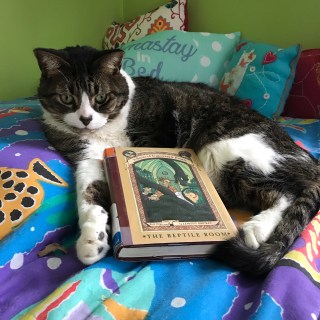
img_3142The Reptile Room

After their experience with their first guardian, the Baudelaires are understandably reluctant to meet their next guardian: their Uncle Monty, a herpetologist whom they have never met. Things go well for a while, with the children’s talents put to good use with Uncle Monty’s collection of pythons, vipers, and other reptiles. For the first time since the death of their parents, they find some happiness in their new home and are excited to accompany Monty on an expedition to search for new reptile species. That is, until Uncle Monty’s new assistant arrives—whom the children immediately recognize as Count Olaf in disguise. Despite their efforts to warn Uncle Monty, Olaf always seems a step ahead in threatening them to keep quiet. He launches another scheme to get their fortune, beginning with murdering Uncle Monty, making the death appear accidental.

This kicks off a theme that remains through most of the series: adults being oblivious to the treachery that is obvious to the Baudelaires. I think this is a theme that resonates with younger readers: adults seem unaware of what it is like to be children, and because the Baudelaire orphans are children, much of what they say is dismissed. This is especially prevalent with Mr. Poe, who begins to use the excuse that the Baudelaires “see Olaf everywhere” after their first traumatic experience, despite the fact each time they claim to see Olaf, they turn out to be correct.

img_3146The Wide Window

The third book in the series follows the same pattern as the previous, beginning with the Baudelaires on their way to meet a new guardian, Aunt Josephine. This guardian turns out to be another kind, but imperfect, guardian: since the death of her husband, she has become fearful of nearly everything. She is fanatical about grammar, but excited about little else. The children fall into a routine until, as expected, Count Olaf shows up in disguise as a Captain Sham. As usual, their guardian does not initially believe the children, although she does eventually realize Olaf’s plot. The problem, of course, is that she is too afraid to do anything about it.

In this book, we get a clearer glimpse into Klaus’s particular talents: reading and research. When Aunt Josephine discovers Olaf’s plot and flees, she leaves a coded message in the form of a purported suicide note. Klaus recognizes the code from the many grammatical errors included, and uses this information to find where she has hidden herself. As with previous books, we come to our not quite happy ending: Olaf’s plot is foiled, but with the loss of Aunt Josephine and the children are sent on their way to another guardian.

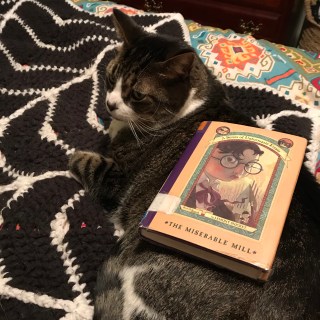
img_3022The Miserable Mill

With the miserable mill, there is a slight break from the typical guardian routine. The Baudelaires are sent to a new guardian, who is the owner of the Lucky Smells Lumber Mill. Rather than take an interest in the children, their guardian, Sir, puts them to work at the mill and has them living in the quarters with the other employees. Even without the issues of child labor here, the mill is run in a fashion of borderline slave labor, with the employees paid in coupons rather than money and provided with only one meal per day. As always, Olaf is lurking just around the corner, but this particular plot is a bit more convoluted and relies on several of Olaf’s henchman. The guardian Sir is much more concerned about the smooth operation of his mill than anything else, and with the help of a hypnotist, Olaf attempts to monopolize on their guardian’s ambivalence to the orphans.

One theme that had been introduced in the previous book is continued here: the presence of helpful adults who fall short of expectations. Aunt Josephine had been concerned for the children, but too fearful to act. In The Miserable Mill, the children meet Charles, their guardian’s business partner, who is kind and seems to want the best for them. He offers help when able, and quietly advocates for the children, but is too afraid to speak up too adamantly in their defense. As usual, the children are able to defeat Olaf in his plot with little help from the adults around them, ending the book with the need for a new guardian.

Because of Winn-Dixie

img_2719Book: Because of Winn-Dixie by Kate DiCamillo
Date Read: December 2 to 9, 2019

Rating: 4 (of 5) stars

I was prompted to finally get this book off my to read list by two things. I happened to be sitting in on a Fifth Grade class when they started to read this as a group, and was at least a little intrigued. It happened to work out that this also fit into the December prompt for the Unread Shelf Project, which suggested reading the shortest book on your shelf. Until this, I had avoided reading this one for quite some time, as I had been told that it was sad. Considering that I knew this was a book about a dog, I made some assumptions about why it might be sad, and decided to pass—who really needs to read another book where the dog dies at the end? Well, spoiler alert: that’s not what happens. In fact, we actually get a happy ending! Of course, I did not know that going in. Perhaps the surprise of a happier than expected ending biased me some in favor of the book, but I am glad that I finally decided to pick up this quite popular children’s novel.

Our main character, Opal, has recently moved with her father, the Preacher, to a new town. Being new, she is unsure of her place in the town, and seems a bit withdrawn and certainly lonely. Enter Winn-Dixie, the stray dog she claims as her own after he has wreaked havoc in the produce section of the local grocery store. Opal’s father has taught her to help the less fortunate, and this dog certainly fits the bill: he is skinny, gangly, and generally appears to be in rough condition. Winn-Dixie quickly wins over Opal, her father, and then a large number of people throughout the town. With the help of the dog, Opal starts to meet and open up to various people around the town.

One of the things that I found interesting in Opal’s journey is that the lesson she learns through Winn-Dixie about opening up to others and not judging based on looks, is something that she already knew—sort of. Opal has a soft spot for the outsiders, which I suppose goes along well with her taking in a rough looking dog. Opal was quick to befriend Otis at the pet shop, despite being told that he had been in jail. She quickly accepted the woman whom the other children referred to as a witch. While she is willing to let these people into her world, she is quick to judge many of the others around her, especially other children and the people who belong to her father’s church.

This is a great middle and upper elementary novel, and works really well for classroom discussions. I imagine that is not a major revelation to anyone. There is good reason that this book is often taught in school. There can be a lot to unpack here, in Opal’s relationships to the town, to her father, and the catalyst for growing up a bit she finds when she brings home Winn-Dixie.

Boris’s Thoughts: “A book about a dog? Really? 1 paw.”

Fortunately, the Milk

img_3501Book: Fortunately, the Milk by Neil Gaiman
Date Read: December 14, 2019

Rating: 4 (of 5) stars

This book was a semi-random purchase as a Christmas gift for my cousin’s son. When my family was a bit smaller than it is now, I started the tradition of buying books for the kids that came for my family’s Christmas Eve celebration. It was easy at first. When I started this, there were three; we are now up to 12. I suppose there are worse things than being known as the family member to count on for a new book, but it has become increasingly difficult to find books that the kids will enjoy, and to try to remember which ones I have already given each of them! I usually go to my cousins for ideas for their kids, but both my cousin and I were stumped on this one. He loves adventure, but can be picky. He likes graphic novels, but has read most of the popular ones. I had a few ideas, but nothing I was too excited about, so I decided to browse a bit at the store. I ended up stumbling upon this one which I think was a perfect fit: a sort of adventure, but also a lot of goofiness; not quite a graphic novel, but definitely a nice balance of pictures interwoven into the story.

One day, while Mum is away, Dad is forced to run to the corner store to get some milk for breakfast. When he takes longer than expected, the children are suspicious about where he has been, but fortunately the milk was there to save him on his wild and wacky journey back home. It all starts with a strange noise as he steps out from the corner store, and then there is no stopping this ridiculous and fun tale from unwinding. There is something here to please everyone: aliens, time travel, dinosaurs, pirates, human sacrifice, hot air balloons… all seemingly random, but strung together into the perfect narrative to entertain young and old.

Based on reading level, I think this probably works best as an independent read for mid to upper elementary children. It is novel length, but not really separated out into chapters. There are many pictures incorporated throughout the text, along with interesting text blocking to make everything flow nicely. I can see the interest level on this extending a bit younger, but could see it being a bit difficult as a read aloud book. The length is certainly too much for a typical bedtime story, but without chapters, it’s not quite as easy to break it up for multiple reading sessions.

Boris’s thoughts: “You were supposed to take the picture before you wrapped it and put it in the Christmas bag.”

A Friend for Dragon

img_3067Book: A Friend for Dragon by Dav Pilkey

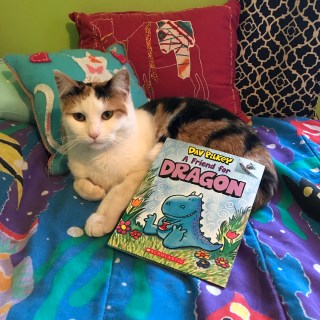
As a kick off to the third year of Books On My Cat, I present to you A Friend for Dragon by Dav Pilkey. This is the first book in the Dragon series of book, which I have written about several times before. Dragon is one of my favorite children’s characters. He is always getting into some sort of misadventure—in this case, Dragon falls for a prank and mistakenly assumes that an apple that has fallen on his head is actually looking to become his friend. Despite the misunderstanding, Dragon finds the apple to be a delightful friend, who is a good listener, has common interests, and shares with his friends.

I admit that this is not my favorite addition to the Dragon collection, but I think it sets a nice tone to the series. We get a good glimpse of his personality, which is then built upon in the later books. Dragon is a little naïve, but is also willing to make the most of any situation with his positive attitude. If everyone else is too busy, why not spend your time hanging out with an apple? Of course, apples do not last forever (especially when you are tricked into thinking you have a special speaking apple, and the culprit of the trick is no longer around to fake an appley voice). Although Dragon is quite distraught at the loss of his friend, he receives a pleasant surprise the summer after laying his friend to rest in the backyard.

Of course, as you may have noticed in the photo, today is also the debut of a friend of Boris: introducing Minka, a sassy little girl that joined our family at the end of December. She was found near where my dad works as a kitten in July; she was alone despite seeming too young to have left her mother. My dad began to care for her, and she moved into the office building. After living there for a few months, and with the weather starting to turn cold, he decided that it was time for her to have a more proper home and asked if Boris needed a friend. I was reluctant, as Boris has always struck me as a lone cat personality, but we decided to give it a try. The two are still getting used to having another cat around, but are starting to warm up to each other a bit. While Boris is still my number one guy, you will start to see a bit more of Minka around here!

Book: A Friend for Dragon by Dav Pilkey
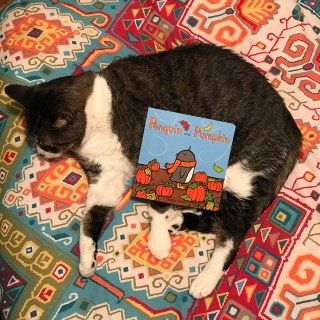
Penguin and Pumpkin

img_2482Penguin and Pumpkin by Salina Yoon

Over the years, I have amassed quite the collection of Penguin-centric children’s literature. While Tacky is certainly the character I relate to the most, the Penguin created by Salina Yoon is by far the sweetest. There are several books about Penguin’s adventures with his friends, sometimes venturing far from the ice world that is his home. In this fall adventure, Penguin learns what fall looks like away from home, and brings back a special fall surprise for his little brother, Pumpkin.

When Penguin and his friends decide to visit a farm to learn what fall looks like off the ice, Pumpkin is still too small to come on such a far journey. Penguin and the others set out on an iceberg for their long trip to the farm, with the size of their vessel gradually diminishing as they get further from home. At the farm, they discover pumpkins of all varieties, and put together a harvest package to bring home. They even build themselves a new boat for the way back, made from a giant pumpkin! Back home, Pumpkin has been imagining some fall adventures of his own, but is very curious about the real fall. He is excited to have his very own pumpkin brought back for him, but the real surprise is the extra bit of fall Penguin brought so he could see what fall really looks like– snowing leaves!

Like I started with, this is a super cute and sweet story. First of all, I think it’s adorable that Penguin has a little brother named Pumpkin. The illustrations are well done and add some fun details into the story. I love the little details like the dwindling ice berg on the journey, and Sleepy Penguin who always seems to be dozing off. There are some bits of conversation added in to the story along with the narrative text. The books are definitely aimed at younger children, with many available as board books. These are fun as read aloud or bedtime stories, with great things to point out to kids in the pictures throughout the book.

Boris’s thoughts: “Did you notice that we get both of the falls that are in this book– the snowing leaves and the real snow! Both fun to watch. 4 paws.”

Boris and Bella

img_2141Boris and Bella by Carolyn Crimi

Happy October! I am so excited for the turn of the weather, and all the spookiness that comes along with October. In the spirit of the season, I plan to keep things spooky for my next few posts! I saw this book on display in the library, and it immediately caught my eye– the cover is a bit creepy-chic, and one of the title characters has a great name (coincidentally, my mother also has a dog named Bella to pair with my Boris).

As it turns out, this is not just an eye catching cover with a personal connection in the title– it is a cute story about friendship with a Halloween-ish theme.  Bella Legrossi and Boris Kleanitoff are neighbors, who are not particularly fond of one another. Bella is the messiest monster, and Boris is a neat freak who goes as far as polishing his pythons daily! Neither of them are popular with the other monsters in Booville, which only complicates things when they try to show each other up by throwing competing Halloween parties– which nobody attends because of Boris and Bella’s tiresome personal habits. As often happens in children’s books, Boris and Bella are able to find some common ground: first in their anger about the party everyone attended instead, and second in a shared love of dancing. While neither of these characters give up their ways, they do ease up enough to become friends.

Although the story does feature a Halloween party, this is not exactly a Halloween book. Halloween-ish? Halloween-lite? Despite monstrous characters, the story itself is about the ability to look beyond differences to find friendship in unlikely places. Nonetheless, the monster theme does make this a nice fit for the season. The illustrations are very detailed and compliment the story, with a color scheme that maintains a spooky mood to the setting. There is also some pun-ny humor for those who appreciate that sort of thing, and some really great kid humor– Baggo Bones connects his hipbones to his neckbone just for fun!

Boris’s thoughts: “I hope you’re not trying to suggest that I am persnickety like this other Boris. 1 paw.”

Rumple Buttercup

b4b5340f-eb2b-4750-b6e2-b3d19fc3d5dbRumple Buttercup by Matthew Gray Gubler

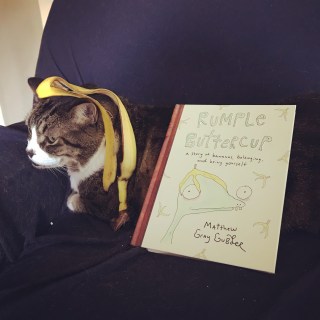
I have to admit that I have a bit of a soft spot for the weirdos of the world, and this story of bananas, belonging, and being yourself written by the wonderfully weird Matthew Gray Gubler perfectly fits the bill. (I know you all must be shocked to hear this, from the girl who puts books on her cat.) With his 5 crooked teeth, 3 strands or hair, green skin, and left foot slightly bigger than his right, Rumple Buttercup is weird. He worries that people will be afraid of him, so lives a lonely life hiding in a rain drain beneath his town. He is so intrigued by the outside world that he sneaks up to look around from time to time—but only under cover of his trusty banana peel.

Rumple’s story is told in a unique format that feels part picture book and part graphic novel. The story is told in three picture filled chapters, spanning 136 pages. Despite the length, this is a quick read due to the interspersed drawings and minimal text. The style of Gubler’s art really lends itself perfectly to children’s literature. The format and length make it a little difficult as a whole group read aloud, but I can see this as a good fit for beginning readers or a one-on-one read aloud with kids. It is a sweet story that can be appreciated by both children and adults, celebrating that weirdness that makes each of us special.

Boris’s thoughts: “It’s a great story, but I can do without the banana peel. 3 paws.”

Land of Stories Companions

img_0673

The Land of Stories (Series) by Chris Colfer

The Mother Goose Diaries

The Mother Goose Diaries purports to be just that—a diary written by the zany Mother Goose character from the Land of Stories. Honestly, I had some pretty high hopes for this one, but it left me feeling a little… meh. I love the eccentric Mother Goose that Colfer created for this series, the misfit fairy who is a bit wild and always up for adventure, but generally has good intentions. That is not quite the Mother Goose that seems to have written this diary. This Mother Goose comes off as more obnoxious than eccentric, and is perhaps too wild. The drug and alcohol references were more blatant and more frequent than expected, considering that this is a middle grade level book. There were definitely interesting uses of history in some places in the book, but at other times the history included seemed flippant and a little annoying.

I think my biggest issue with the book is that I had a hard time seeing it’s connection to the rest of the series. The diary follows Mother Goose through history, but there is minimal mention of the work of the fairies to spread stories of the Fairy Tale World. It is included, but generally glossed over rather quickly. Although the series talks about fairies sharing stories with authors like the Brothers Grimm, they are never mentioned. Nor are the twins, or any of the events from the series brought up at all. I realize that as a companion book this is intended to be separate from the primary series, but felt like there should have been something tying it to the other books.

img_0678

Queen Red Riding Hood’s Guide to Royalty

As we near the end of our journey through the Land of Stories, we come to Queen Red Riding Hood’s Guide to Royalty, another companion book authored by a character from the series. This book was a pleasant surprise for me. While I find Red’s character hysterical, she often becomes annoying. I thought that a whole book dedicated to her might be a little too much, but I think this was done perfectly. It was a short and quick read, which definitely helped it from being too “over the top.” I really enjoyed reading this, but I suspect that anyone who was not a fan of the original series may not fully appreciate the humor here.

In the later books in the series, Red finds an affinity for reading books from the “Other World,” although she often does not understand them or remember the correct names of authors. It is one of those books that inspired her to write this one, The Prince by “Nicole Macarena.” The book includes a little bit of back story to Red and her place in the kingdom that was not included in the original books, but the majority of it is taken up with her advice. As would be expected from her character, most of it is written rather condescendingly, and much of the time she presents as ridiculous and outrageous. However, there are actually some good points and advice included there, despite their somewhat ludicrous presentation.

Land of Stories Series, Part 3

img_0732

The Land of Stories (Series) by Chris Colfer

An Author’s Odyssey

An Author’s Odyssey, the fifth series book from the Land of Stories, mostly serves as a bridge between the fourth and the sixth, final, book. After gathering characters from classic literature to join the fight against the army of literary villains, Alex and Connor venture into Connor’s own stories to begin building an army of their own. There is a mix of action and stagnation here: the main plot of the series is put on the back burner, while Alex and Connor travel through the various stories. There is a mini-adventure of sorts within each story, as they attempt to recruit Connor’s characters. While there were fun things happening here for readers, there is not much movement in the story as a whole. It was fun to revisit some of the characters from previous books in a new light, as the majority of Connor’s characters are based on those that he has met in the Land of Stories. We see new versions of Goldilocks, Red, Mother Goose, and a few others, and then also get to see some of these characters introduced to their counterparts.

Overall, I did like this one, but much of it felt like filler material. Most of the book was a continuation of previous storylines, some of which are carried over further into the final book. One story with resolution here is that of the Masked Man, who follows the twins into one of the stories, only to be confronted by others from his past and killed. As is the norm for the books in the second half of the series, this ends with a bit of a cliffhanger and lead into the next book. Now rid of the Masked Man, various witches from the Fairy Tale World have combined forces and intend to carry out the remainder of the plot he had started. They reveal their secret weapon: a powerful curse placed upon Alex that intensifies her already negative outlook and allows them to control her powers to their advantage.

img_0695

World’s Collide

The sixth and final installment to the Land of Stories series begins a bit differently than the previous tales, with a prologue set far into the future. Connor has become a well-known author, primarily by writing about his adventures and friends from the Land of Stories. He is celebrating his 80th birthday with an event at a bookstore, where he is asked a question about his sister and cannot remember what happened to her. He turns to his final book to glean some information, and we then jump back into the story. The two main events through the course of the book are a rescue mission to find Alex, and then the final showdown between the literary armies. Without giving away too much of the plot here, we do get the traditional fairy tale ending, “happily ever after” and all.

Although some may find the happy resolution to be too easy or cliché, I thought that it was fitting for the series. Perhaps the highlight of the series as a whole here comes from the wisdom imparted by the twins father, which helps to break the curse put upon Alex: “Happily ever after does exist, it’s just not what you think. Happily ever after isn’t a solution to life’s problems or a guarantee that life will be easy; it’s a promise we make ourselves to always live our best lives, despite whatever circumstance comes our way. When we focus on joy in times of heartbreak, when we choose to laugh on the days it’s hard to smile, and when we count our blessings over our losses—that’s what a true happily ever after is all about.”