The Three Little Wolves and the Big Bad Pig

Book: The Three Little Wolves and the Big Bad Pig by Eugene Trivizas

I am sure I have talked about this before, but I have a fascination with fairy tales. Of course, I feel I need to say that I am by no means an expert or even particularly well read when it comes to fairy tales—which is actually part of what I find so intriguing. There are hundreds of these stories that “everyone knows,” but there are so many different versions of each that not everyone really knows the story in the same way. It’s easy to say that the originals have the fairest claim to legitimacy, and while there is truth to that, I am not wholly convinced. Where do you draw the line when an interpretation of a story becomes more popular or well known than its source?

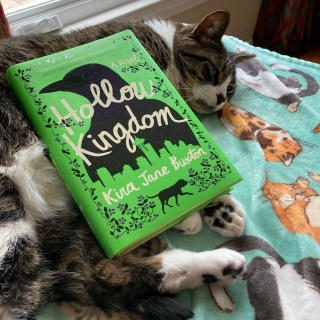
That is quite the lead in for a fairy tale adaptation that is neither well known nor anything like the original story. This is a book left on the shelf at my parents’ house from a Scholastic Book Fair long ago. I have a vague memory of it being read aloud to one of my elementary school classes. Really, I had not thought about it in a very long time until my cousin’s daughter pulled it off that shelf at a family party a few years ago and asked me to read it to her. From what I remember, we both enjoyed it, sitting on the landing upstairs while the party continued on below without us. It was returned to the shelf again until recently, when I stopped to look it over while visiting. A few days before that, I had been reading something online about non-traditional adaptations of fairy tales. It seemed a serendipitous moment, as I had not yet chosen a picture book for this month. I snatched the book up to read at home with the kitties.

I think this one even pushes the limits of being a non-traditional adaptation. The original tale of The Three Little Pigs seems like a familiar one, but not one that I can recall a specific source for. While I am sure that I had it in a story collection at some point, no particular storybook comes to mind. I did a little Google research to find that the most commonly known version may come from a Disney short, but that there are differences in that story from the generally agreed upon original from the mid-1800s. I’m sure you are shocked. While certainly a stretch from either story, this version takes elements from both. As I am sure you have inferred from the title, the tables are turned a bit here, with some cuddly little Wolves being picked on my a big bully of a Pig.

The story starts similarly to the original Pigs tale, with the Wolves being sent off by their mother to build a home of their own. Continuing along those lines, they begin to create houses from building materials they get from several other animals that they happen upon. Luckily for the Wolves, these are rather more sturdy materials than those of the Little Pigs: the first house built by the Little Wolves is made of brick. When the Big Bad Pig comes along, he threatens the Wolves and claims he will huff and puff and blow their house in. Of course, we all learned from the original tale that huffing and puffing is not effective against bricks. Unfortunately for the Little Wolves, the Pig also owns a sledgehammer. We have veered off course from the story you were expecting, perhaps?

The story continues with escalating building materials and destruction, coming to something of a twist ending—I do not want to give too much away, but I will say at least that everyone has the chance to live happily ever after. Overall, this is a cute story that will definitely get some laughs out of both children and adults. As I said above, this works well as a read aloud. I can see this being a great addition to a school unit on fairy tales, at any age. However, I think the ideal age group for this one would be middle elementary, around 7 or 8. Although I think younger children would still enjoy the story, I am not sure that they would fully appreciate the “twisted fairy tale” aspect.

Boris’s Thoughts: “I don’t know if I fully appreciate the twisted fairytale aspect. These animals are crazy.”
Wicked

img_9295Book: Wicked by Gregory Maguire

Date Read: March 19 to June 2, 2021

Rating: 4 (of 5) stars

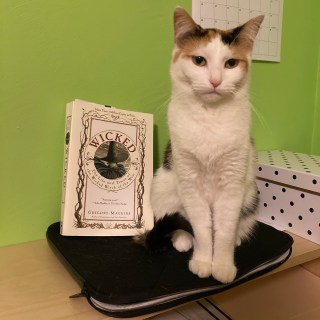
I chose Wicked as a match for the challenge to read a book by an author I have never read—in this case, an author I own more than one unread book from. I added this one to my shelves around the time that the musical was really taking off. Being a long time fan of the Wizard of Oz film, I was really intrigued by the idea behind the story. Eventually I was able to see the musical, which appeased my curiosity for a bit, and then a less-than-favorable review from a friend had me moving it down the list of upcoming books. This was also right around the time I started college and began accumulating books much faster than I could read them. Somehow, I ended up with the full series on my shelves before ever opening the first book. Seems odd when I consider that my friend’s dislike delayed reading, but did not discourage me from buying the remaining books. The logic of a book hoarder, I suppose.

Despite the span of time it took my to get through this one, I actually quite enjoyed it. It was not exactly what I was expecting it to be, and I will start by saying that the musical was definitely inspired by this story, not truly based upon it. Honestly, I thought this was fitting—the translation from the source text to musical felt similar to that of the original Wizard of Oz story to film. The story itself feels a little flat, with character development skirted a bit in favor of actionable moments. This is morphed a bit, and livened up with music, to create a much more engaging experience. That’s not to say, of course, that lovers of the musical will not enjoy the novel, only that the experience is different. The origin of the Wicked Witch is still there, with Elphaba largely presented as misunderstood, although a bit less sympathetic than in the musical.

I enjoyed that the author used aspects of both the original story and imagery from the film in developing Elphaba’s back-story. Fans of the original Oz stories likely know that the primary tale contains many aspects of political allegory. Keeping true to its origin, this in definitely a tale of politics, much more overtly than Baum’s first Oz tale. Elphaba in essence is a political rebel and refugee; this leads her story to be darker and more adult than other Oz iterations. There are themes and commentaries around politics and religion, good and evil. Although consistently intriguing, it could get dense at times and was certainly not a quick or easy read. In the end, I felt that the effort was worth it. The reader gets a good picture of what can lead a person to be considered wicked—Elphaba has a troubled life, resulting some erratic and desperate behavior which is easily framed by those who feel threatened by her. Even her final interaction with Dorothy seems to be based in a major misinterpretation of motives from multiple ends.

Minka’s Thoughts: “All those familiars, and not one cat. It’s a shame. 2 paws.”

Hollow Kingdom

img_8797Book: Hollow Kingdom by Kira Jane Buxton

Date Read: May 2 to 19, 2021

Rating: 5 (of 5) stars

May brought on the challenge of reading a book that I bought as a new release. Surprisingly, I do not have a ton of these to choose from on my shelves. Knowing how many books are already waiting on my unread shelf, I do my best to avoid truly new releases. I usually push myself to wait for a paperback release, knowing that I can save a little money since I will likely not start reading it right away. It’s also a good way to sort out the books that I truly want to read—if I’m still interested in a new release by the time the paperback comes out, it’s worth adding to my list. Of course, there are exceptions made: usually for certain authors, and in this case for a recommendation in a local bookshop in Northern Michigan.

Hollow Kingdom is a book that took me by surprise. It is a story of the downfall of humanity, told from the perspective of a domesticated crow. The concept was intriguing to me, but a few chapters in I started to question my choice. Our narrator and hero, the crow S.T. (short for Shit Turd), starts out being pretty annoying to me. S.T. loves humanity, sharing all of the things that he learned from his owner, Big Jim. The problem? Big Jim does not seem like a particularly likable guy. The result is a crow who comes off as ignorant and pretentious—the exact qualities that he complains about in other animals. Still, there was a glimmer there of something special in the way he spoke about nature.

As I continued reading, S.T.’s brashness began to subside, making way for a beautiful and tragic description of the crumbling world as nature begins to reclaim the earth. S.T. begins to serve as a bridge in the natural world, with some surprising insights into the connectedness of nature and the role of humans in it. He learns what it means to be a part of the world as a bird, but is also able to use his knowledge of humanity to help the animal world. Through the story, S.T. slowly reveals details about Big Jim in a way that peels back the less appealing aspects of his personality for a look at the core of his humanity—a man who viewed his pets as part of his family, who loved and ended up heartbroken.

Despite the off-putting start and a few ridiculous seeming incidents, this story really hooked me and kind of punched me in the gut. By the end of the story, I was in love with S.T.’s picture of the world. This was a perfect mixture of humor and humanity for me, creating a sad and lovely story. I mean, who would have ever suspected that a book about a crow named Shit Turd could bring one to tears?

Boris’s Thoughts: “I like a bird that recognizes the significance of cats. 4 paws.”

Unread Shelf Progress for May

  • Books Read: 1
  • Books Acquired: 12
  • Total Unread Books: 281

I feel like for the purposes of accountability, I need to comment on my totals update. I definitely splurged this month—the result of a trip to a much-loved bookstore that I do not get to visit often. I am committing to balance for the coming months: more books read than books acquired.

Cloudy With a Chance of Meatballs

img_9120Book: Cloudy with a Chance of Meatballs by Judi Barrett, Illustrated by Ron Barrett

I had not yet picked out a book for this month, when I happened upon a children’s literature puzzle in a bookish group on Facebook. The post was a Children’s Book Emoji Pictionary, which included many popular or classic books. While it appeared that most people did not have much trouble with most of the titles, it struck me that there were a few that consistently gave people a hard time. One of them was Cloudy with a Chance of Meatballs (represented by clouds, an umbrella, and a plate of spaghetti). The consensus in the comments seemed to be that most knew of the movie, but did not realize that it was inspired by a book.

With that in mind, I had to pull it off my shelf to revisit. This is one of those books that I remember loving when I was younger, but did not have my own copy of until I picked it up as an adult. I remember this as one of the highly sought-after books in my elementary school library. The book is set up to look a bit like a comic book, with the text in boxes and some pages showcasing multiple panels of pictures. The story is set up as a tall-tale told by a grandfather after a messy pancake incident over breakfast. While obviously intended to be silly, the story itself is fairly straightforward. It is complemented perfectly by the illustrations, which add an extra layer of comedy to the already goofy story.

The reading level of this one is a bit on the high end for a picture book, with an official recommendation on the back cover for ages 9-11. I think this is a good fit both for difficulty and for content. While I think there is a silliness to the story that could be appreciated by some younger children, I think some of the story might be lost on kids that were much younger than that target range. Still, I think this could be good as a read aloud for perhaps 3rd-5th grade students, and could possibly be a good format for discussion on text features with students who are a little older.

Minka’s Thoughts: “Did someone say meatballs? You have my attention. 4 paws.”

The Hate U Give

Book: The Hate U Give by Angie Thomas

Date Read: February 8 to 14, 2021

Rating: 5 (of 5) stars

I read this book back in February to fill the prompt of a book that was recommended to me. Of course, this is one that I had heard about from multiple sources—and I suspect one I would have ended up reading without a specific friend recommendation.

I schedule my blog posts in advance, putting each book I read on the calendar shortly after I finish reading. Originally, I had scheduled this post for the third week in April, which happened to be the week when jury deliberations began in Derek Chauvin’s trial. Although the content was certainly relevant to the time, I did not think it was appropriate to put this particular review out in to the world then.

This is a book that I am not sure I can do justice to with my own words—I will give some, but keep it brief. At its heart, this is a coming of age story, although perhaps in a slightly different than what is traditionally put in that category. Starr’s voice is one that we all need to hear. She offers a perspective on life that is both outside the mainstream and familiar. On the one hand, she is just an ordinary teenage girl, dealing with typical teenage dramas: friends, school, family. At the same time, she is faced with issues of finding her own identity while juggling the complexities of race, violence, and societal expectations. I believe I have said this here before, but will reiterate again: having diverse voices in literature is important for everyone. The sole purpose of diversity is not that minorities can see themselves represented—we all need to hear these perspectives too.

Aside from the important themes and perspective provided here, this story in itself is pretty spectacular. The writing is engrossing, the characters feel so real, and the story is poignant and authentic. Taken as a whole, this is a huge triumph of a story, and absolutely deserving of every bit of hype that it has received.

Minka’s Thoughts: “I agree that it is weird when people treat dogs like kids. Everyone knows that’s only cats. 4 paws!”

The Vanishing Half

img_8761Book: The Vanishing Half by Brit Bennett

Date Read: April 18 to 27, 2021

Rating: 5 (of 5) stars

For April, the Unread Shelf Project asked me to pick a book that was purchased from a used bookstore. This one is something I consider a gem of a find—I picked this up in the used section of my local bookstore only 3 months after it was released. I had seen multiple times on Bookstagram, and had already added to my mental to read list. I have been forcing myself to wait for paperback releases for many books, knowing that it does not make sense to spend the money on a hard cover that I likely will not read right away. So when I saw this at a reasonable price, I was super excited. Not only was it an unexpected find, it was in perfect condition. When I got it home, I realized that it was also signed by the author!

This turned out to be yet another amazing addition to my pretty phenomenal reading year. The book tells the story of a family over time, starting by following two twin sisters as their once inseparable paths diverge. The girls, raised in a small community of light-skinned Black people, run away to the city at sixteen where they seek to find a place for themselves. Stella finds herself in a position where she is able to get a better job and position by hiding her colored background, eventually seeing an opportunity pass over into a new life. Desiree continues to live her life as the person she had always known herself to be: beginning to come into her own in the absence of her sister. Separated for half a lifetime, their paths converge again through the lives of their daughters.

At its heart, I felt like this was a story about identity, and all the complex pieces of our lives that make up who we are. Although both girls grew up in much the same way, there were differences in their personalities and how their shared past impacted them. Desiree sees Stella’s choice to become white as a selfish one, where her sister chose the path looking for an easy life—unaware of the internal terror instilled in her from their childhood traumas that lead her to the decision. Although Stella did find something of an escape, her fears evolved along with her changing identity. Their daughters, in turn, each impacted by the circumstances of their upbringing and their relationships with their mothers.

This was a beautifully written and intricate story that had me frustrated with and feeling empathy for each character in their turn. The changes in time and perspective were well done, so that each time I began to form opinions about a character, there was a shift that allowed some greater insight into the full story. This is definitely an author I will be looking for more from in the future.

Minka’s Thoughts: “Seems twisty. Like me. See? 3 paws.”

Unread Shelf Progress for April

  • Books Read: 1
  • Books Acquired: 4
  • Total Unread Books: 270

The House in the Cerulean Sea

Book: The House in the Cerulean Sea by T.J. Klune

Date Read: February 16 to 22, 2021

Rating: 5 (of 5) stars

This book was my one planned exception to the rules I made for myself in completing the challenges for the Unread Shelf Project this year. In order to truly focus on my unread shelf, I decided that I could only count books that were already on my unread shelf at the beginning of the year. The one exception being when it came time to read the book most recently added to my shelf. This is one of several books I wanted badly to add to my “to read” list, but was waiting for a paperback release. While I am still excited about the others, I am so thrilled that this was the first to be released.

I feel like everything about this book was set up for me to fall in love with it, and I was not disappointed. We start with a character that hits close to home: a social worker living a life that is just fine, if not completely satisfying. He is pushed out of his comfort zone into a setting that would seem magical all on its own—but has a dash of real magic mixed in for good measure. Enter a wonderfully diverse cast of misfits, some lessons to be learned about understanding others, and just a little bit of awkward romance, written in a style that alternately had me smirking and giggling. For me, this was the perfect combination for a book that I did not want to put down and left me with the warm fuzzies. The story was cute and charming, but still managed to have an edge of seriousness when it came to acceptance and appreciation of those who are different.

It’s a funny thing that I often have a much harder time expressing all of the things that I loved about a particular book; much harder than expressing things that did not fit for me. Out of a strange curiosity, I decided to check out a few of the more critical reviews. (I am not sure why, but I often feel the need to see why others dislike the things that I love.) In this case, it only reinforced why understanding of why this book felt so perfect to me: several of the reviews commented that the story was too much like a fairy tale, and the writing style similar to that of Douglas Adams. As an ardent fan of both fairy tales and Douglas Adams, there is no doubt as to why this one swept me off my feet.

Boris’s Thoughts: “Linus really should have just listened to the cat from the beginning. At least he finally figured things out. 3 paws.”

Snow Crash

img_7621Book: Snow Crash by Neal Stephenson

Date Read: January 10 to 28, 2021

Rating: 4 (of 5) stars

I chose this book to meet my first bonus challenge for the 2021 Unread Shelf Project: a book that has been on your to read shelf for more than a year. There were many options to choose from for this, so I decided to reach way back. This is the book that I suspect may have been on my to read list the longest. Although I do not remember the exact date that I added it to my shelf, a friend recommended it to me when I was in middle school. That was around 20 years ago. I cannot say for certain why it took my so long to get to this one. The same friend recommended several other books and authors to me as well, and I have loved all of them. For some reason, this one always got pushed off.

Well, I am glad that I finally read it, and a bit irritated with myself for putting it off for so long. I am not a huge reader of science fiction—it’s not so much that I do not like it, but that I often find it a bit dense and can become overwhelmed by the necessary details and descriptions. I do not avoid the genre, but tend to lean toward the lighter side. Without much of a range for comparison, I would say this was a little more toward traditional science fiction than I am used to reading. Despite the step outside my comfort zone, I really enjoyed so much of what was happening here.

The main plot had a really intriguing combination of ancient religions and modern ideas, with the perfect amount of absurdist humor. Also a unique situation when I refer to modern, as I truly do mean current despite the book being around 30 years old (more on that later). There were definitely some satirical elements that were current at the time of publication that still ring true today, but I found the connections to ancient mythology really fascinating, particularly as to related to the spread of information. Today, we talk about things going viral online, but this was long before that was in common usage or even that internet usage was widespread enough for it to reach so many. Stephenson really dug into the concept of virality, tying in the spread of culture while also pulling in the idea of a computer virus spreading to humans. While it obviously sounds a bit bizarre, the connections made felt really valid.

Coming back to the timeline, another interesting aspect to me was that this was a book set in the future, but not too far into the future. With this being a recommendation from so long ago, and the book released about 10 years earlier, I would put the time frame for the setting to be around now, possibly a few years ago. Given that, it was really interesting to me to see some accuracies (and inaccuracies) in the technology. While there are some things that might be attributed to the novel (like the popularization of the term avatar for someone’s online representation), there are many that are more likely to be either coincidence or some educated guesswork. Personally, I liked that there were some pretty spot on pieces with modern cell phone technology, but that pay phones were still in use.

Boris’s Thoughts: “This all seems unnecessarily complicated. You know what isn’t complicated? Naps. 2 paws.”

The Art Forger

img_7822Book: The Art Forger by B.A. Shapiro

Date Read: March 1 to 18, 2021

Rating: 4 (of 5) stars

In March, The Unread Shelf Project had me do some traveling, by challenging me to read a book that I got on a trip. I had plenty of options, since books are one of the things that I collect when I take trips! I currently have a book for every country that I have visited, and am working on collecting books for each state. I chose this one for this prompt because it was the first “official” book in my states collection. Although it was not the first purchased, it was the first one that I got with the intent of a collection. I picked it up on a weekend trip to Boston a few years ago.

While I did enjoy this one, it fell a little short of what I was hoping it would be. There were so many elements here that appealed to me: a little real life mystery, dual story lines, descriptive settings, and some art nerdiness. I suppose I have always fancied myself to be the creative artist type, although I never had the talent or dedication to make anything real from it. Instead, I content myself with the brilliance of others’ art. So of course, as I started reading about the specific artwork and the Gardner Museum heist, I was compelled to do a little research of my own. I was disappointed to learn that although the heist was real, the main painting that the book focuses on was not. At the end of the story, I understood the decision to write about a fictional painting—but that did not do much to ease my discontent.

Despite my personal irritation at needing to imagine myself a picture of the fictional Degas painting, there were some really intriguing elements to the novel. I liked the art history aspects, which other than the information related specifically to the made-up work were true to life. I felt like the mystery was played out well, with just enough information given in the letter flashbacks to keep things moving. The descriptive use of setting was interesting as well. Personally, I could have done without the romance storyline—it felt a bit forced, as if added in for a little more scandal and intrigue.

I do have some mixed feelings about how the ending played out: while I was mostly happy that Shapiro did not go with the obvious easy solution, I was not wholly satisfied with the ending. It seemed to wrap up a little too quickly and neatly. As I was nearing the end of the book, I was getting anxious that there were not enough pages left to reach an ending with sufficient closure. I was happy that it did not have a completely smoothed out happy ending, which would not have felt realistic given the number of problems to be resolved. I suppose I have chosen to be mostly satisfied with how things turned out: despite some foolish decisions along the way, I felt like Claire got the redemption that she deserved without it being a straightforward “win” for all involved.

Minka’s Thoughts: “There should be more fancy artwork featuring cats. Why is it always ladies bathing? I am much more elegant when I bathe. 2 paws.”

Unread Shelf Progress for March

  • Books Read: 1
  • Books Acquired: 1
  • Total Unread Books: 268

The World According to Cats

img_7670Book: The World According to Cats by Susie Yi (Cat and Cat Comics)

It is the fifth Wednesday of the month, which usually means that I would be sharing something bookish, but not necessarily my usual book review. Since I shared a children’s novel last week instead of my usual monthly picture book, I thought this extra week would be a good time to share something else a little different. (I also could not wait any longer to put this out there, since I was very excited to receive it back in February!)

The World According to Cats is a collection of comics from Susie Yi, the creator of Cat and Cat Comics. I discovered Cat and Cat Comics several years ago. I believe it was a “suggested for you” type post on Instagram, and I was intrigued because I felt like the main character, Mickey, looked a bit like Boris. I started following then, and have been along for quite the journey! I have watched the style of the comics evolve over time, including the addition of some mini-series style comics along with the original short panels. There is also now a full cast of characters, including Yi’s real life pets Mickey, Minnie, and Momo, along with some of their fictional friends.

The book is a collection of comics, with a cat-centric view on topics like love, wisdom, physics, and, of course, judgment. It included a good mix of old and new comics—as a long time reader, I saw some remakes of older comics, a few more recent, and plenty of new material. Yi’s style is fun and cute, with generally positive content to put a smile on your face. While some of the humor is more aimed toward an older audience, everything is family-friendly and can be appreciated by all ages.

Boris’s Thoughts: “The cover says all you need to know: The world revolves around me. 4 paws.”

Curious for more? You can find Cat and Cat Comics free on Instagram, Webtoons, and Tapas!