All My Friends Are Dead

img_5756Book: All My Friends Are Dead by Avery Monsen and Jory John

Every once in a awhile, you need to read something that is absolutely ridiculous. This is a perfect book to meet that need. It is a collection of one-liners and puns that string together to form a loose sort of story. I found this book at a random gift store in Louisville a few years ago. I was initially attracted by the cartoon dinosaur on the cover, then had to pick it up once I read the title. What could this little book be?

Hysterical, that is what this little book turned out to be. Is it high quality literature? Of course not. Did anyone really think that’s what they would be getting here? But it’s great for a quick read when you need a laugh, and makes a great gift for that one person that you are never quite sure what to get. Like I said, everyone needs something ridiculous from time to time. I expect that one day, this will be one of my “coffee table books.” I just need to get a coffee table first. And a living room that will fit a coffee table.

Boris’s thoughts: “I can’t believe you make me do this. All my friends are nerds. 2 paws.”

My Antonia

img_5760Book: My Antonia by Willa Cather

Date Read: April 14, 2015 to May 15, 2015

Rating: 4 (of 5) stars

If I was being completely honest, that should be a much larger date range up there. I started this book for a US History class when I was in high school – I’m going to estimate and say that it was probably around… October 2001. Most of the class was unenthused about reading in general, and we only made it through the first section. I had thought about going back and finishing it many times, but just never seemed to get to it. Then, nearly 15 years later, I decided to participate in a reading challenge which included “a book you were supposed to read in school but didn’t” and “a book you started but never finished.” This was literally the only book I could think of that fit into those categories.

Upon finally finishing this book, I was quite pleased that I had come back to it. In keeping with my apparent tradition of delay with this book, I am writing and posting a review for it nearly three years after reading it. Perhaps this isn’t quite fair to the book. I do not know that I can truly give it justice in a review when it is not fresh in my mind. However, I think the fact that this book is one that stuck in my mind as something I could easily write about this long after the fact speaks to it’s quality. While the details of the story are perhaps fuzzy, it is one that has stuck with me.

There is a passage near the end of the book that particularly struck me when I was reading. For full disclosure, I finished this book in tears… on an airplane… sitting next to a stranger. Something about this passage hit me hard at that moment. I wrote it down then, feeling that it was something that needed to be kept and revisited. I shared it on the blog I was writing at the time, on Goodreads, and now here:

‘Do you know, Antonia, since I’ve been away, I think of you more often than anyone else in this part of the world. I’d have liked to have you for a sweetheart, or a wife, or my mother or my sister – anything that a woman can be to a man. The idea of you is a part of my mind; you influence my likes and dislikes, all my tastes, hundreds of times when I don’t realize it. You really are a part of me.’

She turned her bright eyes to me, and the tears came up in them slowly, ‘How can it be like that, when you know so many people, and when I’ve disappointed you so? Ain’t it wonderful, Jim, how much people can mean to each other? I’m so glad we had each other when we were little…’

Boris’s thoughts: “I don’t remember this one. Fake!! 1 paw.”

Walk Two Moons

img_5767Book: Walk Two Moons by Sharon Creech

Date Read: February 9 to February 13

Rating: 5 (of 5) stars!

My first encounter with this book was in middle school, when it was relatively new. My best friend absolutely loved it, and told me that I HAD TO READ IT. For some reason, I didn’t listen to her. I wish I had.

Reading this as an adult, this is everything that I want to see in children’s/young adult literature. There’s a sort of adventure, some fun quirky characters, a bit of mystery, some beautiful writing, and the all important moment of self-discovery. Sal is surprisingly introspective, yet closed off at the same time. She has a unique method of coping, which I think is true and relatable for kids– they are still making sense of the world, and are not always ready for what life throws their way.

One of my reading quirks is that often when I read a book that I very much liked, I will go look for its negative reviews. I want to understand what it is that people did not like about something I found great. The two main complaints I found were that: the “twist” in the story is predictable, and that Sal’s friend Phoebe (who is a main character) is annoying and not likable. I actually agree with both of these things, but think these are good for the target demographic of this book. Is it great literature? Maybe not (although I would at least call it good). But it is great children’s literature.

While the “twist” might be obvious to adult or even teenage readers, I think it works for the younger audience. This would be a great book for reading with 4th or 5th grade, even up through middle school. The somewhat vague but hinted at story of Sal’s mother is a good opportunity for less experienced readers to speculate on and make their own predictions. Along the same lines, although Phoebe is rather annoying, she is sympathetic. She may behave badly, but she’s also experiencing something that she really doesn’t know how to deal with. We are certainly not viewing Phoebe at her best. And yet, Sal is still her friend, and she feels for her when the “birds of sadness” begin to circle. I think it’s good to encounter characters that you don’t like, especially when they are in some way relatable. You don’t have to like Phoebe to feel bad for her, which I think is a lesson that many kids need to hear.

I also like to collect quotes from books. There were 8 from this book that I wrote down, which is more than usual. I don’t feel it quite necessary to share them all, but here are a few highlights:

“You can’t keep the birds of sadness from flying over your head, but you can keep them from nesting in your hair.”

“Maybe dying could be normal and terrible.”

“It seems to me that we can’t explain all the truly awful things in the world like war and murder and brain tumors, and we can’t fix these things, so we look at the frightening things that are closer to us and we magnify them until they burst open.”

Boris’s thoughts: “Lightweight, cozy snuggle book. 4 paws.”
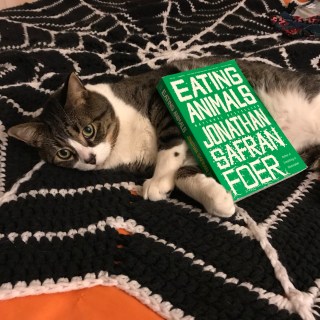
Eating Animals

img_5724Book: Eating Animals by Jonathan Safran Foer

Date Read: June 23, 2016 to July 12, 2016

Rating: 4 (of 5) stars

Before the prime of Amazon prime, back when the only way to get free shipping was to bump your order total over $25, I often found myself browsing Amazon’s book recommendations. It wasn’t so much that I could not have come up with another book to purchase on my own, but it was obviously much more fun to buy a surprise book. One that I wasn’t going to seek out during my next trip to the bookstore. That is where I found this book. It was recommended to me based on my previous purchases, and what little (or perhaps not so little) Amazon knew of my reading habits. I had read a book by the same author before. I’m pretty sure that was the main reason for the suggestion, and I’m going to say really not the best reasoning on their part.

I suppose at this point I should admit my bias: I am a vegetarian. I was before reading this book. I am not vegan, and while reading this has lead me to think more about my choices, I would not say that it has really pushed me strongly in that direction. I would consider this book to be more of an informative piece on factory farming than a straightforward case for giving up meat. Foer presents facts, from various viewpoints, and suggests that readers use this information to make decisions for themselves. He does not preach to the reader, nor does he vilify meat eaters. I appreciate this perspective– one of the hardest things I have found about being vegetarian is the way that others react to me based on their assumption of how I feel about them eating meat. Don’t judge me, and I won’t judge you, thanks.

My biggest takeaway from this book is that the food industry in our country is in an appalling state. Many of the common practices in the large scale farming of animals are not only cruel, but also terrible for the environment and more often than not, rather disgusting. I don’t think any of that would surprise most people. I suppose this is the classic case of what people “don’t want to know” about their food. However, Foer does make efforts to show the other side of this: there are people out there who are trying to make things better, who respect the animals that they raise for food, and attempt to do right by them. It is possible to be a responsible meat eater; it’s just not easy.

As a final thought, I think Foer states it well himself:

“Whether we’re talking about fish species, pigs, or some other eaten animal, is such suffering the most important thing in the world? Obviously not. But that’s not the question. Is it more important than sushi, bacon, or chicken nuggets? That’s the question.”

Boris’s thoughts: “Concerning title, but did not convince human to eat me. 4 paws.”

Me Talk Pretty One Day

img_5683Book: Me Talk Pretty One Day By David Sedaris
Date Read: January 21, 2018 to February 8, 2018

Rating: 3 (of 5) stars

I kept thinking that I needed a little more time to think about this book before putting my thoughts into writing, but a week after finishing, I still wasn’t quite sure what to say. So I waited a little longer. And I still don’t feel like I’m quite sure what I want to say.  I suppose that in itself says something.

I have read some polarized opinions on Sedaris. People either love him or hate him. I have to honestly say that this confuses me. This book was sort of meh for me. I have a hard time imagining his writing to invoke such strong feelings, positive or negative. There were some stories that I very much enjoyed, and some really great moments. However, the rest of the book left me… unenthused. This sounds a bit petty, I suppose. I really don’t expect that every book is going to blow me away. Part of my issue is that Sedaris does not really present himself as particularly likable. Again, I don’t expect that every book is going to have a narrator/author that I like. I guess I just feel that if I am going to take the time to read about someone that I do not particularly like, I need to get a little more out of it than a couple laughs. I do have another of Sedaris’s books on my to read list, and I will keep it there, but I’m going to let this one set a bit longer before reading him again.

Boris’s thoughts: “Chapters of reasonable length for snuggle sessions. 3 paws.”

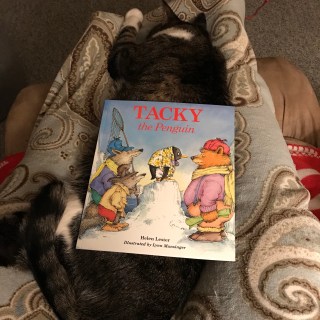
Tacky the Penguin

img_5718Book: Tacky the Penguin by Helen Lester

No blog that belongs to me could ever be complete without some at least some picture books, and I certainly can’t think of a better place to start than with Tacky. While it may be said that I am a bit biased toward penguins in general, Tacky is most definitely one of my favorite characters from children’s literature.

I suppose I should start by saying that if it were possible to have a fictional spirit animal, Tacky would probably be mine. (There is another character I also relate pretty well to, but we will just have to save that for a future post!) Tacky is a bit odd. He does not quite fit in with the other pretty penguins. He marches to the beat of his own drum (1-2-3, 4-2, 3-6-0, 2 1/2, 0). Nonetheless, Tacky always turns out to be a good bird to have around.

While I wouldn’t exactly call it a “series,” there are several books featuring the adventures (or perhaps more accurately, the mis-adventures) of Tacky and his penguin companions. I have not read all of these, but have enjoyed all of those that I have encountered. Tacky is a great character for showing kids that it’s okay to be different– and sometimes even advantageous.

Never Let Me Go

img_5731Book: Never Let Me Go by Kazuo Ishiguro

Date Read: August 5, 2016 to August 15, 2016

Rating: 3 (of 5) stars

In trying to come up with the words for my feelings on this book, I think I just have to say that I found this book both interesting and annoying. The primary reason for my mixed feelings is that the reasons for each of those words are exactly the same.

The way the story is told often feels very disjointed. The narrator has a hard time getting to the point, and very often goes on tangents. There are bits and pieces that are not explained, but then resolved a few pages later after going off into something seemingly unrelated. While this was sometimes confusing and annoying, in some ways I felt that it made it seem more real. That’s often how people think and talk, especially when they are relaying a complicated story. I found myself wondering if this was intentional, or possibly the result of poor editing. Either way, I feel like it does work for the story – although not necessarily in a way that I am fond of. Overall, despite the wanderings and ramblings, I felt the story did come together at the end, and that there was sufficient resolution to everything that was brought up (or at least to my own wonderings as I was reading the story… I’m sure if I really dug into it, I could come up with something).

Another part that I feel uncertain about is the voice/emotion used throughout the story. It some ways, I feel like she is describing things as being emotionally charged, but I don’t ever really feel that in her own voice as she tells the story. Again, I can’t pinpoint if this is intentional, or just poor writing/character development. Kathy’s voice seems somewhat sad, but mostly indifferent, when reflecting on her past. Is that because she is supposed to be indifferent? Does she feel that, like is mentioned in the story, it was all pointless if her life was always going to end the same way? But if that’s the case, then why is she even sharing the story? Or is what I read as indifference merely her acceptance of her life as it was?

So with those thoughts, I certainly don’t love this book, but I also certainly can’t say that I hated it or that reading this book was a waste of time. Would I recommend it? Maybe. The world created in the book is an interesting one, although somewhat puzzling and sad for these characters.

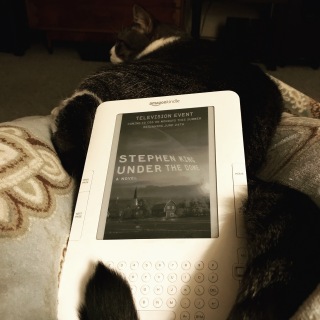
Under the Dome

Book: Under the Dome by Stephen King

Date Read: November 21, 2017 to January 20, 2018Under the Dome

Rating: 4 (of 5) stars

This book was a bit of an undertaking for me. I have read a few Stephen King books before, but this was the first lengthy novel that I have taken on in quite some time. Initially I was a bit concerned about the length of the book– I worried that I get bored with it and end up stretching it out even further than necessary. I was pleasantly surprised with the pacing of the story. While I would not necessarily say that there was “nonstop action,” the plot moved along well and was intricate enough that I wanted to pay attention to the details of what was happening without feeling overwhelmed by the complexity. I liked the set up of the novel, broken up into named “parts” with numbered chapters in each.

Overall, I did really enjoy the book. One piece that I feel a little torn about is the number of characters, and how they were so easily dispensed of. I suppose I should say this is a spoiler alert, but I also think this should be fairly obvious: there is a huge death toll in this book. Many characters are introduced and named only to be killed within a few pages. While I did not necessarily keep track, I would guess there were nearing 100 named characters in the course of the novel, and only a small number of these remaining at the end. I suppose some of this is to be expected. This is a novel by a noted author of horror. But at the same time, some of it felt excessive and unnecessary. There are tons of developing problems throughout the novel, several of which are simply dealt with by the death of one or more involved characters. I suppose this is at least efficient.

Finally, I feel it appropriate to address one of the top criticisms that I have heard in other reviews of this book: that the distinction between good and evil is too clearly made, making the characters too “black and white,” and perhaps a little flat. I will say I both agree and disagree with this. Yes, the main good guys vs. bad guys situation set up here is fairly straightforward, and this really does not have much to do with the presence of the dome. The bad guys have always been bad, and the good guys have, generally, been good (or at least reasonable and decent people). However, I think leaving it at that is an oversimplification. There are myriad other characters that do not strictly follow those lines. Sure, sides end up being drawn fairly easily, but I wouldn’t say that any of the “good” characters are presented as infallible. I also personally really enjoyed some of the characters who didn’t clearly fit in either of those categories: like Andy Sanders and Chef Bushey. By no means would either of them fit into the “good guy” category, but both also find themselves opposed to the “bad guys” at several points along the way. They are the wildcards, which I don’t think can be left out when considering the book as whole.

And as a truly final note, I did write down one quote to remember:

“When dawn was still long hours away, bad thoughts took on flesh and began to walk.”