The Cricket in Times Square

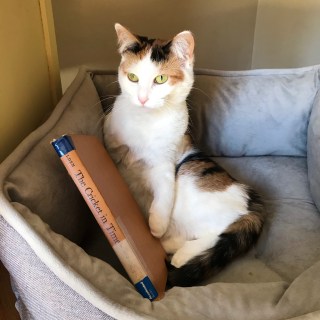
img_7901Book: The Cricket in Times Square by George Selden

To follow up last week’s post on a book I am still unsure was a new or re-read, I have another book from my childhood—one that I can saw with certainty I have read before. How can I be so sure? I can tell you when I read it: in the fall of 1995 as a read aloud in Mrs. Lint’s Fourth Grade class. I was so inspired by the story of Chester Cricket that I insisted on dressing up as him for Halloween that year. My mom had to spray paint some fairy wings black, and I glued a bunch of googly eyes to a mask to make insect compound eyes. I am sure not a single person knew what the costume was supposed to be, but I was so proud of it. Oh the joys of being a weird kid.

Of course, that was many years ago. Obviously it is a book I enjoyed as a kid, but not one that I thought about often. Until recently: last year, it was in a pile of books to discard at the school library, as the cover was damaged and no students had checked it out in several years. I added in onto my bookshelf then, and shortly after discovered that it was among the free audio books I could access through my district online library. At only 134 pages and roughly 2.5 hours audio, this was a nice fit for a long walk on a winter day. My only regret is that the story would have been a better fit for an evening stroll in late summer or fall.

I am not quite going to claim that I loved this story, but I think that it speaks to its appeal for children by the fact that seeing it on a shelf triggered such a detailed and specific memory. I suspect the idea of the friendship between different animals held a high appeal for me. And as an adult, I still think the idea of a cat and mouse becoming friends in New York City is fitting. I did think the ending was a bit sad, with Chester becoming burnt out with something he loved and leaving his new friends to journey home—but the tiniest bit of research led to me the fact that this is the first book in a series! While I do not now feel the need to continue, I imagine that would have been valuable information to my Fourth Grade self.

Even with the somewhat sad ending, I think there is a good message there for kids: sometimes we get tired of the things we like, and we might need a break. Overall, I thought this was an entertaining story with a cozy feel to it, and a good fit reading difficulty and interest wise for middle grades. It is a little dated, having been written in the 60s, but I think it has aged fairly well.

Minka’s Thoughts: “I don’t know if I’m cultured enough to have friends that would be so fun to chase. 3 paws.”

The Outsiders

img_5950Book: The Outsiders by S.E. Hinton

Date Read: January 4 to 7, 2021

Rating: 4 (of 5) stars

A few months ago, I wrote a post about revisiting previous reads through audio. This was my first audio book of the year. It is one that I had been sure that I had read before, although I do not own and it was long enough ago that I never had it listed in my logs. I feel like I normally have a pretty good memory for books, but as I was listening to this one, I started to question whether or not I really had read it before. Even after reaching the end, I am not entirely sure. One of the biggest factors in my uncertainty is a feeling that if I had read this years ago, I feel like it is one that would have stuck with me more. There are parts that were familiar to me: meeting the girls at the movie theater, hiding out in a church, even reading Gone With the Wind. At the same time, there were major events that I did not remember or anticipate at all.

I suppose all that is to say that this is an unusual one for me: a book that I am not sure I have ever physically read but finished on audio at the beginning of the year. There were so many things about this book that I really loved—and I have to say that some of the things that it did not fully resonate with me enough to get 5 stars probably has to do with me reading it now as an adult rather than when I was younger. In some ways, I think this might be the perfect book for its target demographic. While some aspects of it may be dated, Hinton does an excellent job of capturing how it feels to be a teenager even now—a weird mix of feeling like everything in the world is against you, but in some small way tuning in to the fact that others’ struggles may not be that different from your own. And, of course, feeling at the same time like everyone else’s struggles could not possibly be anything like your own personal experience.

Of course, the experiences of relayed by Ponyboy Curtis certainly fall outside the norm for the typical teenager—most readers probably find themselves somewhere in the middle between the two groups described in the book, although nonetheless feeling like they are also an outsider. I really enjoyed the voice of Ponyboy. He is introspective enough to add some depth to the character, but not so reflective and self-aware as to become unbelievable as a real teenage boy. This is a great book for middle school and high school age students, who may need the reminder that their thoughts and feelings are valid and shared. It’s also a great book for adults who may need a bit of a reminder about how hard it can feel to be a teenager.

Boris’s Thoughts: “I still don’t understand how you read with these. Where are the words? Where was the snuggles? Is it really a book if it did not involve cat snuggles?”

Turtles All The Way Down

img_7411Book: Turtles All The Way Down by John Green
Date Read: December 27 to 29, 2020

Rating: 5 (of 5) stars

I read this at the end of the year, as I was trying to squeeze in a few more books to round things out to an even 50 (although my goal for the year had only been 30). This was my last book of the year, as I decided that I did not want a book that was going to span the year mark. I know it’s an arbitrary technicality, but I like my data clean—something that I think the main character, Aza, would appreciate.

Supposedly this book is about a missing billionaire, and the “adventure” that ensues when two teenage friends begin an investigation hoping for some reward money. While I will say that this is something that happens in the book, I would definitely not say that this is what the book is about. To be honest, the underlying sad love story that is typical of Green’s work is merely an undercurrent here to a much more interesting story about mental health. This is a first person account of a girl who is struggling with obsessive-compulsive disorder.

While Aza is dealing with some unusual circumstances related to her childhood friend’s missing billionaire father, most of it is an account of her every day life. Her mental state impacts every aspect of her life, and she seems only semi-aware of how it impacts those around her as well. I thought it was interesting that she is able to see how her illness effected her developing relationship with an old friend turned love interest, but did not realize the influence on her relationship with her best friend. I suppose this is part of the nature of mental illness: even when you know you are unwell, you do not realize its extent.

As Aza’s internal thoughts spiral out of control, her behavior also becomes increasingly concerning. Her fear of germs turns from excessive hand washing and sanitizing to trying to sanitize her internal organs as well. Seeing the underlying thought processes here was somewhat disturbing, as it is pretty clear how this obviously destructive and dangerous behavior seemed perfectly logical to Aza. I liked that Aza was connected to the help that she needed, without minimizing the hard work that she had ahead of her.

While I was reading, I was impressed with the handling of Aza’s illness. Although I am very interested in mental health, I am sometimes put-off by depictions in media. It was not until much later (actually, part way through writing this review) that I realized that Green also has obsessive-compulsive disorder, making this an “our voices” novel on mental illness. Although I know there is plenty of legitimate criticism of the repetitive themes in Green’s books, I think this one was very well done and worth the read.

Minka’s Thoughts: “Where are the turtles? I was misled! 1 paw.”

Anxious People

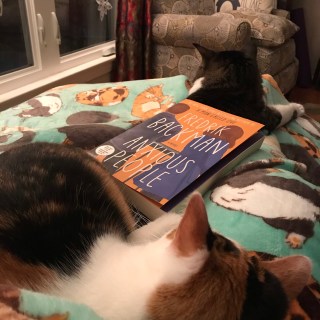
img_7587Book: Anxious People by Fredrik Backman

Date Read: February 1 to 7, 2021

Rating: 5 (of 5) stars

After finishing A Man Called Ove, I knew that Fredrik Backman was an author that I was not done with. I was super excited when I learned that he had a new book coming in 2020, and even more so when I won this advance reader’s edition in a giveaway on Instagram. This was a giveaway copy from the original recipient after the release of the book, and not sent to me from the publisher. I chose it for the February prompt for the Unread Shelf Project: a book you got for free. Most of the books I have gotten for free have been gifts, so this one and only book I have ever won seemed like a perfect creative twist for the prompt.

This is a story that could be about numerous things: a town, a robbery, a father and son, a divorce, a bridge, a couple (or several couples), a hostage situation, a second chance. In the end, it was about all but not quite any one of these. It reminded me of the term “sonder”—defined as a feeling of realizing that every person who passes through our lives, however briefly, has a life as complex as our own. To me, it is a sentiment that makes me feel both small and significant. An unusual sort of connection to the world at large, and one that I think we all could use just a bit more of in our lives.

Backman certainly knows how to spin a beautiful, although sometimes meandering, narrative. There are a few parallel storylines going on, each with seemingly spurious connections that all come together nicely in the end. There is enough information shared to pique the reader’s interest and generate some ideas of where things are headed, before another string is woven in to complicate and sometimes challenge our thinking. It reminded me somewhat of the tendency for conversation or thoughts wander. The type of journey where you begin by talking about where you would like to go to dinner, but somehow end up in a debate over whether it was 2 or 3 summers ago when you bought a particular lawn chair—there were logical connections along the way, but it takes a bit of effort to track them back.

One of the things that I found most intriguing is how Backman starts with a cast of characters who are not particularly likeable, but uses that to as an asset to the story rather than a hindrance. There are some glimpses of potential good qualities, but nothing that outright makes you want to root for them. Each one of them comes with their own agenda, challenges, and anxieties, but they all have something to offer, and somehow manage to make the story better for all of their flaws.

Along the way, I definitely found myself generating ideas about the overall picture, just as the police officers were trying to put together the pieces of the situation. I found myself needing to revise quite a bit—often as a result of assumptions that I had made about the information given thus far. I think that is part of the beauty of this story, its ability to challenge the reader while still keeping interest and staying true to life. There are twists that are not really twists, and coincidences that seem too convenient until you realize that perhaps in a small town they are not.

Circling back around to my comments on sonder, to me, this was a story about our connections to the people around us. A commentary on how we impact one another, whether we realize it or not. Even the best of us are sometimes unsure, anxious, lonely, or idiots—that is part of being human. After the year of uncertainties and anxieties that we have all experienced in some way, this story is a comfort to me.

Boris’s Thoughts: “Ahh. A feeling of connectedness without having to leave home. Sounds perfect. 4 paws.”

Unread Shelf Progress for February

  • Books Read: 5
  • Books Acquired: 4
  • Total Unread Books: 268

Eleanor Oliphant is Completely Fine

img_7578Book: Eleanor Oliphant is Completely Fine by Gail Honeyman
Date Read: December 20 to 26, 2020

Rating: 5 (of 5) stars

I had been eyeing this book for quite awhile before finally picking it up at one of my local stores. Despite hearing the title and seeing a few different renditions of the cover, I did not know much about the premise when I started. Based on the cover art for one edition, a house made of burnt matches, I suspected that fire would play a role in the story. Other than that, I was mostly drawn in by the title, and the belief that I would discover that Eleanor Oliphant was not actually completely fine.

To start, I have to say that I found this story to be both hysterical and quite moving, with the perfect balance between humor and sadness. I found my feelings about Eleanor changing pretty quickly as I read, although not always in a positive way. Upon a first impression, she is not particularly likable. She is rigid, rude, and very quick to judge others. She is very certain of the “rightness” in how she lives, although her view of the world does not fit into the norm defined by everyone else. I suppose you could argue, in a way, that she is “completely fine”—the version of completely fine that is constantly teetering on the edge of disaster.

As the layers of Eleanor’s life begin to slowly peel back, her awkwardness shifts from off-putting to endearing. Although we do not see the full picture of Eleanor’s background, there is enough revealed to allow the reader to begin to sympathize with her. She is certainly misguided and unaware of social expectations—although she does her best with her ill-conceived interpretations of social skills. She knows that she does not quite fit in, and many of her efforts to do so lead down the path of hilarity. At the same time, it becomes clear that the surface of Eleanor’s perfectly organized life is hiding some deep issues.

My favorite thing about this book was that it was absolutely not a romance. Although she would not admit it, Eleanor is profoundly lonely. She creates a romance in her head with who she imagines could be the perfect partner, without realizing that she is also quietly cultivating some much more real connections. When she reaches a breaking point and heads into a downward spiral, it is these friendships that help to set her on a course toward recovery. I loved that the author did not seek to “cure” or “fix” Eleanor’s problems by throwing her into a romantic relationship. Her experience is much more true to real life, and the bumpy ride that many find themselves on.

Boris’s Thoughts: “See? Who needs romance? All of Eleanor’s problems start to get better when she gets a cat. This is clear proof that cats fix everything. 4 paws.”

The Book Woman of Troublesome Creek

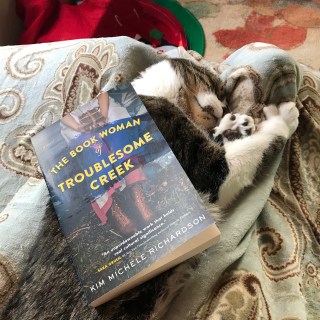
img_7212Book: The Book Woman of Troublesome Creek by Kim Michele Richardson

Date Read: December 17 to 20, 2020

Rating: 5 (of 5) stars

I picked up this book as a new addition to my states collection a few years ago, when a friend and I took a trip down to Louisville for a few days. While we spent most of the trip enjoying beverages and tacos on patios, we did a fair share of neighborhood exploring as well. Carmichael’s Bookstore was only a couple miles from where we were staying, so we set out to patio hop our way to and from the store one afternoon. I was unsure of what book I might choose to represent Kentucky in my collection, but Carmichael’s made it easy: this book set in Kentucky and by a Kentucky-based author was a new publication, as well as being on the staff recommendations list.

This unique historical fiction is a book for people who love books. It combines two aspects of history that I previously knew little about: the Depression era Kentucky Pack Horse Library Service and the historic blue-skinned people of Kentucky. The latter, actually, I had not heard of before seeing this book. The book follows Cussy Mary, a packhorse librarian and the last in the line of a blue-skinned family. She loves reading, and is passionate about her job of sharing books with the hill people of Kentucky. She travels a weekly route exchanging books for her patrons. She connects to each of them through a mutual appreciation of the books, always keeping an eye out for new materials to suit each of them from the library’s extremely limited catalogue.

Initially, I thought that blue-skinned was an exaggeration—perhaps referring to people who were abnormally pale or sickly appearing. However, as I was reading it became clear very quickly that it truly meant blue. I did some mini-research, which led me to the real family that Cussy Mary’s was based on. The “Blue Fugates” lived in Kentucky from the early 1800s until as recently as the 1970s. I do not want to give too much away, but will say that it is a fascinating example of recessive genetic traits. The book does delve into the details of this eventually, as Cussy Mary works with a local doctor who is intrigued by her condition.

This turned out to be much more than I was expecting, with an ending that I did not see coming. Cussy Mary spends most of her life surrounded by tragedy: poverty, hunger, discrimination. Despite being pushed to the fringe of society by her classification as “colored,” she persists in a dedication to her patrons through both her books and her attempts to bring a little ease to their lives. There are a few dramatic turns toward the end of the novel, which are taken in stride, and appear to be heading toward a fairly clean and mostly happy ending for Cussy Mary—but it did not turn out exactly as I had anticipated or hoped. I do not want to say that I was dissatisfied with the ending, as it was quite fitting given the context of the story.

Boris’s Thoughts: “I suppose that book for book people means a book for book cats. 4 paws.”

Where the Crawdads Sing

img_7456Book: Where the Crawdads Sing by Delia Owens
Date Read: January 1 to 9, 2021

Rating: 5 (of 5) stars

This was my pick for the first Unread Shelf Project prompt of the year: a book with high expectations. I thought through quite a few different ways to interpret this, and decided that I would use some data from Goodreads to narrow things down. This was the highest rated book on my to read list that has been rated by over 1 million people. I felt that this gave an endorsement both for the popularity of the book, and a general consensus on quality. In addition to that, this is a book that was given to me as a gift and came highly recommended.

Despite the hype, I actually knew very little about this one going into it. In fact, I was a couple chapters in before I even decided to read the description on the inside jacket. Overall, I really enjoyed the layers to this story; although it took me a little bit to really get into it. Once I was hooked though, I could not get enough of the story. I admit I was a little put off by the time jumps in the first part of the book, created by the dual storyline. Kya’s childhood was so much more interesting to me than the murder-mystery set up happening so many years later. Of course I realized that all would eventually become relevant, but it was occasionally frustrating to be pulled away from the more engrossing part of the narrative.

I mentioned enjoying the layers of the story, which I think was the most appealing aspect of this novel for me. There is so much here to consider: love, tragedy, discrimination, trauma, coming of age, loss, judgment, and a great appreciation for the natural world. To pinpoint any one cause of Kya’s eccentricities or her ostracization would be difficult, but examining her past, it is easy to see why she developed a fear of the outside world and the behavior patterns that went along with this. It was curious to me that the main source of Kya’s peculiarities was a fear of those in town, whose own prejudices led them to fear her as well.

While I have seen this elsewhere as a criticism of the book, I appreciated the details included in the naturalistic elements of Kya’s relationship to her home. It was obvious that the author has impressive knowledge on the subject, and helped in building the fascinating juxtaposition within Kya’s own character—the bits of truth in the town’s view of her life, contrasted with the accomplishments far beyond what anyone would suspect from her. Even later when the detectives from town see her collections, they do not understand them, assuming there is some element of madness in her work. I suppose this plays even further into the “fear of the unknown” element between Kya and the town.

Minka’s Thoughts: “I think I understand this girl. I, too, am fascinated by birds. 3 paws.”

Unread Shelf Progress for January

  • Books Read: 2
  • Books Acquired: 0
  • Total Unread Books: 269

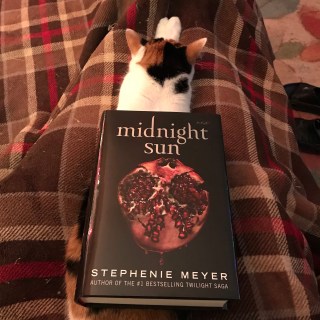
Midnight Sun & Twilight

img_7155Book: Midnight Sun by Stephenie Meyer; Twilight by Stephenie Meyer

Date Read: December 10 to 16, 2020

Rating: 4 (of 5) stars; 3 (of 5) stars

Like most everyone else who read these, I found Twilight in the middle of the hype in 2008. The series was complete, and the movie would be coming out soon. My sister, who was not a big reader, was interested in the series, and we decided to split the cost of the boxed set of books. I loved the idea of encouraging her to read, and figured that I would get around to them eventually; but when her and my mom both finished it and started to get excited for the movie release, I caved so that I could join them.

I think it goes without saying that I do not consider Twilight, or any of the remaining books, as high quality literature. I take them at face value and consider them for what they are: quick entertainment romance novels aimed at a younger demographic. As that, they succeed spectacularly. (I suppose I should note that, at the time, I was probably just on the cusp of this ideal demographic, having graduated high school a couple years before the first book was released.) Along with that, I have to give Stephenie Meyer credit with perfect timing in the release of Midnight Sun, coming long enough after the initial series that those who read the first can look back with enough nostalgia to not cringe too much.

Knowing that Midnight Sun was coming soon, and with my new habit of rereading via audio book, I decided to revisit Twilight over the summer. I like to be prepared when reading something from a series. It was definitely an interesting look back. While the story was much as I remembered, the writing was a bit worse than my memory. Bella is more irritating of a character than I recalled—although this may be somewhat biased from reading the other books. I do remember liking her more in the later books of series, so perhaps taking that development backward clouded my view. I will say, however, that the narrator for the audio book was matched well, and I do like listening to audio books written in first person.

All things considered, I think this was a better story from Edward’s perspective. Perhaps some of this is improvement in writing over time, but I also think that part of that relates to the difference in the voice of who is telling the story. Sure, Edward comes across pretty arrogant much of the time, but he is also more reflective, and, well, does not talk like a teenage girl. Being familiar with the story from Bella’s view, and the more neutral view from the movie, it was interesting to see things from the other side. There is certainly more brought in regarding the other members of the Cullen family, which makes for a richer story with a bit more depth. I particularly liked filling in the pieces toward the end of the story, when Bella is in the hospital.

The switched viewpoint also allows for more insight into the actions of Edward and several other characters, given the “talent” of mind reading that Meyer has endowed him. It was good to piece together the motivations of him and others, which also shed some new light on some of the events from the original book. Edward’s view of himself was also different that I was expecting—although he often has a superior attitude, he very truly believes himself to be something terrible and unworthy of good things. His reminders to Bella that he is “not good for her” are much deeper than the obvious consideration for her safety. Turns out, Edward’s head is a pretty dark place to be, but of course, why didn’t I see that coming?

Minka’s Thoughts: “This book is so big. Almost me-sized. Do you think it wants to play?”

Annihilation

img_7041Book: Annihilation by Jeff VanderMeer

Date Read: December 1 to 8, 2020

Rating: 3 (of 5) stars

For December, the Unread Shelf Project asks you to read the shortest book on your shelf. It’s really the perfect fit for this time of year, when everyone seems to be going just a little crazy to fit in their holiday plans along with wrapping up their goals for the year. While I am often somewhat rigid when it comes to metrics and data, I interpret this one a little loosely: anything under 200 pages counts as my shortest books. There are quite a few of them—mostly Shakespeare, as I am that person who gets the complete works of Shakespeare and then individually lists all plays as things to read (making Shakespeare both the shortest and longest books on my list!). In the end, of course, I did not go with Shakespeare: I picked this one up at one of my local independent bookshops, when I went in for a gift and had to leave with something for myself too.

Annihilation is a little outside my normal reading spectrum, as a mystery and science fiction combo. While I do enjoy both, I do not read too heavily in either genre. The story is a slow build without much direct action, but much time put into building the world of Area X. This fits with the context of the novel—it is written as a journal belonging to a biologist, who is part of an expedition to an area reported to have had experienced an “environmental disaster.” Early on, her reports suggest that there is more going on than meets the eye, although this is never quite defined.

Each member of the expedition has a different area of expertise, which they are defined by rather than named: the Psychologist, the Anthropologist, the Surveyor, and the Biologist. While they have been given general orders as a group, each seems to have their own slightly varying agenda. The expedition quickly devolves, as each of the members is impacted by their surroundings and begin to follow their own paths. The biologist’s journal paints an eerie picture of the landscape, as she tries to make sense of her surroundings and describe things that she does not seem to understand herself.

While the concept here is definitely interesting, this book left me wanting more than it was willing to give. It was an enjoyable read, although a little unsettling in places. The style allows for the reader to start piecing some things together, and there’s definitely a ton of room for speculation. However, the ending is left too open for my liking. Of course, this is the first book in a series, so there may be some of what I was looking for in the other books; though I am not sure that I am invested enough in the story to continue.

Boris’s Thoughts: “All that strange wildlife, and not cats? Ridiculous. 1 paw.”

Unread Shelf Progress for December

  • Books Read: 5
  • Books Acquired: 8
  • Total Unread Books: 271

Old MacDonald Had A Truck

img_6773Book: Old MacDonald Had A Truck by Steve Goetz

My discovery of this book came out of a bad habit: I often browse the discount section for children’s books that look interesting, and if the price seems right I will buy a few without really thoroughly looking at them. I figure these are great things to have on hand for gifts, and although I would love to personally pick out a book for every occasion, there are times when it’s nice to have something on hand. Knowing that the holidays were coming up, I grabbed this one primarily based on the title and a quick glance at the illustrations.

A few days later, I took a closer look at the books I had picked up to see what might be good fits for Christmas, and gave this one a more careful look—the next day I headed back to the bookstore to pick up another copy. At first glance, this is a play on the familiar “Old MacDonald Had a Farm” song, with most of the text following the pattern of the verses. However, rather than going through a list of animals, the song goes through all the machinery owned by Old MacDonald: an excavator, bulldozer, and many others. Rather than animal noises, each piece of machinery is paired with its function, with a dig dig here or a push push there. It’s great fun for kids interested in vehicles or machines, but also has some other interesting features.

To go along with the different vehicles included, the author occasionally makes a play on the “E-I-E-I-O” part of the song, substituting an appropriate “O” rhyme that matches the equipment. I especially enjoyed the “E-I-E-I-SLOW” to go along with the steamroller. There is also a double story here for those who give more than a cursory glance at the illustrations. As each of the machines are being introduced, we can see that Old MacDonald is working on a construction project on his farm—leading up to the appearance of the truck from the title, which happens to be a racing stunt truck ready for the course that he has built!

Minka’s Thoughts: “Old MacDonald had a… cat? ME-I-ME-I-OW. I am poet!”