Everything Is Illuminated

img_4360Book: Everything is Illuminated by Jonathan Safran Foer

Date Read: May 17 to June 9, 2020

Rating: 3 (of 5) stars

I have been sitting in front of my keyboard for several minutes thinking about how exactly I would like to start this review, but nothing quite feels right. I suppose I should say that I really wanted to like this book. In some ways I did, but it is sitting heavier with me than I was expecting. Parts of this were beautifully crafted; other parts were cleverly crafted. It all comes together into something that is sometimes tragically beautiful and sometimes irritatingly painful to read.

The premise of the story, as indicated in the back cover summary, is that this is the story of a young man who is visiting Europe, hoping to find the woman who he believes saved his grandfather from the Nazis. This is a vast oversimplification. There are actually three different stories here, told in an alternating fashion between characters: Jonathan, the young American searching for the past, writes the story of his grandfather’s town and his family’s past; Alex, the young man who served as his guide and Ukrainian translator, writes letters to Jonathan to tell of his family, also sending along his own writings about their journey.

Through each of these stories we are given glimpses into the past, both charming and horrifying. The story of Jonathan’s family ends with a chance escape, but we hear the heartbreaking fate of his town through the woman they encounter while searching for the long forgotten town. We also hear first hand the experience of Alex’s grandfather, who still felt the misfortune of the Nazi invasion despite not being one of the targeted Jewish people. His guilt in the aftermath felt a bit close to home with the current state of affairs. These two stories of the past have a somewhat listless ending. While the stories draw to a definite end, there is no satisfaction for finding their conclusion. The story of Alex’s family has a more satisfying, although still tragic, ending with Alex giving up his dreams for what he knows to be the right thing for his family.

I had a hard time getting into this book, partially because the style of some sections were difficult to read. I understand the use of the broken English for parts of the story, but I felt like it was overdone. It was an important aspect of the story for some things to be written like this, but it was often unnecessarily crude. While the structure of the novel was unique and often interesting, there was an underlying feeling that the author might be trying a bit too hard to come off as clever.

Despite my personal qualms with the style, the themes of truth, responsibility, and tragedy here are undeniable and well handled. We are faced with the responsibility of each individual in their place in history, as well as their responsibility in relaying their stories to future generations. Alex writes to Jonathan that he hates him for not allowing some happiness for his grandfather in his story. When viewing the past, is it the responsibility of the writer to tell the story exactly as it was, or perhaps how it should have been?

Boris’s Thoughts: “This is quite depressing for having such a cheerful cover. Deception. I like that. 4 paws.”

Tweak

img_4045Book: Tweak by Nic Sheff

Date Read: April 17 to 29, 2020

Rating: 3 (of 5) stars

At its heart, this is a memoir about drug addiction and recovery. There is a ton of good information and perspective here on the subject, including Sheff’s own struggle with the concept of addiction as a disease. The memoir is divided into two parts, the first beginning with a month long drug binge in San Francisco following a previous 18 month stretch of sobriety. After exhausting all options and approaching his “rock bottom” there, Sheff returns home to Los Angeles and begins working toward recovery in Part Two. Sheff shares the roller coaster of this journey through periods of sobriety and relapse, including the influence of relationships with those around him. He seems fairly introspective throughout, and is open with readers about the roots of his issues.

With that solid core to the memoir, I really wish I could have given this more stars, but there were too many places where this fell short for me. Right from the start, the writing felt disjointed, making it hard to read. Most of the first section felt like it was struggling to put out a coherent thought, with long interludes and tangents. While this may partially fit with the first section focused on his drug-addled spiral, and some of this was useful information, it was not presented well. For example, it is certainly relevant to discuss the frequent fighting between his mother and stepfather, and his recognition of the impact of childhood on his adult life; however, is it necessary to point this out every time he witnesses two people arguing or fighting?

Maybe the hardest part of this for me was that Nic is very unlikeable as a character. It is not easy to continue caring about the story of someone that is so difficult to like. He is arrogant, self-serving, and obsessed with the idea of celebrity. Some of these are pointed out to him, and while he does begin to recognize his faults, much of it continues to show in his writing throughout the book. For example, at one point a therapist points out to him that he frequently name-drops the famous people he knows, seemingly as a way to enhance his own importance. He acknowledges this as a negative quality, and talks about making efforts to stop… but then he indirectly does exactly that in his book published years later! Of course for the purpose of the memoir, names were changed in interest of maintaining anonymity of others. However, he often provides enough detail about individuals that it would not be difficult to figure out.

Boris’s Thoughts: “It’s hard for me to follow your thoughts here, since I find almost everyone unlikeable. 2 paws.”

A Wolf at the Table

img_5193Book: A Wolf at the Table by Augusten Burroughs

Date Read: July 1 to 12, 2020

Rating: 4 (of 5) stars

A Wolf at the Table was the pick for July’s Unread Shelf Project prompt: a book voted on by Bookstagram. I wanted to choose two books that had some sort of similarity, and found an interesting pair: two memoirs written by brothers. Unfortunately for John Elder Robison, his younger brother won this one, receiving 100% of the 4 votes cast. I admit that I was hoping for a slightly better voter turnout, but I suppose I will take what I can get!

This is not my first read from Augusten Burroughs, although I believe it is the first time that I have written about him here. This book has been suggested to be a sort of prequel to his more popular Running with Scissors, which primarily focuses on his teenage years, when he was living with his mother’s psychiatrist. The bulk of A Wolf at the Table is about the time before his parents’ divorce, focusing specifically on his relationship with his father while growing up in a tumultuous household.

I think the first thing that needs to be said is that this book was not what I was expecting it to be. While both A Wolf at the Table and Running with Scissors deal with some heavy subject matter at times, this book was much darker and more serious than his debut work. While there is definitely some use of humor in places, we do not get the same level of wit or whimsical absurdity that I have come to expect from Burroughs. This may sound like a criticism, but I do not intend it to be. These are very different stories, and it makes sense that they need to be told differently. I was, however, taken a bit off guard.

Through the book, we get an in depth view of the relationship between Augusten and his father—or at least the view of this relationship from the perspective of the child. For the most part, I felt that the feelings portrayed were written realistically from the child’s perspective, which I think is impressive. We all have childhood memories and feelings associated with them, but it’s difficult to explain these as an adult in the same way that we felt them when we were children. There is so much conflict expressed here: the want of affection coupled with very real fear of a man that seems to be an enigma. Throughout, Burroughs references feelings of anger toward his father, along with his worry that these feelings are manifesting to turn him into his father. The final chapters of the book jump forward into adulthood, partially addressing the impact of his early relationship with his father on later experiences.

In the back of the edition that I have, there is a list of discussion questions. Usually I glance through things like this and move on, but one question here stood out to me. Could the “wolf” of the book’s title be read as a metaphor that extends beyond the father? Can memories become more real and terrifying than the incidents or people that inspire them? Coming from the perspective of a psychologist… Yes. Absolutely. Our memories are certainly a reflection of our experiences, but how we recall those experiences is a major part of what creates our reality. I think this dovetails nicely with one thing that always comes up in discussions of memoirs: accuracy.

This is a memoir written in the form of a novel; there are many conversations included, many of them occurring when the author was quite young. There are many places where he presumes the emotion in others. How much truth is there really in the details? To that, I would pose a counter question: How much does that matter? Regardless of the individual details, there are certain overarching patterns in behavior, clearly marking our subject as a victim of some type of abuse. If this is an accurate reflection of his memory, is the accuracy of each individual word important?

Boris’s Thoughts: “I do not like that man’s relationship with animals. Can I give no paws?”

Unread Shelf Progress for July

  • Books Read: 2
  • Books Acquired: 1
  • Total Unread Books: 260

Bookish Things – Poe and Goals

When I decided to revamp my blog at the beginning of the year, I planned to include a few “bonus posts” for the months that had a fifth Wednesday. I started with some information on the Unread Shelf Project in February, and July turned out to be the next month with an extra week! I have put much thought into the types of things that I would share in these posts, and came up with a list of ideas that still need a bit of fleshing out. To start though, I thought I would share something fun and bookish that relates to some personal goals that I have made.

61602902298__8409ccd0-edb3-4c86-8fe5-87a9d4d4f6b4It won’t shock anyone to hear that in addition to my extensive collection of books, I have accumulated many bookish things. I think it is a natural consequence of people knowing that you are a reader, along with my lack of self-control when it comes to all things books. I mean, how else would I have a to read list topping 250 books on my shelves? (Truthfully, I am a person who likes accumulating “stuff”—but I make exceptions for things that speak to my heart.) The latest addition to my bookish belongings is an Edgar Allan Poe t-shirt, pictured here.
I know I have mentioned a love for Poe here at least once, although I am not sure that it shows quite as heavily as it may in real life. He is one of the few authors I have read in entirety, and I find him and his work quite fascinating. When I saw I have a collection of bookish belongings, I actually have two collections: bookish things, and Poe-ish things. It helps, I suppose, that unrelated to Poe, I also very much enjoy ravens. So I suppose it should come as no surprise that when I saw this Out of Print Poe shirt I felt it needed to come home with me. Bonus points that it is reminiscent of the style of Andy Warhol (and on sale!).

Since I found this at a bookstore, I did not have the opportunity to try it on. I made a guess in size, and took it home. Unfortunately, it is a bit small. Now, here is where I am going to digress a bit. When I say that I guessed on the size, that’s partially because I chose the size that I am accustomed to, not the size that I probably need. I do not always maintain the healthiest of habits, and sometimes this catches up to me. I find my favorite clothes do not fit quite how I would like them to anymore, and I generally feel a bit off. I can admit that the quarantine of the last few months has not been great for this. I have been taking more walks, but I have not been eating as well. I usually strive for balance as much as possible, but lately I have been living more at the extremes, claiming to myself that it’s okay as long as I go extreme in both directions sometimes. Spoiler alert: it’s not. I end up with the negative consequences on both ends of the spectrum, without any of the positives.

So to wrap things up, I want to put this out there as something to help keep me more accountable to myself: this shirt is now my “goal” shirt. I am not on some crazy weight loss mission; to be honest, I do not really think it’s healthy for weight loss to be the sole goal of any dietary/exercising changes. My hope is to return myself to a place where I feel more balanced mentally and physically; and where I can go show off this awesome shirt!

Where The Wild Things Are

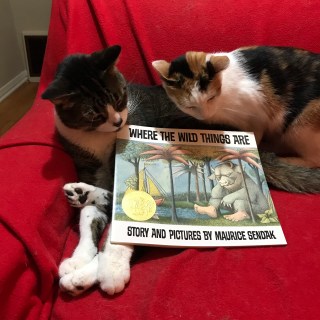
img_5145Book: Where The Wild Things Are by Maurice Sendak

When it comes to sharing children’s books, I often browse the shelves of the school library which is obviously much more extensive than my personal collection. However, with the abrupt end to in-person school this spring, I am forced to turn to my own shelves for the time being. Many of the picture books that I have in my collection are those that I consider classics—this one included.

I cannot say for sure when I first encountered this particular book, but it was definitely one of my favorites in childhood. Long before I was able to read any of the words, I would page through the book to look at the pictures of the wild things, especially the scenes of the wild rumpus! Even as an adult, I am fascinated by Sendak’s use of pictures and words to tell the story. The sparse, carefully chosen words combined with the vibrant pictures are uniquely engaging. This is a fun read aloud, and perfect to inspire a love a books.

While I certainly remember the basic stories of many of my childhood favorites, it’s always interesting to me to revisit these from a new perspective. Of course Max’s story of sailing away on a private boat to where the wild things are is enthralling for children. Who would not want to rule over the wild things and declare a wild rumpus? Digging a little deeper into the story, it’s possible to pull out a tale that is just as relatable for children: Everyone is wild sometimes. That is okay, but sometimes comes with consequences. When our wildness has run its course, we will be homesick for things familiar. Even though Max’s mother needed to punish him for his mischief, she is still there to take care of him.

Boris’s Thoughts: “Are you trying to imply something with this book choice? Only one of us is wild. 1 paw.”

Minka’s Thoughts: “It’s me! I’m the wild thing! 4 paws!”

The Tattooist of Auschwitz

img_3982Book: The Tattooist of Auschwitz by Heather Morris
Date Read: April 8 to 16, 2020

Rating: 5 (of 5) stars

I have seen this book all over Bookstagram for the last few months, so when I saw it in a small bookshop I decided that I needed to give it a try. I feel like this is a little outside my normal reading realm, as I am not usually a historical fiction reader. (I know this is based on a true story, but as it is not purported to be a fully accurate factual account of events, I think it should still be considered a work of fiction.) I wish I could give a good reason for my tendency to steer away from historical fiction, but I cannot quite put my finger on it. I suppose this genre just does not seem to jump out to me in the same way that others do.

That all said, I quickly found myself totally engrossed in this story. The cover declares it to be a story of “love and survival,” although I feel like those two descriptors should be reversed. No doubt this is a love story that will satisfy any romantics out there, but I personally found the survival aspects of the more intriguing. Both Lale and Gita must fight for their survival, constantly walking the line of making life bearable and endangering themselves and others.

An interesting aspect of the story is the fear associated with their positions—Lale as the Tätowierer and Gita simply as a person put to work. Despite their treatment as prisoners, they are at risk for being labeled as conspirators against their own people. Lale is reluctant to become the Tätowierer, but rationalizes this with his own survival, and the thought that he can at least try to treat new prisoners humanely as he does his work. It is an interesting perspective on difficult choices: is it realistic to think that they would refuse to work when the other option is death? Although not quite overtly stated, the guilt associated with his assigned work is the driving force in his dangerous efforts to help others in the camp.

I suppose I would be remiss to completely disregard the love story aspect of the novel, since I imagine that is what held the appeal for many readers. Of course, I cannot blame them—it is beautiful as a love story as well. While I always give an internal eye roll at the “love at first sight” trope, this definitely goes beyond that in its depth. Lale and Gita find themselves in a harrowing time and situation, forcing their relationship to develop in a nontraditional manner. There are countless obstacles at hand to separate them, and so much uncertainty in their lives that this bit of happiness seemed a saving grace for them both. The relationship was certainly against the odds—both in surviving the camps, and then locating each other afterwards when they were forced to flee independently.

Minka’s Thoughts: “Hmmm. This is different. I like it! 3 paws.”

Notes from a Public Typewriter

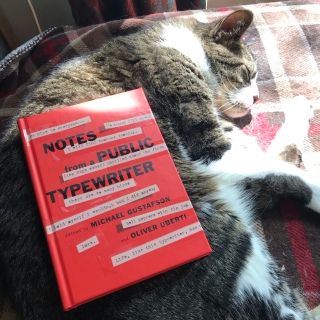
img_4522Book: Notes from a Public Typewriter by Michael Gustafson

Date Read: March 30 to April 1, 2020

Rating: 4 (of 5) stars

A few years ago, a group of Michigan independent bookstores came together for a project that I immediately fell in love with: the Michigan Booksellers tote, which featured a map of the state on one side and a list of bookstores on the other. The tote could be used for a 10% discount on books on your first visit to each of the stores, and seemed like a fun adventure. I am not sure if I was more excited for the excuse to travel to see each of the stores, or the excuse to add more books to my collection. Along the way, I decided that in addition to picking up any books I might be looking for at the time, I would also buy a staff recommended book from each of the stores as a sort of souvenir of my bookish traveling.

Along this journey, I stopped in the Literati bookstore in Ann Arbor at the beginning of March when I was there for work. As luck would have it, rather than a staff selected book, this bookstore had a book of its own! A fun and unique feature of Literati is the public typewriter in its basement. Over the years, the owners of the bookstore (Michael and Hilary Gustafson) have collected the notes left by their community, many of which were compiled to create this endearing book. The public notes are divided into several sections introduced by the storeowner, which serve to tell the story of the bookstore and the community that it serves.

I am so happy that I found it when I did. As I said, I bought this in early March, and then read it right at the end of the month—a little more than 2 weeks in to the quarantine in my state. This book highlights the unique connections that we have to those in our community, even when we do not know the individuals directly. I could not help but feel a little spark of magic and connectedness in a time when I really needed to experience that.

I’m sure some of this was influenced by the fact that Ann Arbor holds a bit of nostalgia for me. I grew up not far from there, and spent a fair amount of time in the city when I was in high school and college. The city is full of interesting sights, and a trip there was never complete with a stop at my favorite Borders Books. In his narrative pieces, Gustafson talks about the now defunct Borders, mentioning that Literati repurposed some of their original shelving. Although I was only there for a short time, I fell a little bit in love with Literati when I visited, and this book will hold a lovely piece of that on my shelves at home.

Boris’s Thoughts: “You feel good? I feel good. 4 paws.”

The Da Vinci Code

img_4905Book: The Da Vinci Code by Dan Brown

Date Read: June 9 to 30, 2020

Rating: 4 (of 5) stars

I admit that I am a little behind with this one. I was intrigued by the controversy when the movie came out, but that was when I was in college and not quite ready to commit to do a ton of extra reading for pleasure. So I saw the movie, and mentally shelved the book as to read. Fast forward a few years, I’m browsing deals on kindle books, and there it is: this book that I have been intending to read. Serendipity! I added it to my kindle shelf and continued to browse. That was almost 10 years ago now, and I am just now getting around to it, thanks to the June prompt from the Unread Shelf Project which told me to pick a book from a series.

Now here’s the thing: I do not own a ton of series books, and most of the ones I do own, I have already read. Despite my very lengthy to read list, I only had a couple to choose from; and I argued with myself about which of them should actually “count.” Does it still count as reading a book in a series if you have no intention of reading any of the other books in the series? Well… ultimately, with the coaxing of a friend, I decided yes. She insisted that the book was worth it, and that it worked as a standalone if I chose not to continue with the other books… and that I did not have to read the book that actually comes before it. Then she offered to lend me the rest of the series if needed. So here I am.

After all that went in to the decision to read this one, I am coming in right at the last moment to finish this within the month of June. I really feel there is no good excuse for that, since although this book is a bit lengthy, it is a relatively quick and easy read. While I will say that overall I enjoyed this read, I do find myself a bit conflicted. It’s obvious that this is written for mass appeal, and meant to be a fast paced page-turner. There are some aspects of this that feel meticulously researched; at the same time, I feel like we are getting a very surface level understanding of something that is part truth and part conspiracy theory. I enjoyed the idea of a scavenger hunt for the Holy Grail, and the concept behind the grail being Mary Magdalene. The ideas are definitely interesting, and some pieces potentially plausible, but the idea of taking this as fact is a bit far fetched.

There was one major issue here for me though: for being a novel purported to be about the sacred feminine, it is pretty anti-feminist. I imagine that much of this relates to the fact that it is a book in a series with a male protagonist, who needs to come through as the “star” of the show. At the same time, I felt myself quite frustrated with the treatment of Sophie’s character. Most obviously, Sophie is professional code breaker, and yet she needs the help of Langdon to figure out the most basic of codes left for her by her grandfather? Seems a little ridiculous. Throughout the novel, she’s primarily used as a plot device to allow for lengthy historical explanations. She could have been so much more.

As for the remainder of the series, I think I’m going to pass. I am not crazy about the trope of the brilliant leading man who continuously finds himself involved in conundrums where he is required to solve mysteries with a new beautiful woman who is obviously attracted to him. Does that seem oddly specific? Perhaps. I have no doubt that the remaining books in the series are entertaining—but I think that I will find my reading time used better elsewhere.

Minka’s Thoughts: “Are you sure this is a book? It doesn’t look like a book. It doesn’t taste like a book. Do I give paws if it’s not a book?”

Unread Shelf Progress for June

  • Books Read: 2
  • Books Acquired: 9 books, 1 found not previously counted
  • Total Unread Books: 262 books

Gift Horse

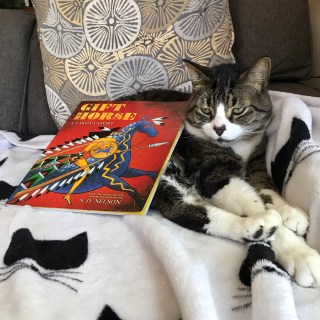
img_4872Book: Gift Horse: A Lakota Story by S. D. Nelson
If you have been following along with me for a while, you may remember that I have been making a habit of picking up books during my travels as souvenirs. I am working on collections for each state and country that I have visited. While I usually select novels, I could not pass up including a picture book this time as well. The newest addition to my picture book collection is a book that I picked up at the Wall Drug Store on a recent trip to South Dakota.

Gift Horse tells the story of a young Lakota boy’s journey to manhood, beginning with a horse that is given to him by his father. This coming of age story centers on Flying Cloud, a name given to the boy because of the cloud of dust kicked up behind his horse as he ran across the prairies. Flying Cloud tells about the rites of passage along the way to becoming a Lakota warrior, including many of the traditions and rituals that are important in the culture of the Lakota people.

Although a bit text heavy for young children, the pictures are striking and the story interesting. It provides a view into Lakota culture and explains the tribe’s relationship with nature in a way that is understandable for children. For example, he talks of hunting and thanking the buffalo for providing food and warm clothes, but also includes a tale devising a clever plan to collect the quills from a porcupine because he does not need to kill the animal to get what he needs. At the end of the book, the author includes some additional learning information to go along with the story.

Boris’s Thoughts: “Nice pictures, lots of animals. I approve. 4 paws.”

Penguins and Other Seabirds

img_3709Book: Penguins and Other Seabirds by Matt Sewell

Date Read: March 23 to 24, 2020

Rating: 4 (of 5) stars

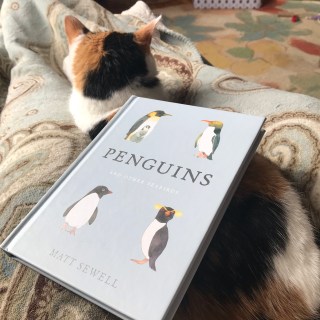
If you have been around Books On My Cat awhile, you may have noticed my affinity for penguins (especially when it comes to children’s literature). While this does not quite follow in that line, this charming little book would be a delight for penguin aficionado. It caught my eye in the discount section of a new bookstore I visited some time back, and I decided that it definitely needed a good home.

I read through this one quickly, as it is not really written to be a lengthy endeavor. It would make a nice “coffee table book”—something to set out and peruse at your leisure. The book is informational, but written much more casually than any sort of text or nature guide. There is a relatively short blurb for each bird, accompanied by a watercolor drawing. I definitely found the information shared to be interesting, but really enjoyed each of the drawings. They were well done and, well, delightful. Each was a simple and straightforward portrayal, although still managing to include a good amount of detail.

I would also like to share a laughable moment that I had while reading. As I mentioned, I thought the drawings were well done, and took note of several throughout. Midway through the book, I was a bit discouraged to find one that did not seem to be done so well: the Crested Auklet. It looked a bit like a cartoon character, with the beak bent into a sort of smile and eyes that seemed much too simplified. I decided that I needed to check out the actual bird for comparison, and to my surprise, the drawing had been spot on!

Minka’s Thoughts: “Do you think penguins would want to play with me? Maybe the hopper ones? Can we hop together? 4 paws if we can play!”