Something Wicked This Way Comes

img_5193Book: Something Wicked This Way Comes by Ray Bradbury

Dates Read: September 18 to October 5, 2017

Rating: 5 (of 5) stars

As I often do, I am finding it difficult to put in to words what it is that made this book great to me. Alas, here I am, trying to put it into words anyway.

The general theme of the story is fairly straightforward– good versus evil. The “good guys” and the “bad guys” are laid out pretty clearly, and there’s a clear winner of the battle. However, to consider this book only in those terms would be a gross oversimplification. While it may be built around a simple frame, there is something beautiful in the words that truly build this story.

Bradbury perfectly captures all of the wonder and magic of the fall season, and his style here fits with that beautifully. I have read Bradbury before, but never noticed the beauty in his writing. The Halloween carnival is the perfect setting, and I felt there was just enough mystery and intrigue for my liking. This is horror, but not overt, in-your-face horror. It’s more of a lurking, sinister horror, where you never know what may lay around the next corner– not quite waiting for the killer to jump out and grab you, but wondering what trap may have been set for you to stumble upon.

Boris’s thoughts: “I don’t know about all this creepiness, real life is scary enough! As long as you will keep me safe, I give it 3 paws.”

The Boy of a Thousand Faces

img_8077Book: The Boy of a Thousand Faces by Brian Selznick

At 48 pages, this is not quite a children’s picture book, but not quite a novel either. Something in between: perhaps a children’s novella? I am a big fan of Brian Selznik. I love the style of his novels and the way he combines words with illustrations to tell a story. This is a little different than his longer works, in that he uses the pictures to supplement this story rather than to continue driving the plot. However, the pictures are no less essential here than in his novels.

Being born on Halloween, it is no surprise that Alonzo has a fascination with monsters. His love is fueled by the late-night horror film show hosted by Mr. Shadow, where he discovers the greatness of Lon Cheney. Alonzo is inspired by the films, which turns into a dream to become the “boy of a thousand faces.” I love that his character has a dream that is outside of what might be considered normal. Alonzo goes beyond “I want to be a movie star” to actually working on and creating something new. His goal is not to be famous, but in the creation of something to be enjoyed by others.

The reciprocal relationship between Alonzo and Mr. Shadow is interesting as well. Alonzo is inspired by Mr. Shadow and his show, reaching out to him when he is beginning to feel disillusioned with his dream. At the same time, Mr. Shadow believed that nobody was interested when his show ended, but was inspired by Alonzo to “bring back” something that he loved in a new way.

I love this as a tribute to traditional horror films, special effects, and Lon Cheney. I think it is also a great introduction to the horror genre. It is a bit creepy, but not something that would truly scare most children. It’s perfect for kids who might have an interest in things that are a bit dark seeming, that might seem a little weird to others.

Boris’s thoughts: “Hmmm… dark and weird… I approve. 3 paws.”

The Witches of Eastwick

img_5282Book: The Witches of Eastwick by John Updike

Date Read: October 6 to November 12, 2017

Rating: 2 (of 5) stars

Although October is my favorite month, I am going to start it off with something a bit untraditional for me: a review of a book that I did not like! Prior to reading this, I had heard many mixed opinions on Updike. Most were negative. There are a few people out there, however, who think he is a genius. His characters are so “real.”

Let me start by saying I had some fairly high hopes for this book. Three small town witches, mysterious rich man, scandal. Sounds like so much potential! Unfortunately, my high hopes did not last long. Apparently, what people mean by saying his characters are “real,” is that they are “flawed.” This is definitely true. To a fault. There is not a single character in this novel that I liked. I could not find a single slightly redeeming quality in any of the witches. They were selfish, petty, and generally horrible people. Even their “loyalty” to their coven was so easily cracked with the introduction of a man. These are supposed to be “real women?” Seems more like a parody of every negative quality that you think a woman could possess.

Then there is a power of the witches, which is linked so heavily to their sexuality. This I can understand to an extent– there is a power in a woman’s sexuality, and this would be especially poignant in the era in which the book is set. However, this seems to be the only power that the witches have. A witch whose power is inextricably linked to her sleeping with other women’s husbands? Seems pretty lame to me.

I found the plot to be a bit lackluster as well. There were a few interesting moments, but for the most part, it seemed mediocre. The witches do some questionable things, introduction of mysterious man that seems good at first but ultimately leads to discontent among them, discontent leads to revenge, leads to more questionable things, we get a little hint of some possible remorse, but then ending with indifference. Nothing in the plot of the novel seemed to matter to anyone in the end. Perhaps this is supposed to be some deeper level of social commentary, but it comes off as rather dull.

I will give the novel as a whole a few redeeming points, which is why I gave this 2 stars instead of 1. I did enjoy the style of the writing, and many of the descriptions. This is part of what helped push me through the novel, although also gave me a false hope that it would get better as I read. There was also a single scene, so to speak, that stood out to me. When Alexandra first meets Darryl, he “traps” her on the island with the incoming tide. She realizes that this was in intent, and chooses to exert some power over him by leaving anyway– standing tall and turning her back to him, even though it should have been something that embarrassed her.

Boris’s thoughts: “What kind of real witch has a dog as a familiar? Where are the cats? 1 paw.”
The Little Prince

img_6395Book: The Little Prince by Antoine de Saint-Exupéry
Date Read: June 10 to June 12, 2018

Rating: 5 (of 5) stars

I am a little bit ashamed to admit that it took me until 2018 to read this book. I really loved this book, but I also have some mixed feelings about this book. I’m going to admit up front that I’m not sure this is going to count as a traditional book review– more of my own semi-rambling thoughts. Although, I suppose that is at least somewhat appropriate for such a well known story.

The Little Prince is a book about what a pain adults can be, written by an adult for children, but maybe actually for the adults that are reading the book to children. Did I lose anyone there? Understandable.

I suppose what I’m getting at here, is that I cannot quite decide who the intended audience actually is for this book. Certainly it is written as a children’s book, but there is so much that I feel is intended for adults. These things, of course, are good reminders. We are kind of a pain– especially from the perspective of children. We are so often wrapped up in our own thoughts, our own things to do, our own “matters of consequence.” At the same time, I think there are plenty of themes in there for children as well– responsibility, relationships, recognizing that our actions are part of what gives the things around us value. Perhaps these are themes for children that are also areas where adults may need some reminders?

Honestly, I could probably type for days without ever feeling that I have done this book justice. It is sad, but it is sweet. If you’ve debated reading it, I would suggest that you stop putting it off. It is a fast, easy read–the only reason I did not finish it in a day is laziness and silly adult responsibilities. Even if you do not love it, it is a book that I feel undoubtedly is worth the read.

Boris’s thoughts: “I think this counts as a snuggle-time book. 4 paws.”

Miss Smith’s Incredible Storybook

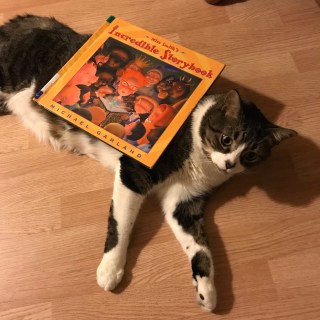
img_7899Book: Miss Smith’s Incredible Storybook by Michael Garland
This book is a fairly recent discovery for me, within the last few years. I saw it for the first time when it arrived as a new book in our school library. It’s a fun story, and the illustrations are awesome. This one is a bit higher reading level than many of the other children’s books that I have posted, but makes a great read aloud across elementary grades.

It begins, unfortunately, how many stories begin: with a student bored at school. However, then enters the new teacher: Miss Smith, with her spiky red hair, leather jacket, and wild dresses. The day goes on as expected, until story time, when Miss Smith takes out her storybook, which has the power to truly bring stories to life. As a total book nerd and a psychologist, I love this: the teacher who can make reading interesting and come alive… but in this case, by actually making the storybook characters come alive. Suddenly school is interesting! Who wouldn’t want to come to school every day to be pulled into a new an exciting world? Of course, at some point, this all has to go terribly wrong. Things go awry when the principal steps in, resulting in storybook characters escaping and wreaking havoc until Miss Smith returns to save the day.

This is the first of a few stories featuring Miss Smith and her storybook. All follow a similar theme: stories coming to life, with varying adventures and interactions with known and not-so-known fictional characters. One of the things I appreciate in these books is the detail in the illustrations. Unlike some recurring children’s characters, Miss Smith and her students are not always wearing the same clothes, and things vary from day to day. I also love the relatively small detail of the buttons that Miss Smith wears on her jacket– in this first book, she has a button for The Clash, but this changes in the other stories. While it seems like a minor thing, I love when there are small things like that to look for in a book.

Boris’s Thoughts: “Short and fun? I suppose I can get behind that. 4 paws.”

Aristotle and Dante Discover the Secrets of the Universe

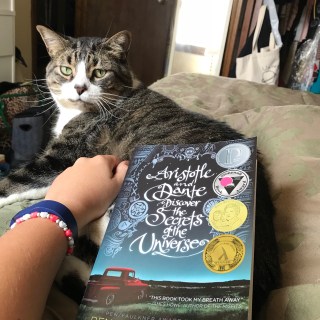
img_7411Book: Aristotle and Dante Discover the Secrets of the Universe by Benjamin Alire Sáenz
Date Read: July 12 to July 16, 2018

Rating: 5 (of 5) stars

Love, love, love this book. It’s a cute and sweet book, and a not-quite-love story, but also so much more than that. I suppose it could be best described as a sort of coming of age story, but that does not quite encompass the full scope either.

I really enjoyed the cultural aspects of growing up for both Ari and Dante, framing each of their experiences differently (and from a different perspective than my own). Dante is quite clear in conveying that he does not feel like he is a “real Mexican,” but is also clearly worried about not living up to his parents expectations. Ari’s narration of the story is interesting in that he can be quite introspective, but also quite clueless regarding his own thoughts and actions.

The dynamics within each of the families is another intriguing layer. Ari is fairly straightforward about feeling that his family is “broken.” He struggles to relate to his father, wants to talk about his brother but feels like he can’t, and seems to be a bit resistant in his relationship with his mother. He sees Dante’s family as completely different– they seem open, close, get along, and Dante freely admits that he is “crazy about” his parents. Of course, this is all from the perspective of a teenager, so perhaps Ari is not the most reliable. This plays out with a bit of a switch in the end, with a surprise for Dante’s parents, and the realization for Ari that his parents know him better than he thought.

Of course, all of this is outside the main story of Aristotle and Dante. I loved getting to know each of these characters. There are no illusions of perfection, just some messy and honest reality of adolescence. I found myself jotting down several quotes or passages as I read, partially because I felt they were so fitting for the time of life for these characters, but also because I can still relate to those feelings now. Definitely keeping this one around for future reads.

Boris’s thoughts: “Yeah, yeah, I can see why you like it. But really, why did Ari have to get a DOG? 3 paws.”

Adventures of Huckleberry Finn

Book: The Adventures of Huckleberry Finn by Mark Twain

Date Read: August 14 to September 10, 2017img_5077

Rating: 4 (of 5) stars

This is one of several books that I have placed in the category of “I can’t believe nobody made me read this before I was an adult.” I know that I had wonderful and well meaning English teachers throughout my time in school, and many of them probably assumed that another teacher would have us students read the classics at some point, but somehow I missed out on several books such as this. Alas, I somehow escape high school without ever opening a book by Mark Twain, Charles Dickens, or myriad others that are considered the “books everyone has read” (or, perhaps, read just enough of to pass the class). Turns out, I actually quite like reading books typically labeled as “classics.” Admittedly, I probably have not read as many as I should. I digress.

I did feel a bit at a disadvantage for not reading Tom Sawyer first. I realize that this is not exactly a sequel to the other book, but felt there was a bit of lacking of background that I may have gotten from the other book. However, that did not stop me from enjoying this one. I enjoyed the series of adventures, strung together into a plot, but often possible to consider as independent storylines. I appreciated getting a glimpse of Tom Sawyer as a character in the end, although I admit that I liked Huck Finn better as a character. He is presented very much in the context of his “white trash upbringing,” but is smart and often thoughtful in spite of it.

The writing in period/southern dialect took a bit of getting used to, but was not a huge challenge to read. Of course, everyone reviewing this book must address the frequent use of the “n word.” Yes, it’s there. Personally, I can get past this considering the time and context– we are talking about a book that was set and published in the 1800s. I actually found it to have aged better than other publications from the time period.

Boris’s thoughts: “Classics? Are those the kinds of books that make you sit on the couch for a long time at night? I like those too. 4 paws.”

The Year of Goodbyes

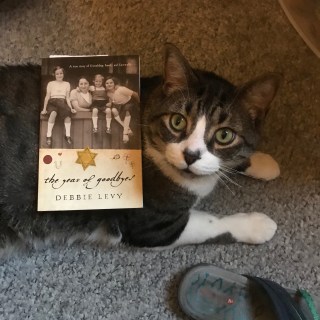
img_7713Book: The Year of Goodbyes by Debbie Levy

Date Read: July 7, 2018

Rating: 4 (of 5) stars

Following the World War II theme from last week, I have a book with a very different feel. Debbie Levy presents this book based off of her mother’s posiealbum from 1938. It is an autograph book, filled with poems written by her friends. These poems provide the framework for a series of journal entries and reflections that string together the events of the year, from the perspective of the 12 year old author.

It was an interesting read, although a bit unsettling. The book shows the gradual change from normal life to the fear and uncertainty that lead Jutta’s family to flee Germany. Goodbyes from friends leaving, or in some cases disappearing without explanation. I suppose the gradualness of the change, people slowly losing their friends, family, and rights, is what is most unsettling, knowing what comes next. While there is definitely an emotional element in the book, it seems stronger in retrospect, realizing the history of what happened just after the year of the posiealbum.

I can see this being a good book as an introduction to the history of World War II for kids in upper elementary, middle school, and perhaps high school. Much of the content is taken from the perspective of someone in that age range, and there are certainly many possible discussion topics. The poetry is an interesting element, although admittedly not really my personal cup of tea.

Boris’s thoughts: “Short and sweet and lighter than your hardcovers. 4 paws.”

Mother Night

Book: Mother Night by Kurt Vonnegut

Date Read: July 4 to July 11, 2018img_7558

Rating: 5 (of 5) stars

I feel that I need to preface this with a warning: I love Vonnegut. I realize that his writing is not for everyone, but I have thoroughly enjoyed all of his works that I have read. I recently read something online that described Vonnegut as the “ultimate cynic and ultimate humanist,” which I think is the perfect embodiment of my feelings as well. Vonnegut is satire and black humor, but with an undercurrent of pure, imperfect humanity.

While not his most popular or well known novel, Mother Night is perhaps the ultimate example of that dichotomy. Howard W. Campbell Jr. tells the complicated story of his involvement in the war: he was a Nazi, but secretly working on the side of the Americans. In order to be a good spy, he had to be a good Nazi. And so, of course, most of the world knew him only as the prominent Nazi that he became. After the war, he is saved from execution by his double-agency, and slowly fades into obscurity. The past, however, has a way of coming back around. I do not want to give away anything further to the conclusion, but will say that I did not quite expect it to end as it did, although in retrospect I wonder if I should have.

In the introduction of the novel, Vonnegut tells the reader the moral of the story: “We are what we pretend to be, so we must be careful about what we pretend to be.” It’s laid out pretty clearly throughout the novel, so I do not intend to dwell there. The element I found more interesting was Campbell’s musings on why he was so successful: “this is a hard world to be ludicrous in, with so many human beings so reluctant to laugh, so incapable of thought, so eager to believe and snarl and hate.” It is something that resonates, although it does not quite sit well with me that it does. So it goes.

Boris’s thoughts: “Funny. Sad. Funny. Sad. You humans are odd. 2 paws.”

Elephant and Piggie

img_7573Book: Today I Will Fly by Mo Willems (Elephant and Piggie Series)

It feels a bit like cheating to have two children’s books from the same author in short succession. But this is my blog, and I make the rules, so I am going to do it anyway.

Piggie is a free spirit. She has an imagination and likes an adventure. Elephant Gerald is more practical, and a bit more cautious. He doesn’t see the world in quite the way that Piggie does, but they are still best friends.

These books are super fun, and great for beginning readers. They are set up in a comic book like style, relying on pictures and speech bubbles to tell the story. There are many Elephant and Piggie books, and I have not come close to reading them all. However, I enjoyed all those that I have come across. Many of them have a theme of friendship or lesson to learn, but there are also some that are simply fun. In some, the characters speak not just to each other, but also directly to the reader.

The book pictured, Today I Will Fly, was the first of these published. Piggie has decided that she is going to fly. Gerald, of course, knows that pigs cannot fly. Ridiculous! So Piggie knows she is going to need some help. I read this book to a classroom for First and Second Grade students this spring as part of our Reading Month celebration. The kids went wild for it.

Boris’s thoughts: “At least this one did not come with that creepy mascot thing. 4 paws.”