The Year of Goodbyes

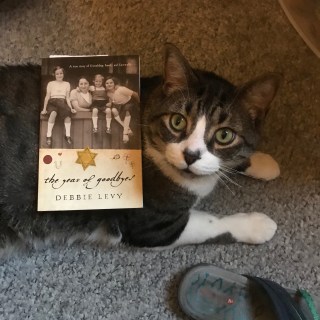
img_7713Book: The Year of Goodbyes by Debbie Levy

Date Read: July 7, 2018

Rating: 4 (of 5) stars

Following the World War II theme from last week, I have a book with a very different feel. Debbie Levy presents this book based off of her mother’s posiealbum from 1938. It is an autograph book, filled with poems written by her friends. These poems provide the framework for a series of journal entries and reflections that string together the events of the year, from the perspective of the 12 year old author.

It was an interesting read, although a bit unsettling. The book shows the gradual change from normal life to the fear and uncertainty that lead Jutta’s family to flee Germany. Goodbyes from friends leaving, or in some cases disappearing without explanation. I suppose the gradualness of the change, people slowly losing their friends, family, and rights, is what is most unsettling, knowing what comes next. While there is definitely an emotional element in the book, it seems stronger in retrospect, realizing the history of what happened just after the year of the posiealbum.

I can see this being a good book as an introduction to the history of World War II for kids in upper elementary, middle school, and perhaps high school. Much of the content is taken from the perspective of someone in that age range, and there are certainly many possible discussion topics. The poetry is an interesting element, although admittedly not really my personal cup of tea.

Boris’s thoughts: “Short and sweet and lighter than your hardcovers. 4 paws.”

Mother Night

Book: Mother Night by Kurt Vonnegut

Date Read: July 4 to July 11, 2018img_7558

Rating: 5 (of 5) stars

I feel that I need to preface this with a warning: I love Vonnegut. I realize that his writing is not for everyone, but I have thoroughly enjoyed all of his works that I have read. I recently read something online that described Vonnegut as the “ultimate cynic and ultimate humanist,” which I think is the perfect embodiment of my feelings as well. Vonnegut is satire and black humor, but with an undercurrent of pure, imperfect humanity.

While not his most popular or well known novel, Mother Night is perhaps the ultimate example of that dichotomy. Howard W. Campbell Jr. tells the complicated story of his involvement in the war: he was a Nazi, but secretly working on the side of the Americans. In order to be a good spy, he had to be a good Nazi. And so, of course, most of the world knew him only as the prominent Nazi that he became. After the war, he is saved from execution by his double-agency, and slowly fades into obscurity. The past, however, has a way of coming back around. I do not want to give away anything further to the conclusion, but will say that I did not quite expect it to end as it did, although in retrospect I wonder if I should have.

In the introduction of the novel, Vonnegut tells the reader the moral of the story: “We are what we pretend to be, so we must be careful about what we pretend to be.” It’s laid out pretty clearly throughout the novel, so I do not intend to dwell there. The element I found more interesting was Campbell’s musings on why he was so successful: “this is a hard world to be ludicrous in, with so many human beings so reluctant to laugh, so incapable of thought, so eager to believe and snarl and hate.” It is something that resonates, although it does not quite sit well with me that it does. So it goes.

Boris’s thoughts: “Funny. Sad. Funny. Sad. You humans are odd. 2 paws.”

Elephant and Piggie

img_7573Book: Today I Will Fly by Mo Willems (Elephant and Piggie Series)

It feels a bit like cheating to have two children’s books from the same author in short succession. But this is my blog, and I make the rules, so I am going to do it anyway.

Piggie is a free spirit. She has an imagination and likes an adventure. Elephant Gerald is more practical, and a bit more cautious. He doesn’t see the world in quite the way that Piggie does, but they are still best friends.

These books are super fun, and great for beginning readers. They are set up in a comic book like style, relying on pictures and speech bubbles to tell the story. There are many Elephant and Piggie books, and I have not come close to reading them all. However, I enjoyed all those that I have come across. Many of them have a theme of friendship or lesson to learn, but there are also some that are simply fun. In some, the characters speak not just to each other, but also directly to the reader.

The book pictured, Today I Will Fly, was the first of these published. Piggie has decided that she is going to fly. Gerald, of course, knows that pigs cannot fly. Ridiculous! So Piggie knows she is going to need some help. I read this book to a classroom for First and Second Grade students this spring as part of our Reading Month celebration. The kids went wild for it.

Boris’s thoughts: “At least this one did not come with that creepy mascot thing. 4 paws.”

The Giver

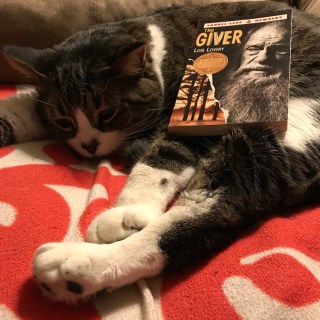
Book: The Giver by Lois Lowry

Date Read: Variousimg_5854

Rating: 5 (of 5) stars

I can say without a doubt that there is no book that I have read as many times as The Giver. There is something about this book that brings me back, again and again. Despite that, this is a somewhat difficult post for me to write. I love this book, but I have a hard time putting my finger on what exactly it is that draws me in. I do not quite have the words to describe the feelings I have when reading it. On one of my re-reads of this book, I decided to keep a highlighter and pen nearby. Mark it up. Write it out. Really dig down into what it was about this book that has me so enthralled. I finished it without making a single mark in the book. I could not find a passage, or even a sentence, that captured the heart of this story.

My first encounter with this book was in middle school. I read it again for a project in high school. I read it a third time when my younger sister had to read it in high school. Shortly after that, I finally bought my own copy. Since then, I have re-read it every year or two. My most recent read was just this summer, where I for a second time did much of my reading with a notebook by my side. I still do not feel fully satisfied that I am writing a review that will truly capture what I have to say, but I will try.

The world that Lowry builds is sparse. We get a basic description of the things that can be found in the community, but little else. Very few details, not really enough to paint a clear picture.This is true not just for the setting, but also the characters of the novel. With an exception for the main characters, we do not get much depth. While I can see why some readers would find this annoying, I think it fits perfectly with the story. The world Jonas lives in is based on Sameness– those details that we are looking for are not important. I think that is part of the beauty of this book. There is a simplicity.

But then we add complexity. As Jonas learns of the world of the past, we get glimpses of the path that lead society to this state. While the general idea we get of the world is dystopian (perhaps disguised as a Utopia), the progression is seemingly logical to a point. No hunger? No war? Certainly, a world with more security would sound appealing to many. I suppose the question becomes where the line gets drawn between safety and freedom. Is it necessary to take away all freedoms to create the order needed to eliminate these problems? Does the ability to choose the color of your clothing really impact the world on a larger scale? Maybe. Is a world without pain worth giving up those things needed to create it? I suppose this comes down to the dichotomy of life– if we eliminate the risk of pain, is there a possibility for true pleasure? Which of those is the real purpose of living? To get through life unscathed, or to collect the bumps, bruises, and scars that lead to happiness? Obviously, I do not have answers to any of these, nor would I even attempt it.

Finally, of course, is the ambiguous ending. I feel somewhat differently about this each time that I read it. When I first read the book, I did not feel the ending to be ambiguous. I made my interpretation as I read, and that was good enough for me. In future readings, I realized that it could be open to additional interpretations. I find this an interesting aspect to the story, although I have always preferred by initial interpretation.

Boris’s thoughts: “I suppose if you like it that much, it can’t be bad… I guess… 3 paws.”

Silver Linings Playbook

img_5051Book: Silver Linings Playbook by Matthew Quick

Date Read: August 8 to 13, 2017

Rating: 5 (of 5) stars

I very much enjoyed this book. It has been awhile since I initially read it, so please forgive me for bouncing some of my commentary off of input and opinions of others. At this point, I think that’s the really the best way for me to frame my thoughts in this instance. Browsing through the top reviews on Goodreads, it seems that one of the most popular descriptions used is “fun,” which I find… interesting. I suppose I can see it, a bit. There are definitely some fun elements in the book, but that would not be my first inclination. Easy read? Sure. Funny? Definitely. But not quite haha funny, more dark comedy funny. Someone else called it “the adult Perks of Being a Wallflower.” I’m definitely more on board with that description, but still not quite there.

If I am going to boil this down into a simple statement, I will say that this book is depressingly hopeful. That doesn’t sound quite right though. Hopefully depressing? No, that’s not it either. Depressing and hopeful? I’m having a hard time hitting on the exact right words. I suppose part of that is that I think Quick did an incredible job of making these characters real.

The majority of this book contains really depressing material. Pat is obviously a mess, but is trying to put things back together with the outlook of a hopeless optimist. It’s pretty obvious to the reader that his expectations are unrealistic, but such is life. I love that we get to see two sides of his therapist– not just as a doctor, but as a real person! It’s like when you’re in elementary school, and it never occurs to anyone that teachers do anything other than live at school. Tiffany, too, is a mess, but not quite in the same way as Pat. At moments, she seems more self aware, but perhaps too far into the spectrum of pessimism. But she’s not quite a pessimist either, as we can see in her passion for the dance competition. The plot was good, a bit predictable as to where it was heading, but there were sufficient twists along the way to keep things interesting.

I suppose I should wrap this up before I give too much away. The ending was fitting for the story. I can understand why some readers were a bit frustrated with it, seemingly a bit anti-climactic. However, I think that fits with the realness of the characters. Life does not generally wrap things up nicely like in the movies. Throughout the the book, Pat tells us about the movie of his life. The ending is the final reminder that this is not, in fact, a movie. This is Pat’s real life.

Boris’s thoughts: “Good for long stretches on the couch. 4 paws!”

Ísland (Iceland) Fairy Tales

img_7408Book: Iceland Fairy Tales by Anonymous

Date Read: July 11, 2018

Rating: 4 (of 5) stars

I first saw this little book at the Museum of Icelandic Sorcery and Witchcraft in Hólmavík. While I decided to pass on it then, it kept nudging at me each time that I saw it. I thought I had left without it, but when my flight home was pushed back an additional 2 days, I ended up back in Reykjavík at a gift shop I had not yet visited. There it was, and I decided that I would take it as a sign that the book needed to come home with me.

Although clearly intended as a book for tourists, it was a nice little introduction to Icelandic folklore. There were definitely some familiar elements in some of the stories, but more emphasis on ogres, trolls, and similar creatures. After experiencing some of Iceland, I understand why there is a history of these kinds of beliefs. I can easily imagine trolls or elves hiding in the nooks and crannies of the Icelandic landscape. Despite some issues with editing (and perhaps poor translating), it was a quick little read that left me satisfied with the content. I also found other books that I am hoping will give me a more in depth picture of the country’s mythological history.

Boris’s thoughts: “I’m glad your home, but I’m not talking to you yet. 2 paws. I guess.”

Miss Peregrine’s Home for Peculiar Children

img_6295Book: Miss Peregrine’s Home for Peculiar Children by Ransom Riggs

Date Read: November 28 to December 4, 2015

Rating: 3 (of 5) stars

I wanted to love this book. I really wanted to love this book. I felt like there was potential for a good story here, but it fell way short of my expectations.

I have read a lot of comments on the book that the pictures were the best part… But I can only partially agree with that. The pictures were interesting. I like the concept of incorporating the pictures into the story. However, beyond the introduction of the characters in the earlier portions of the book, the inclusion really seemed forced – as if the author just added in little bits of unnecessary information just so that a picture could be inserted. Once the plot started to actually move, the pictures didn’t really seem to fit anymore.

Before going any further, I am issuing a major SPOILER ALERT. I try not to give away too much when I write reviews, but the nature of this next point makes it impossible. Plot holes. Plot holes left and right. If you want skip the potential spoilers, just go to the bottom of the numbered list.

1. How can Emma make a light underwater at the shipwreck, but not be able to make one in the rain?
2. How can Bronwyn carry a large metal door to use as a shield, and also swim in open water? Okay, so she has super-human strength… but she still needs to stay afloat!
3. The children are stuck in a loop. Only peculiars can enter loops. Why do some of the children have doubts that Jacob is peculiar after he has entered a loop?
4. If only peculiars can enter loops, why can wights enter loops? It explicitly says that wights are common, but also that they can (presumably) live for thousands of years. So which is it?
5. Why are the children in the loop only safe if they stay on the island? Because of the dangers off the island when the loop was created? If duplicates of those dangers still exist inside the loop, why don’t duplicates of the children also exist inside the loop?
6. I don’t even want to start with the time travel issues. So if the loop closes and the children are now in 1940, does that change the course of history for the “real” world? Are there now parallel universes operating? And that’s only the tip of the potential time travel iceberg!

And my final issue? The ending of the book was written in a way that almost requires a sequel. While I don’t mean to say that sequels are a bad thing, I think there is a difference between potential (somewhere for the story to go from here) and need (little or no resolution). I can also understand that sometimes an author just has more to say, and they plan for a book or idea to be a series. However, in this case, this timing seems off. The original book was published in 2011, and the next two released in quick succession in 2014 and 2015. That just seems like poor planning if this was always intended to be a trilogy. It feels more like the author decided that he wanted to make sure he could write a second book in case it became popular, but he didn’t really have an idea of what he could actually write about. But let’s just throw in a sort of cliffhanger, just in case.

Despite all my negative comments, I did not hate this book. I do not regret reading this book. Do I intend to continue reading the series? No.

As a final note, despite being disappointed by this book, I decided to watch the movie. Although I’m often skeptical of book to film adaptations, I will typically watch them. This one was interesting. It was true to the general story, but many of the details were adjusted. While this would normally frustrate me, I appreciated it this case. The adapters took some liberties and closed (or left out) some of those annoying plot holes! They even fixed the ending! I felt much more satisfied at the end of the film than I was expecting.

Boris’s Thoughts: “I suppose I can be on board with a book that has a bird lady in the title. 3 paws.”

Norse Mythology

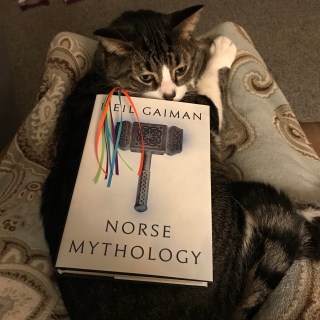
Book: Norse Mythology by Neil Gaiman

Date Read: February 14, 2018 to February 28, 2018img_5787

Rating: 4 (of 5) stars

This book came out with near perfect timing for me. In late 2017, a couple of friends asked me if I was interested in going on a trip with them in the summer… to Iceland. That was a quick yes for me. Not long after committing to the trip, I decided that I would need to brush up on some Norse Mythology– this mythology is still a big part of the culture of Iceland today, and I felt it only appropriate that I should have at least a basic knowledge of the subject. Fast forward just a bit to holiday shopping at various local bookstores, and I came across this take on the mythology written by Neil Gaiman. Perfect! While I am not super well versed in Gaiman’s work, I have read several of his books and have quite enjoyed them.

I have always been interested in mythology, folktales, fairy tales, and legends. That being said, I sometimes have a hard time reading them. While I enjoy them, they do not always turn out to be the quick reads that I want them to be. This book worked out very well for me. While I realize this is nowhere near a comprehensive collection of Norse tales, I liked how Gaiman selected stories that could be fit together into a narrative arc. I did not need to cross reference stories and jump back and forth as I read, because the chronology was there. From what I can tell, he has stayed true to the narrative of each tale, with minimal additions. I suppose this is both a positive and negative. I can see why those more familiar with these tales would be disappointed in this book, but for me and my purpose in reading, it worked. I finished with a feeling that I have a basic knowledge of Norse Mythology, and did not spend months agonizing over a lengthy textbook-ish rendition to do so. From what I know about the geography of Iceland, so much of the creation and destruction myths seem to fit so well. I am looking forward to seeing this in person, and feel like reading this ahead of time has given me an opportunity for a greater appreciation of my destination.

As a final thought, I would like to share my reasoning in the timing of this post. While I read this book back in February, and wrote the majority of this review shortly after, I felt it fitting to wait until closer to my trip to post. I leave tonight! I am super excited for this trip, and my first major international travel in more than 10 years! As I will be gone for close to 2 weeks, I will not be posting another book review until I am back. I have a long flight ahead of me though, so I will have plenty of reading material to get me through.

Boris’s thoughts: “Book is a little heavy, but human seemed pleased while reading. 3 pa– Wait? You’re leaving? Stop! No! 1 paw! 1 paw!!”

The Memory Keeper’s Daughter

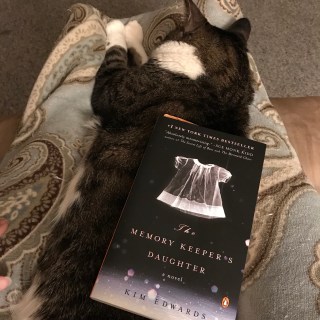
Book: The Memory Keeper’s Daughter by Kim Edwards

Date Read: May 14 to June 10, 2018img_6170
Rating: 4 (of 5) stars

I’m still a bit torn in how I feel about this one. In many ways, I did quite like this book, but much of it also does not feel quite right for me. I debated between 3 and 4 stars on this one, and decided on 4 based on some things in the structure of the novel that I felt were interesting.

I like the premise of the novel, but the plot was rather plodding. There seemed to be so much going on individually with each character, but really, not much happens in terms of actual plot development. The same goes with characters. While I do think there was some personal growth for each of the family members, I think it was pretty minuscule considering the span of a lifetime. At the same time, I think this works for the novel on some levels. Isn’t that kind of how life works sometimes? Every person has struggles and triumphs, but if we were to lay them out as a dramatic timeline, most of us would find our lives to be rather dull. In the moment, events seem big, but often they do not turn out to be as monumental as we presume. At the same time, big is not the same as consequential. Everything, to some degree, is consequential. And then contrasting this (or perhaps complementing it?), is Caroline’s “big moment” of realization when she simply looks at her small family through the window of their home.

This leads in to what I mentioned earlier about the structure of the novel. The story spans approximately 25 years in around 400 pages. There are time jumps, several of them rather significant. In each case, these occur at the climax of a dramatic event, leaving no direct resolution. Everything is resolved (or not) behind the scenes, and we learn how each of these played out based on characters’ reflections on the past. While I could see this as something that could annoy many readers, it’s not something that I have seen done before, and I thought it was an interesting choice on the part of the author.

There is, of course, one major lacking: Phoebe’s perspective. While the novel does not take a first person view from any character, we do get to see life from the perspective of the main characters: David, Norah, Paul, and Caroline, but never Phoebe. We learn that she likes cats and music, knows how to weave, and has a boyfriend that she wants to marry. But that’s really about it. That’s a huge discredit, especially for the title character. I think it’s unfortunate that in a novel that very much promotes that idea that she should be viewed as a person and not a disability, we do not get the opportunity to see the world from her eyes.

This is going to seem nit-picky, but I feel like I need to mention it since I am still thinking about it. I feel like there was a lack of attention to detail on the part of the author. For example, the book refers to Van Gogh’s Starry Night being viewed at the Louvre. However, Starry Night is not (nor has ever been) at the Louvre. In fact, there are no Van Gogh paintings in the Louvre at all. There are also some inaccuracies related to the times and distances traveled in a few places in the novel. While these are admittedly not major faults, they are things that irk me a bit. I knew immediately that these things could not be correct just from my general knowledge. I feel like these were errors that could have very easily been avoided with just a little fact checking.

Boris’s thoughts: “Phoebe likes cats? Well then I like Phoebe. 4 paws.”
Don’t Let the Pigeon Drive the Bus

img_6152Book: Don’t Let the Pigeon Drive the Bus by Mo Willems

Oh, the Pigeon. I totally understand why people do not like the Pigeon. He is loud. He is obnoxious. He is persistent. He is whiny. He is annoying. But oh, I must admit, I kind of love the Pigeon. This one is not actually my favorite of the Pigeon books, but I thought it would be the most appropriate for a review, as it is the original. As usual though, most of what I have to say about this can be applied to the other books in the series as well. (I think my favorite is probably The Pigeon Needs a Bath, or perhaps, Don’t Let the Pigeon Stay Up Late.)

I love the set up of this book. It’s somewhere between a picture book and a comic book. The story is shown through pictures and dialogue. What I find most interesting is that the dialogue is one sided– the Pigeon is talking directly to the reader. Imploring, begging the reader to just, please, LET ME DRIVE THE BUS! I think this gives the (adult) reader options. This could be read as a monologue, or an interactive read aloud with children. Sure, there is not much variation in the children’s response to the Pigeon, but I think this makes it great for younger kids. (And certainly allows for the possibility of some fun!) This could also be a great choice for early readers, or for older children to read with younger. The illustrations are very simple, but are still able to portray the action of the pigeon in his plight to drive the bus.

You may notice that Boris is not alone in his picture with this book. A friend of mine told me that the Pigeon reminds her of me. At first I wondered if I should be offended, but she assured me, that it’s not that I am actually like him, but that he seems like “my kind of character.” Well, I suppose I do have to agree with that. For my birthday a few years ago, she gifted me a Pigeon. But not just a Pigeon, a TALKING Pigeon.

In the true spirit of the whiny, obnoxious, persistent Pigeon, he is only able to say one thing: LET ME DRIVE THE BUS. He generally hangs out in my office at work, where he is a big hit. A warning to parents though: he’s awfully cute, but you definitely don’t want your child walking around with a noise making toy that can only say one thing. Boris was not a huge fan. Our little photo shoot was a bit of a struggle, and I’m still not sure if he was annoyed or afraid of the Pigeon.

Boris’s thoughts: “If you put that thing near me again, I will destroy it……..which might be fun. 3 paws.”