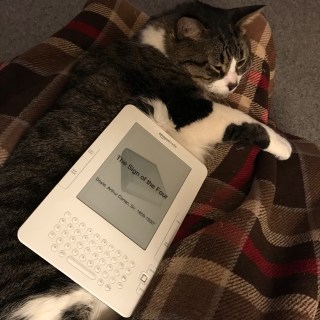
The Sign of the Four

img_5999Book: The Sign of the Four by Sir Arthur Conan Doyle

Date Read: April 4 to April 10, 2018

Rating: 4 (of 5) stars

Despite the relatively high rating that I gave this book, I struggle with it a bit. I tend to be more of a crime TV watcher than a crime novel reader. It usually frustrates me to spend so long reading a book to find the resolution of this type of story line, but I find the Sherlock Holmes stories I have read to be an appropriate length to keep my attention. The problem is… Sherlock Holmes.

I like the idea of Sherlock Holmes, but I have to be honest, I really do not like him as a character. He is arrogant, obnoxious, and talks down to everyone, even those for whom he purports to have some level of respect. Every day life is just too mundane, and a murder isn’t really worth solving unless there’s something complicated about it. Sure, he’s a brilliant detective, but who has the patience to read a novel where the main character is constantly taunting: “I know the answer, but I’m not going to tell it to you because the pieces don’t fit perfectly yet… can’t you figure it out on your own?”

That all being said, I love Watson as narrator. He is able to convey the excitement and suspense of the case, with just enough impatience for Holmes antics that it makes the reader not feel so bad for disliking him. While certainly not the detective that Holmes is, Watson is intelligent enough to be a few steps ahead of the police in following Holmes’ breadcrumbs toward the resolution. Watson is the balance that is needed to make these stories enjoyable for me.

Perhaps so far I have cheated you a bit in this being a book review. I have mostly commented on Sherlock Holmes in general, rather than specifics to this book. With such a well known character/series, it’s hard to talk about a single story in isolation, and I feel a bit at a disadvantage as this is only the second of these stories that I have read. From what I have read from others, this particular story seems to be considered fairly mediocre in the grand scheme of Sherlock Holmes. Seems fair enough. While I enjoyed the book, I do have a hard time imagining Holmes to become the sensation that he was if all of the stories were like this. However, in comparing this to the other that I have read (A Study in Scarlet), I think I slightly prefer the balance obtained in this story. A Study in Scarlet was too disjointed– the story of Holmes solving the mystery, and the explanation of the mystery, were entirely separate. The backstory to the mystery of The Sign of the Four was much better integrated.

Boris’s thoughts: “This review has taken you much too long to write, it’s cutting into my lap time. 1 paw.”
The Witch of Blackbird Pond

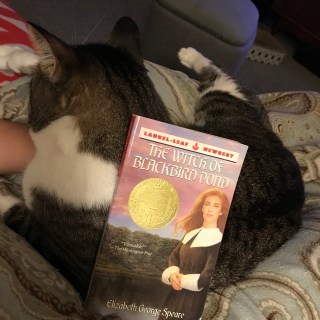
Book: The Witch of Blackbird Pond by Elizabeth George Speare

Date Read: November 12 to November 24, 2015img_5711-1

Rating: 5 (of 5) stars

This is a book from my childhood, and yet, not something that I would quite consider a childhood memory. Okay, okay, I realize that makes no sense.

I know the cover of this book from my childhood. I remember talking about the events of the first chapter of this book some time in middle school. But when I decided to revisit it a few years ago, I had absolutely no recollection of anything that happened in the rest of the book. I knew the basic premise of the book, but the story was completely unfamiliar to me. I have chosen to attribute that to me not finishing it back then, as I really do not think I could have forgotten a story that I now love so much.

The story covers a huge range of topics, while painting a fair picture of life in Puritan New England. Kit is the perfect hero for the target age range for this book– she is fierce and independent, but learns that her own priorities require her to balance this with her family and her friendships. And of course, what is there that you could not love about about Hannah? She is perhaps quirky, but warm and loyal. She bakes for her friends, and will not abandon those who depend on her (even if it is her cat).

While perhaps a minor point in the story, there is a moment that resonates for me, and touches upon my love for the fall season. Having lived all of her life in the tropics, Kit is at first taken aback by the weather of dreary New England. However, one morning she awakes to an unexpected sight: the world has become awash with brilliant reds, oranges, and gold. She realizes as she gazes over the landscape, “in October, any wonderful unexpected thing might be possible.”

Boris’s thoughts: “You started this on the day you met me, AND someone goes back to rescue a cat? 4 paws!”

The Happiness Project

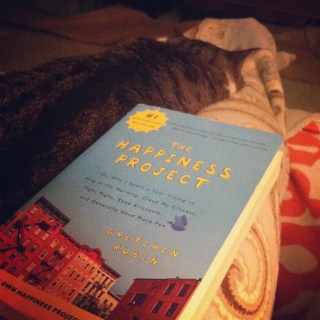
img_4325Book: The Happiness Project by Gretchen Rubin

Date Read: February 19, 2017 to March 15, 2017

Rating: 5 (of 5) stars

For some reason, this seems to be a fairly polarizing book. There are tons of people who love it, and tons of people who seem to take issue with the premise. I actually understand the reasoning of why people take issue with this, although I definitely fall into the “love it” category. Immediately upon finishing this book, I felt compelled to share it with someone else. I lent my copy to a friend just a few days later. She also loved it. Just this past Christmas I bought it as a gift for my Secret Santa at work. Although the book does not necessarily call it by name, one of the primary topics is a huge area of interest for me: Positive Psychology.

Honestly, I think the Positive Psychology aspect of this is what most people have a problem with. While not quite revolutionary, it’s a non-traditional approach to wellbeing. Happiness is not the opposite of depression. You do not have to be unhappy to want to improve your happiness. You could even potentially argue that you can improve your happiness even if you are depressed, but it is not the same as curing depression. I think the general idea of this perspective on happiness makes people uncomfortable. I also think it’s a bit contrary to what people think of as “happy.”

Many of the approaches to happiness that are explored in the book do seem to be small, novel, or even indulgent. But, well, that’s kind of the point. You do not have to move mountains to improve your satisfaction with your life, you just need to find what works for you and work with it. Do you. If something that makes you truly happy seems silly to other people, who cares? Perhaps it seems selfish, but your attitude and emotions impact so much of your life– taking time to put yourself in a positive frame of mind, while being “for you” in the moment, can lead to more positive results for everyone you interact with on a day to day basis.

I feel like I have so much to say, but also that I’ve hit upon the things that I feel are the core of what I enjoyed about this book. I love the balance between narrative/personal stories, and the research of Happiness (often termed in research as “subjective wellbeing”). I would highly recommend it to anyone willing to read with an open mind.

Boris’s thoughts: “Spending time with me makes you happy, right? 4 paws.”

No Country for Old Men

img_5897Book: No Country for Old Men by Cormac McCarthy

Date Read: March 9, 2018 to April 1, 2018

Rating: 4 (of 5) stars

Anyone who does not believe that there is a sort of beauty in destruction and decay has clearly never read anything by Cormac McCarthy. This is the third of his books that I have read, and I do intend to read more. There is an internal struggle every time I go to my shelf to choose my next book, and my eyes fall upon the McCarthy section. I had finished reading “The Road” shortly before I heard some terrible news– my favorite bookstore, Borders Books, was going out of business. After I recovered from the shock, there was a more pleasant realization: closing stores means discount books. Once prices reached 80-90% off, I bought every McCarthy book the store still had available (among many others). As a result, I have relatively large collection from this author that hangs out on my “to read” list. I want to read them so badly, but I know they will devastate me.

As expected, No Country for Old Men was no exception to this. It was beautiful, and it was horrifying. While it could be said that the first bit of the book moves a little slowly, I love how the setting is built up slowly, bit by bit. This then eventually leads into a whirlwind of gruesome activity. Throughout the book, there are moments of unexpected calm, a short but compelling description of innocuous detail that is quickly disrupted by gunfire. My eyes moved easily over the words, devouring them, but my mind often forced me to close the book even at moments I was dying to know where the next turn would lead.

I very much enjoyed the dynamic between Bell and Chigurh. Although there is no direct interaction between them, they are essential to the existence of the other character. I try not to put too much time into perceived symbolism in my reading– while I feel that there is sometimes some obvious link, I think much of what we discover in literature is what we want to find there. Bell is interesting in the obligation that he feels to his community. Even when he realizes how much of the situation is outside of his control, he continues to search for meaning. He is not willing to accept that the unfolding events are just simply events, with no meaning beyond their immediate consequences. I have seen Chigurh compared to Death, but I think this is too simple. While he presents his actions as the inevitable, he is also self-preserving and elusive. He could be fate, or he could be random chance. Or perhaps he is neither, and both of these possibilities are just what we choose them to be.

Boris’s thoughts: “This all seems too complicated for me. Can you just pick up the book, or put the book down? 2 paws.”

Am I There Yet?

img_5996 Book: Am I There Yet? by Mari Andrew

Date Read: April 1, 2018 to April 4, 2018

Rating: 5 (of 5) stars

I discovered Mari Andrew’s Instagram account (bymariandrew) a few years ago, and immediately fell in love with it. It was some time around when she completed her first 365 days of illustrations. There was something about her illustrations that spoke to my heart, and I went back to look at all of her previous posts (and so now have no recollection of when I actually starting following her). Her illustrations are thoughtful and honest; it’s obvious that she puts her heart (and heartache) into her work. She bravely shares her experiences and herself in a way that makes the viewer (and now reader) feel like they know her personally, even if just a little bit.

I wanted to share this about her artwork first for a few reasons (first of all being why someone who has never met an author might feel compelled to refer to them on a first name basis). Second, to say that Mari’s writing is very much like her art. She makes you feel. Although the experiences she shares have been quite different from my own, there is a universality in the emotion that her writing evokes. Her essays are perfectly paired with her artwork to lead you through the story of each chapter, and the “Loop-de-Loop, Zigzagging Journey” to where she finds herself now. This is a book that I definitely plan to revisit, and absolutely will be sharing with others.

As a final note on the personable feelings of Mari’s art and writing, I want to share one more (perhaps unusual) feeling after reading this book: proud. Although I do not personally know Mari, I feel like I have followed her along for a chunk of this journey, and am proud of her accomplishment in creating this book. Even if I have only participated through being one of the thousands reading and “liking” her online posts, I have experienced an emotional journey of my own. I think that is the magic of Mari’s work, and I feel honored to have been able to share in that, even if from a great distance. Thank you for your work, Mari. I look forward to seeing where you go next!

Boris’s thoughts: “Great snuggle book, since you want to read it all at once! (Just make sure you feed me first.) 4 paws.”

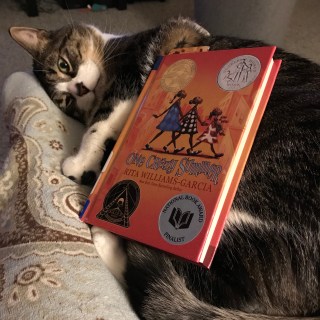
One Crazy Summer

Book: One Crazy Summer by Rita Williams-Garcia

Date Read: March 1, 2018 to March 8, 2018img_5861

Rating: 4 (of 5) stars

This was the selection for the “One Book, One City” program in Grand Rapids for 2018. Grand Rapids Public Schools and Grand Rapids Public Library partner on the project that provides a copy of the book to all 5th grade students in the city, as well as classroom resources for teachers and an online community for students to participate in. It is an incredible project, and one that I have seen students truly take off with. This year, students were encouraged to participate in an online classroom and blog project, where they answered questions posted throughout the month and had opportunities to interact with students from other schools. Several schools that were active with the online resources were invited to an event to meet the author and talk about her book. Being a part of the schools in Grand Rapids (albeit not a classroom teacher), I often find myself compelled to read the books I see becoming popular with students. While the 5th graders in my city were reading and marking up their personal copies of this book, I decided to took advantage of my access to the school library.

I suppose to summarize my thoughts in a sentence: What a great choice of books for this project. There are so many great conversations that can be started from this book: family dynamics, sibling relationships, racism, history, social justice, independence, growing up, poetry, personal identity. I love how many different paths a book can take you in. One difficulty I can see with this, however, comes from a teaching perspective. Because there are so many dynamics, you’re really only scratching the surface of most of it. While I am familiar with the history of the time period, many of the students in the target age range are not. I suppose you could see this as both positive and negative: most students who encounter this book today probably know about as much about the Black Panthers as Delphine and her sisters did when they were on their way to the community center.

I suppose it is worth pointing out the probably cliche, but probably perfect for the story, use of the unattainable: Disneyland. As Delphine and her sisters depart for California, she is saving the money that their Pa had given them, planning to take her younger siblings to Disneyland. Of course, when they arrive in Oakland to meet their mother, one of the first things she does is confiscate their money– to which Delphine protests: they are going to Disneyland! It is the fantasy highlight of their trip. As an adult reader, I can see how unrealistic the expectation of Disneyland truly is. The amount of money given to them surely was not enough, and although in California, Disneyland is nearly 400 miles from Oakland. At least the girls get to see the Golden Gate Bridge, and visit Chinatown. Perhaps though, we have the perfect metaphor for their whole experience. Undoubtedly, the girls were heading to Oakland expected their mother to be their fantasy mother. Cecile falls far short of that, but at the same time, I think in the end they did get something from that relationship– just not what they had been expecting.

Boris’s thoughts: “Black Panthers? I approve. 4 paws.”

All My Friends Are Dead

img_5756Book: All My Friends Are Dead by Avery Monsen and Jory John

Every once in a awhile, you need to read something that is absolutely ridiculous. This is a perfect book to meet that need. It is a collection of one-liners and puns that string together to form a loose sort of story. I found this book at a random gift store in Louisville a few years ago. I was initially attracted by the cartoon dinosaur on the cover, then had to pick it up once I read the title. What could this little book be?

Hysterical, that is what this little book turned out to be. Is it high quality literature? Of course not. Did anyone really think that’s what they would be getting here? But it’s great for a quick read when you need a laugh, and makes a great gift for that one person that you are never quite sure what to get. Like I said, everyone needs something ridiculous from time to time. I expect that one day, this will be one of my “coffee table books.” I just need to get a coffee table first. And a living room that will fit a coffee table.

Boris’s thoughts: “I can’t believe you make me do this. All my friends are nerds. 2 paws.”

My Antonia

img_5760Book: My Antonia by Willa Cather

Date Read: April 14, 2015 to May 15, 2015

Rating: 4 (of 5) stars

If I was being completely honest, that should be a much larger date range up there. I started this book for a US History class when I was in high school – I’m going to estimate and say that it was probably around… October 2001. Most of the class was unenthused about reading in general, and we only made it through the first section. I had thought about going back and finishing it many times, but just never seemed to get to it. Then, nearly 15 years later, I decided to participate in a reading challenge which included “a book you were supposed to read in school but didn’t” and “a book you started but never finished.” This was literally the only book I could think of that fit into those categories.

Upon finally finishing this book, I was quite pleased that I had come back to it. In keeping with my apparent tradition of delay with this book, I am writing and posting a review for it nearly three years after reading it. Perhaps this isn’t quite fair to the book. I do not know that I can truly give it justice in a review when it is not fresh in my mind. However, I think the fact that this book is one that stuck in my mind as something I could easily write about this long after the fact speaks to it’s quality. While the details of the story are perhaps fuzzy, it is one that has stuck with me.

There is a passage near the end of the book that particularly struck me when I was reading. For full disclosure, I finished this book in tears… on an airplane… sitting next to a stranger. Something about this passage hit me hard at that moment. I wrote it down then, feeling that it was something that needed to be kept and revisited. I shared it on the blog I was writing at the time, on Goodreads, and now here:

‘Do you know, Antonia, since I’ve been away, I think of you more often than anyone else in this part of the world. I’d have liked to have you for a sweetheart, or a wife, or my mother or my sister – anything that a woman can be to a man. The idea of you is a part of my mind; you influence my likes and dislikes, all my tastes, hundreds of times when I don’t realize it. You really are a part of me.’

She turned her bright eyes to me, and the tears came up in them slowly, ‘How can it be like that, when you know so many people, and when I’ve disappointed you so? Ain’t it wonderful, Jim, how much people can mean to each other? I’m so glad we had each other when we were little…’

Boris’s thoughts: “I don’t remember this one. Fake!! 1 paw.”

Walk Two Moons

img_5767Book: Walk Two Moons by Sharon Creech

Date Read: February 9 to February 13

Rating: 5 (of 5) stars!

My first encounter with this book was in middle school, when it was relatively new. My best friend absolutely loved it, and told me that I HAD TO READ IT. For some reason, I didn’t listen to her. I wish I had.

Reading this as an adult, this is everything that I want to see in children’s/young adult literature. There’s a sort of adventure, some fun quirky characters, a bit of mystery, some beautiful writing, and the all important moment of self-discovery. Sal is surprisingly introspective, yet closed off at the same time. She has a unique method of coping, which I think is true and relatable for kids– they are still making sense of the world, and are not always ready for what life throws their way.

One of my reading quirks is that often when I read a book that I very much liked, I will go look for its negative reviews. I want to understand what it is that people did not like about something I found great. The two main complaints I found were that: the “twist” in the story is predictable, and that Sal’s friend Phoebe (who is a main character) is annoying and not likable. I actually agree with both of these things, but think these are good for the target demographic of this book. Is it great literature? Maybe not (although I would at least call it good). But it is great children’s literature.

While the “twist” might be obvious to adult or even teenage readers, I think it works for the younger audience. This would be a great book for reading with 4th or 5th grade, even up through middle school. The somewhat vague but hinted at story of Sal’s mother is a good opportunity for less experienced readers to speculate on and make their own predictions. Along the same lines, although Phoebe is rather annoying, she is sympathetic. She may behave badly, but she’s also experiencing something that she really doesn’t know how to deal with. We are certainly not viewing Phoebe at her best. And yet, Sal is still her friend, and she feels for her when the “birds of sadness” begin to circle. I think it’s good to encounter characters that you don’t like, especially when they are in some way relatable. You don’t have to like Phoebe to feel bad for her, which I think is a lesson that many kids need to hear.

I also like to collect quotes from books. There were 8 from this book that I wrote down, which is more than usual. I don’t feel it quite necessary to share them all, but here are a few highlights:

“You can’t keep the birds of sadness from flying over your head, but you can keep them from nesting in your hair.”

“Maybe dying could be normal and terrible.”

“It seems to me that we can’t explain all the truly awful things in the world like war and murder and brain tumors, and we can’t fix these things, so we look at the frightening things that are closer to us and we magnify them until they burst open.”

Boris’s thoughts: “Lightweight, cozy snuggle book. 4 paws.”

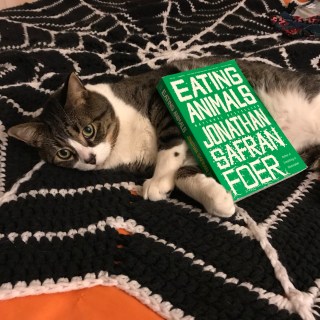
Eating Animals

img_5724Book: Eating Animals by Jonathan Safran Foer

Date Read: June 23, 2016 to July 12, 2016

Rating: 4 (of 5) stars

Before the prime of Amazon prime, back when the only way to get free shipping was to bump your order total over $25, I often found myself browsing Amazon’s book recommendations. It wasn’t so much that I could not have come up with another book to purchase on my own, but it was obviously much more fun to buy a surprise book. One that I wasn’t going to seek out during my next trip to the bookstore. That is where I found this book. It was recommended to me based on my previous purchases, and what little (or perhaps not so little) Amazon knew of my reading habits. I had read a book by the same author before. I’m pretty sure that was the main reason for the suggestion, and I’m going to say really not the best reasoning on their part.

I suppose at this point I should admit my bias: I am a vegetarian. I was before reading this book. I am not vegan, and while reading this has lead me to think more about my choices, I would not say that it has really pushed me strongly in that direction. I would consider this book to be more of an informative piece on factory farming than a straightforward case for giving up meat. Foer presents facts, from various viewpoints, and suggests that readers use this information to make decisions for themselves. He does not preach to the reader, nor does he vilify meat eaters. I appreciate this perspective– one of the hardest things I have found about being vegetarian is the way that others react to me based on their assumption of how I feel about them eating meat. Don’t judge me, and I won’t judge you, thanks.

My biggest takeaway from this book is that the food industry in our country is in an appalling state. Many of the common practices in the large scale farming of animals are not only cruel, but also terrible for the environment and more often than not, rather disgusting. I don’t think any of that would surprise most people. I suppose this is the classic case of what people “don’t want to know” about their food. However, Foer does make efforts to show the other side of this: there are people out there who are trying to make things better, who respect the animals that they raise for food, and attempt to do right by them. It is possible to be a responsible meat eater; it’s just not easy.

As a final thought, I think Foer states it well himself:

“Whether we’re talking about fish species, pigs, or some other eaten animal, is such suffering the most important thing in the world? Obviously not. But that’s not the question. Is it more important than sushi, bacon, or chicken nuggets? That’s the question.”

Boris’s thoughts: “Concerning title, but did not convince human to eat me. 4 paws.”