Silver Linings Playbook

img_5051Book: Silver Linings Playbook by Matthew Quick

Date Read: August 8 to 13, 2017

Rating: 5 (of 5) stars

I very much enjoyed this book. It has been awhile since I initially read it, so please forgive me for bouncing some of my commentary off of input and opinions of others. At this point, I think that’s the really the best way for me to frame my thoughts in this instance. Browsing through the top reviews on Goodreads, it seems that one of the most popular descriptions used is “fun,” which I find… interesting. I suppose I can see it, a bit. There are definitely some fun elements in the book, but that would not be my first inclination. Easy read? Sure. Funny? Definitely. But not quite haha funny, more dark comedy funny. Someone else called it “the adult Perks of Being a Wallflower.” I’m definitely more on board with that description, but still not quite there.

If I am going to boil this down into a simple statement, I will say that this book is depressingly hopeful. That doesn’t sound quite right though. Hopefully depressing? No, that’s not it either. Depressing and hopeful? I’m having a hard time hitting on the exact right words. I suppose part of that is that I think Quick did an incredible job of making these characters real.

The majority of this book contains really depressing material. Pat is obviously a mess, but is trying to put things back together with the outlook of a hopeless optimist. It’s pretty obvious to the reader that his expectations are unrealistic, but such is life. I love that we get to see two sides of his therapist– not just as a doctor, but as a real person! It’s like when you’re in elementary school, and it never occurs to anyone that teachers do anything other than live at school. Tiffany, too, is a mess, but not quite in the same way as Pat. At moments, she seems more self aware, but perhaps too far into the spectrum of pessimism. But she’s not quite a pessimist either, as we can see in her passion for the dance competition. The plot was good, a bit predictable as to where it was heading, but there were sufficient twists along the way to keep things interesting.

I suppose I should wrap this up before I give too much away. The ending was fitting for the story. I can understand why some readers were a bit frustrated with it, seemingly a bit anti-climactic. However, I think that fits with the realness of the characters. Life does not generally wrap things up nicely like in the movies. Throughout the the book, Pat tells us about the movie of his life. The ending is the final reminder that this is not, in fact, a movie. This is Pat’s real life.

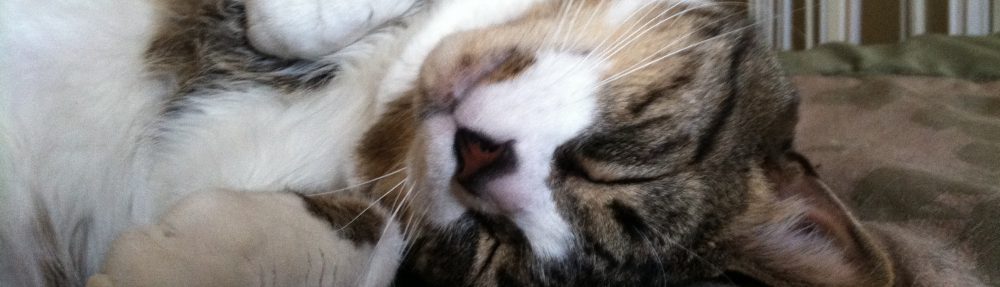
Boris’s thoughts: “Good for long stretches on the couch. 4 paws!”

Ísland (Iceland) Fairy Tales

img_7408Book: Iceland Fairy Tales by Anonymous

Date Read: July 11, 2018

Rating: 4 (of 5) stars

I first saw this little book at the Museum of Icelandic Sorcery and Witchcraft in Hólmavík. While I decided to pass on it then, it kept nudging at me each time that I saw it. I thought I had left without it, but when my flight home was pushed back an additional 2 days, I ended up back in Reykjavík at a gift shop I had not yet visited. There it was, and I decided that I would take it as a sign that the book needed to come home with me.

Although clearly intended as a book for tourists, it was a nice little introduction to Icelandic folklore. There were definitely some familiar elements in some of the stories, but more emphasis on ogres, trolls, and similar creatures. After experiencing some of Iceland, I understand why there is a history of these kinds of beliefs. I can easily imagine trolls or elves hiding in the nooks and crannies of the Icelandic landscape. Despite some issues with editing (and perhaps poor translating), it was a quick little read that left me satisfied with the content. I also found other books that I am hoping will give me a more in depth picture of the country’s mythological history.

Boris’s thoughts: “I’m glad your home, but I’m not talking to you yet. 2 paws. I guess.”

Miss Peregrine’s Home for Peculiar Children

img_6295Book: Miss Peregrine’s Home for Peculiar Children by Ransom Riggs
Date Read: November 28 to December 4, 2015

Rating: 3 (of 5) stars

I wanted to love this book. I really wanted to love this book. I felt like there was potential for a good story here, but it fell way short of my expectations.

I have read a lot of comments on the book that the pictures were the best part… But I can only partially agree with that. The pictures were interesting. I like the concept of incorporating the pictures into the story. However, beyond the introduction of the characters in the earlier portions of the book, the inclusion really seemed forced – as if the author just added in little bits of unnecessary information just so that a picture could be inserted. Once the plot started to actually move, the pictures didn’t really seem to fit anymore.

Before going any further, I am issuing a major SPOILER ALERT. I try not to give away too much when I write reviews, but the nature of this next point makes it impossible. Plot holes. Plot holes left and right. If you want skip the potential spoilers, just go to the bottom of the numbered list.

1. How can Emma make a light underwater at the shipwreck, but not be able to make one in the rain?
2. How can Bronwyn carry a large metal door to use as a shield, and also swim in open water? Okay, so she has super-human strength… but she still needs to stay afloat!
3. The children are stuck in a loop. Only peculiars can enter loops. Why do some of the children have doubts that Jacob is peculiar after he has entered a loop?
4. If only peculiars can enter loops, why can wights enter loops? It explicitly says that wights are common, but also that they can (presumably) live for thousands of years. So which is it?
5. Why are the children in the loop only safe if they stay on the island? Because of the dangers off the island when the loop was created? If duplicates of those dangers still exist inside the loop, why don’t duplicates of the children also exist inside the loop?
6. I don’t even want to start with the time travel issues. So if the loop closes and the children are now in 1940, does that change the course of history for the “real” world? Are there now parallel universes operating? And that’s only the tip of the potential time travel iceberg!

And my final issue? The ending of the book was written in a way that almost requires a sequel. While I don’t mean to say that sequels are a bad thing, I think there is a difference between potential (somewhere for the story to go from here) and need (little or no resolution). I can also understand that sometimes an author just has more to say, and they plan for a book or idea to be a series. However, in this case, this timing seems off. The original book was published in 2011, and the next two released in quick succession in 2014 and 2015. That just seems like poor planning if this was always intended to be a trilogy. It feels more like the author decided that he wanted to make sure he could write a second book in case it became popular, but he didn’t really have an idea of what he could actually write about. But let’s just throw in a sort of cliffhanger, just in case.

Despite all my negative comments, I did not hate this book. I do not regret reading this book. Do I intend to continue reading the series? No.

As a final note, despite being disappointed by this book, I decided to watch the movie. Although I’m often skeptical of book to film adaptations, I will typically watch them. This one was interesting. It was true to the general story, but many of the details were adjusted. While this would normally frustrate me, I appreciated it this case. The adapters took some liberties and closed (or left out) some of those annoying plot holes! They even fixed the ending! I felt much more satisfied at the end of the film than I was expecting.

Boris’s Thoughts: “I suppose I can be on board with a book that has a bird lady in the title. 3 paws.”

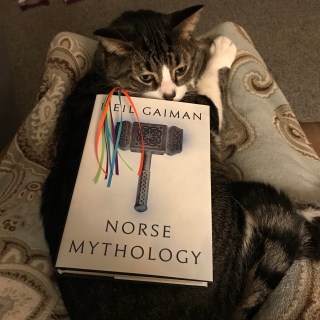
Norse Mythology

Book: Norse Mythology by Neil Gaiman

Date Read: February 14, 2018 to February 28, 2018img_5787

Rating: 4 (of 5) stars

This book came out with near perfect timing for me. In late 2017, a couple of friends asked me if I was interested in going on a trip with them in the summer… to Iceland. That was a quick yes for me. Not long after committing to the trip, I decided that I would need to brush up on some Norse Mythology– this mythology is still a big part of the culture of Iceland today, and I felt it only appropriate that I should have at least a basic knowledge of the subject. Fast forward just a bit to holiday shopping at various local bookstores, and I came across this take on the mythology written by Neil Gaiman. Perfect! While I am not super well versed in Gaiman’s work, I have read several of his books and have quite enjoyed them.

I have always been interested in mythology, folktales, fairy tales, and legends. That being said, I sometimes have a hard time reading them. While I enjoy them, they do not always turn out to be the quick reads that I want them to be. This book worked out very well for me. While I realize this is nowhere near a comprehensive collection of Norse tales, I liked how Gaiman selected stories that could be fit together into a narrative arc. I did not need to cross reference stories and jump back and forth as I read, because the chronology was there. From what I can tell, he has stayed true to the narrative of each tale, with minimal additions. I suppose this is both a positive and negative. I can see why those more familiar with these tales would be disappointed in this book, but for me and my purpose in reading, it worked. I finished with a feeling that I have a basic knowledge of Norse Mythology, and did not spend months agonizing over a lengthy textbook-ish rendition to do so. From what I know about the geography of Iceland, so much of the creation and destruction myths seem to fit so well. I am looking forward to seeing this in person, and feel like reading this ahead of time has given me an opportunity for a greater appreciation of my destination.

As a final thought, I would like to share my reasoning in the timing of this post. While I read this book back in February, and wrote the majority of this review shortly after, I felt it fitting to wait until closer to my trip to post. I leave tonight! I am super excited for this trip, and my first major international travel in more than 10 years! As I will be gone for close to 2 weeks, I will not be posting another book review until I am back. I have a long flight ahead of me though, so I will have plenty of reading material to get me through.

Boris’s thoughts: “Book is a little heavy, but human seemed pleased while reading. 3 pa– Wait? You’re leaving? Stop! No! 1 paw! 1 paw!!”

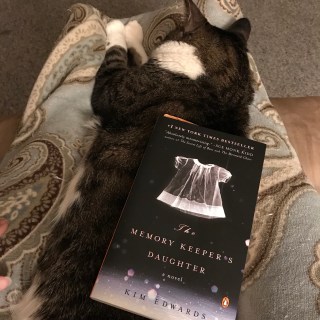
The Memory Keeper’s Daughter

Book: The Memory Keeper’s Daughter by Kim Edwards

Date Read: May 14 to June 10, 2018img_6170

Rating: 4 (of 5) stars

I’m still a bit torn in how I feel about this one. In many ways, I did quite like this book, but much of it also does not feel quite right for me. I debated between 3 and 4 stars on this one, and decided on 4 based on some things in the structure of the novel that I felt were interesting.

I like the premise of the novel, but the plot was rather plodding. There seemed to be so much going on individually with each character, but really, not much happens in terms of actual plot development. The same goes with characters. While I do think there was some personal growth for each of the family members, I think it was pretty minuscule considering the span of a lifetime. At the same time, I think this works for the novel on some levels. Isn’t that kind of how life works sometimes? Every person has struggles and triumphs, but if we were to lay them out as a dramatic timeline, most of us would find our lives to be rather dull. In the moment, events seem big, but often they do not turn out to be as monumental as we presume. At the same time, big is not the same as consequential. Everything, to some degree, is consequential. And then contrasting this (or perhaps complementing it?), is Caroline’s “big moment” of realization when she simply looks at her small family through the window of their home.

This leads in to what I mentioned earlier about the structure of the novel. The story spans approximately 25 years in around 400 pages. There are time jumps, several of them rather significant. In each case, these occur at the climax of a dramatic event, leaving no direct resolution. Everything is resolved (or not) behind the scenes, and we learn how each of these played out based on characters’ reflections on the past. While I could see this as something that could annoy many readers, it’s not something that I have seen done before, and I thought it was an interesting choice on the part of the author.

There is, of course, one major lacking: Phoebe’s perspective. While the novel does not take a first person view from any character, we do get to see life from the perspective of the main characters: David, Norah, Paul, and Caroline, but never Phoebe. We learn that she likes cats and music, knows how to weave, and has a boyfriend that she wants to marry. But that’s really about it. That’s a huge discredit, especially for the title character. I think it’s unfortunate that in a novel that very much promotes that idea that she should be viewed as a person and not a disability, we do not get the opportunity to see the world from her eyes.

This is going to seem nit-picky, but I feel like I need to mention it since I am still thinking about it. I feel like there was a lack of attention to detail on the part of the author. For example, the book refers to Van Gogh’s Starry Night being viewed at the Louvre. However, Starry Night is not (nor has ever been) at the Louvre. In fact, there are no Van Gogh paintings in the Louvre at all. There are also some inaccuracies related to the times and distances traveled in a few places in the novel. While these are admittedly not major faults, they are things that irk me a bit. I knew immediately that these things could not be correct just from my general knowledge. I feel like these were errors that could have very easily been avoided with just a little fact checking.

Boris’s thoughts: “Phoebe likes cats? Well then I like Phoebe. 4 paws.”

Don’t Let the Pigeon Drive the Bus

img_6152Book: Don’t Let the Pigeon Drive the Bus by Mo Willems

Oh, the Pigeon. I totally understand why people do not like the Pigeon. He is loud. He is obnoxious. He is persistent. He is whiny. He is annoying. But oh, I must admit, I kind of love the Pigeon. This one is not actually my favorite of the Pigeon books, but I thought it would be the most appropriate for a review, as it is the original. As usual though, most of what I have to say about this can be applied to the other books in the series as well. (I think my favorite is probably The Pigeon Needs a Bath, or perhaps, Don’t Let the Pigeon Stay Up Late.)

I love the set up of this book. It’s somewhere between a picture book and a comic book. The story is shown through pictures and dialogue. What I find most interesting is that the dialogue is one sided– the Pigeon is talking directly to the reader. Imploring, begging the reader to just, please, LET ME DRIVE THE BUS! I think this gives the (adult) reader options. This could be read as a monologue, or an interactive read aloud with children. Sure, there is not much variation in the children’s response to the Pigeon, but I think this makes it great for younger kids. (And certainly allows for the possibility of some fun!) This could also be a great choice for early readers, or for older children to read with younger. The illustrations are very simple, but are still able to portray the action of the pigeon in his plight to drive the bus.

You may notice that Boris is not alone in his picture with this book. A friend of mine told me that the Pigeon reminds her of me. At first I wondered if I should be offended, but she assured me, that it’s not that I am actually like him, but that he seems like “my kind of character.” Well, I suppose I do have to agree with that. For my birthday a few years ago, she gifted me a Pigeon. But not just a Pigeon, a TALKING Pigeon.

In the true spirit of the whiny, obnoxious, persistent Pigeon, he is only able to say one thing: LET ME DRIVE THE BUS. He generally hangs out in my office at work, where he is a big hit. A warning to parents though: he’s awfully cute, but you definitely don’t want your child walking around with a noise making toy that can only say one thing. Boris was not a huge fan. Our little photo shoot was a bit of a struggle, and I’m still not sure if he was annoyed or afraid of the Pigeon.

Boris’s thoughts: “If you put that thing near me again, I will destroy it……..which might be fun. 3 paws.”

Politically Correct Ultimate Storybook

Book: The Politically Correct Ultimate Storybook by James Finn Garner

Date Read: January 17 to 18, 2016img_6291

Rating: 2 (of 5) stars

This book was a gift. Admittedly, one that I likely would not have picked out myself. Nonetheless, I had some high hopes for it. I like fairy tales and those sorts of stories, and thought that the “politically correct” twist on it had the potential for hilarity. I was sadly disappointed.

By no means do I want to imply that there were not some good moments. There were some stories that made me laugh. I especially loved Sleeping Beauty (or, of course, The Sleeping Person of Better Than Average Attractiveness) being cursed to have unrealistic expectations of her future relationships. Honestly though, I thought that some of the story titles were funnier than the stories themselves. I feel like there was some good potential here, it just fell short for me.

I realize that part of the point of this book was to “go overboard” on political correctness. Or, at least, I think that was the point. I just felt that much of it just ended up being dumb, not funny. I also think that much of it really had nothing to do with political correctness. The best examples for this come from the selection of Holiday stories. Santa portrayed in a villainous way for being overweight? What’s politically correct about that? If politically correct was the goal, then I would think coming up with neutral seeming language would have been more appropriate. Then, there is the faux pas of the party host, who raises a holiday toast with his guests– forgetting that he has served eggnog, and one of his guests is vegan. The error is, of course, corrected. Again, where is the political correctness here? Having an alternative for a vegan friend is not “being PC,” its just being considerate.

Boris’s thoughts: “You didn’t like this one? You like everything. 1 paw.”

Bloodsucking Fiends

img_6096Book: Bloodsucking Fiends by Christopher Moore
Date Read: Various

Rating: 5 (of 5) stars

So I’m doing it again. It has been quite some time since I’ve read this book, but have come back to it several times. So, I will start with a story.

I discovered Christopher Moore when I was in college. There was a Borders Books near campus, which was where I often spent my long breaks between afternoon and evening classes, browsing and adding to my to read list rather than working on homework or reading for class. Borders liked to do these weekly table sales: buy 2 get one free, or buy one get one half off. It was like I had to find more than one to add to my ongoing collection. (Incidentally, I consider this a primary contributing factor to my now out-of-control to read list of 260+ books.) Anyways: it was on one of these tables that I found “You Suck: A Love Story.” I’m not generally a big fan of romance novels, so I was obviously intrigued. Upon discovering it was the follow up to a novel called “Bloodsucking Fiends” (also a love story), I knew I had to read them both.

Within a few pages, I knew I was hooked on Christopher Moore. His novels are well thought out, a bit ridiculous, and hurt your stomach laughing out loud funny. I love that he takes on subjects and characters that are well known, but then makes them his own. These are not the same vampires you know from Bram Stoker and Anne Rice, but that doesn’t stop them from researching themselves in the source materials.

Speaking of research, despite the zaniness of it all, it is clear the Moore does his homework before embarking on a novel. He shows a clear understanding of the material from which his characters grow, and masterfully guides them into new life. That’s right, I just described a guy who incorporates fart and penis jokes into all his writing as “masterful.” Really though, how else can you describe someone who can perfectly meld pure ridiculous with well known mythology? Somehow, you end up with a novel that makes you think, but also makes you laugh.

As a final comment on Christopher Moore, I think it’s important to note that he does not just draw on classic material, but also on his own. Although I would not consider them to be in any way a series, his novels all take place in the same world. This ranges from brief cameos to full on character borrowing. It’s not unusual to suddenly realize that a character is familiar because they were introduced through a minor part in a previously read book. While I suppose some might find annoying, I appreciate that Moore is able to make this feel natural. I have not yet encountered an issue with story continuity, nor have I felt that I didn’t get “enough” about a character in an individual novel.

Boris’s thoughts: “You know you’re never going to finish that to read list if you keep rereading books. Whatever. 3 paws.”

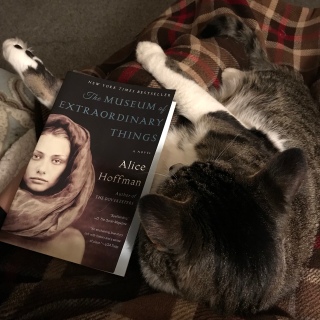
The Museum of Extraordinary Things

img_6038Book: The Museum of Extraordinary Things by Alice Hoffman

Date Read: April 11 to May 13, 2018

Rating: 5 (of 5) stars

This book was not what I was expecting. To be honest, I’m not 100% sure what I was expecting when I picked this one up. It came highly recommended by a friend, although I feel like our taste in books does not always have a huge overlap. It’s not that I was expecting it to be bad– I was just expecting something different than what I got.

While this novel could be called a romance, there is much more to it than that. Honestly, the romance aspect of the story was the least interesting part to me. There are several layers to the story– romance, mystery, perhaps even adventure. I particularly liked the historical aspect, tying in the events of the city in 1911, and touching on the labor movement. I knew the setting was historical, but thought the history aspect ended there. I was pleasantly surprised with the inclusion of historic events, and how they were intertwined with the characters. The firsthand depiction of the fire at the Triangle Factory was fascinating, albeit horrific. I appreciated Eddie’s perspective on the world, and how different it was from Coralie’s. Seeing the developments and changes in each of them through the novel was interesting.

After saying that, I feel that I should emphasize the word “appreciated.” There was quite a bit about Eddie that I did not like, but I do think his character is redeemable. He is cynical and selfish, and there was much in his behavior that just sort of irked me. However, his ability to view the world differently through his photography and his impulse to seek justice for the Weiss family create an appealing contrast to the other aspects of his character. I always have a greater appreciation of an author who can create a character that I do not quite like, but still want to root for.


Boris’s thoughts: “Too many dogs. More interested in the fish. 2 paws.”

Dragon’s Fat Cat

img_6116Book: Dragon’s Fat Cat by Dav Pilkey

Dav Pilkey has become quite popular with several of his characters (Captain Underpants, Dog Man, etc.), but I don’t think there will ever be one that I love quite as much as Dragon.

This is one of five books chronicling the (mis)adventures of Dragon. Whether he is learning how to take care of a new pet, celebrating a holiday, or just trying to get by in his daily life, Dragon has a way of getting things a bit mixed up. He is a little too easily spooked for Halloween, buys too much food at the grocery store to fit into his car, and is really not sure what can be done about the smelly yellow puddle problem that comes along with having a pet. However, he always knows where to turn to get a little help with his problems, and things end up working out for him in the end. He is a fun, silly character that has a few laughs for both kids and the adults that are reading with them.

Of course, I may be biased because we are both obviously cat people.

These are great for early readers–they have the feel of a chapter book, but the fun of a picture book. Each book is also broken up into shorter stories, but text is lower level and there are tons of great illustrations. I love the little “extras” that get added in to the story through the pictures.

As is my habit, I realize that I have again reviewed a whole series rather than an individual book. However, I’m going to stand by this as fair. As children’s books, these all go together fairly seamlessly. I certainly would have a hard time recommending one over the others. While I could probably narrow down a favorite story in each book, differentiating from there would be difficult. The four books that I have read each have a specific focus (Dragon’s Fat Cat, Dragon Gets By, Dragon’s Halloween, and Dragon’s Christmas), and each of the four books that I have read fit so well with their unique subject.

Boris’s Thoughts: “Are you trying to imply something? I’m not fat, I’m big boned! I’ll give a little credit though, since I guess that one cat does look a bit like me. 2 paws.”