The Little World of Liz Climo

img_0393The Little World of Liz Climo by Liz Climo

This is another book from someone that I discovered on Instagram. While I do not remember exactly how I originally came across her work, it was instant live. It’s cute and quirky and always makes me smile. I love the simplicity in style, combined with the wit in each character. I knew that she had published books, but had never really sought them out. I stumbled across this at a bookstore and decided that I needed it on my shelf. I will definitely be keeping an eye out for more of here books!

This a perfect little book for when you need to take a break– whether that is from some heavier reading, or taking a step back from a rough day. The problems of the animals in Liz Climo’s world are perfectly balanced between real humanity and imagined animal issues. Despite having followed her online for some time, I found that there was plenty of content here that I had not seen before. One more thing this book is perfect for? A blog post in a pinch, when you have been feeling too busy and tired to put mental energy into writing.

Boris’s thoughts: “I think that bear and I could be friends. 4 paws.”

The Immortalists

img_0238The Immortalists by Chloe Benjamin

Date Read: April 16 to April 29, 2019

Rating: 5 (of 5) stars

Would you want to know the day that you are going to die? This story is built around a fairly simple premise, but unwinds into an intricate and complex tale of family and relationships. As children, four siblings, Varya, Daniel, Klara, and Simon, visit a woman that people say can tell your future—specifically the day that you will die. Over the course of the novel, the following 40-ish years, we get to know each of the siblings a bit better in their own rite, as well as in relation to their family.

While reading, I loved and hated each one of the siblings. I adored their individuality, I cursed their faults, and I grieved each of their subsequent deaths. There were so many points that I could not put it down, even when I had a sinking feeling of what was coming. The story of each sibling is vibrant and emotional; despite the huge differences in how they chose to live in the time they were told they had remaining. The obvious discussion, which is even mentioned on the back cover, is the intertwining of fate and choice. Would Simon have lived so recklessly if he had not anticipated dying young– would he have lived longer if he had played it safe? How did knowledge of a death date play into Klara’s obvious mental illness, and would she have met the same end without it? Even Daniel, who claims to not believe the prophecy, is driven by the knowledge to actions that seem spectacularly out of character. While there could certainly be much said here, I thought the sibling relationship aspect was even more interesting, in the context of the impending dates.

After each death, we get a glimpse of that character from the view of the next, with trails of these through each sibling’s story. In each case, the surviving siblings carry with them some perceived responsibility for those before them. Is Klara responsible for Simon because she encouraged him to live his life? Is Daniel responsible for any of this by convincing his siblings to see the woman in the first place? What about Varya, who was oldest and should have known to put a stop to it? In her meeting with the woman, Varya asks, “what if I change?” Was her destiny determined before she asked, or was it the knowledge of her death date that changed her?

As expected, the novel overwhelmingly centers on death. However, it is also full of life—the richness of each story is intriguing and compelling. I loved the ending, which I thought contrasted with the first sections, but fit perfectly in the context of the full story. In a novel about death, we end on a note of life and hope for the future.

Boris’s thoughts: “After all of that… no, I don’t think I want to know the day I will die. I would, however, like to take a nap. 2 paws.”
The Remains of the Day

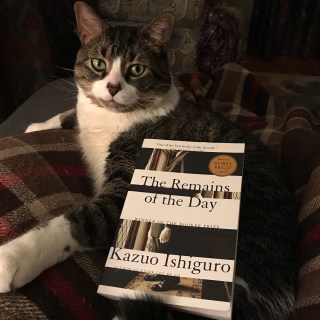
img_0221The Remains of the Day by Kazuo Ishiguro

Date Read: March 18 to April 16, 2019

Rating: 4 (of 5) stars

Although it took me a painfully long time to get through this one, I actually quite enjoyed it. The story unfolds slowly, with the past and present interspersed. The narrative is a sort of stream of consciousness, a trail through present circumstances and reflections on the past as our narrator, Stevens, drives himself through the countryside. It is beautifully written, and the style was striking to me– the type of mind wandering is very much like the train of thought that I often find myself in when driving alone for a length of time.

Stevens is intriguing as a narrator, in that he is both extremely reliable, and completely unreliable. He recounts events themselves with extreme precision, but with no acknowledgment of emotion. He talks at length of dignity, but never truly defines it for himself. His definition, it seems, is that dignity means detachment. He separates himself from reality, making himself into what he believes his employer wants him to be. As he gets closer to his meeting with Miss Kenton, we start to see some small cracks in this shell. Although he does not yet admit it, he denies his connection to his former employer. While he will defend Lord Darlington to readers, he will not do so publicly. He begins to admit that perhaps he was misleading himself to believe Miss Kenton wants to return to Darlington Hall with him.

The ending we get is both tragic and hopeful. While his reunion with Miss Kenton is heartbreaking (he even admits this himself!), he seems to get some closure he was lacking. At that moment, Stevens becomes a bit more understandable as a character. His conversation with a stranger on the pier gives us a little hope for his future– perhaps he will seize upon the remains of his day, even if it is simply in his mastering of bantering with his new employer.

Boris’s thoughts: “You need to start reading some happier books. 2 paws.”

Dragons Love Tacos

img_0228-1Dragons Love Tacos by Adam Rubin

Did you know that dragons love tacos? This was a new edition to our school library this year, and the librarian suggested that I should bring it home for Boris to read before it went out into circulation.

This book is light on plot, but high in silliness. The first part of the book provides some various evidence about how much dragons love tacos. We get a bit of a story going in the second part of the book, when we are introduced to the one thing that dragons love more than tacos: taco parties. BUT, of course, dragons cannot have hot sauce on their tacos. It makes them too fiery. When the boy in the story plans the best taco party ever, there is a mix-up with his totally mild salsa, and chaos ensues. Don’t worry though, even though it was an accident to burn down the whole house, the dragons will help rebuild. Because dragons have building skills, and they are nice, in addition to loving tacos.

It was a pretty easy read, and pages are dominated by illustrations rather than text. It would be a non-intimidating book for early readers, although there are some more difficult words. I can see this as a good read aloud. It’s silly enough to keep most kids interested, even without a big draw to find out what happens in the end.

Boris thoughts: “I am a dragon. I never knew. 4 paws.”

Brave New World

img_9303Book: Brave New World by Aldous Huxley

Date Read: March 3 to 18, 2019

Rating: 4 (of 5) stars

Third time is the charm, so to speak. After starting this book on two other occasions, I finally made it all the way through!

I had a bit of difficulty with March’s prompt from The Unread Shelf Project: the book that has been on your shelf the longest. Here’s the thing– I have about 60 books that have been on my shelf the longest (the books that I added within the first two days of starting my Goodreads account 8 years ago). Part of the reason that I chose this one over the others is that I had started it before, but never made it very far in. A friend of mine also lists this as one of her favorites, so I thought it would be worth powering through! (It was.)

I am not sure that you can get more “classic dystopia” than Brave New World. While I think we can all agree why the society is problematic from any viewpoint, there is an interesting balance struck. Society is functional, as it balances productivity with consumption, and meets human needs on a very basic level (really, what more do we need than food, sex, and entertainment?). To top it off, everyone is trained from birth to know what they want and to be happy with their place.

While I was not really crazy about the writing style (a bit dry, matter of fact, like I would expect in a textbook), I did like the way that the society was initially set up for us. We get a basis of how the society is built by its introduction to the students touring the hatchery, and then the details are filled in from three perspectives: Lenina, who is wholly satisfied in this world; Bernard, who knows enough to be critical, but is content enough to do little more than push boundaries; and finally the Savage, a complete outsider who is horrified by what he sees happening around him.

One other piece to this that I found interesting, is that this is a problematic society that recognizes that it is problematic. Those at the top realize the monotony of life for the individual, but choose to maintain it as is. Being “in the know” gives them to freedom to think and even criticize society, but this must be kept secret from the masses. This puts quite a spin on the punishment of being transferred to an island– the islands are the only place where people can live and think freely! Even the Director admits at the end, it would be a sort of unknown luxury to live on an island. Perhaps I should see about being transferred to Iceland.

Boris’s thoughts: “Any society that does not include CATS is not worth considering. 1 paw.”

The Epic Fail of Arturo Zamora

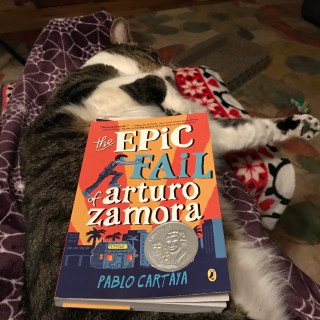
img_9277Book: The Epic Fail of Arturo Zamora by Pablo Cartaya
Date Read: February 24 to March 3, 2019

Rating: 4 (of 5) stars

This book was the 2019 selection for “One Book, One City” in Grand Rapids. (For more information about One Book One City, please see my post about last year’s book, One Crazy Summer, which also includes a description of the program.)

There are so many topics covered here, that it is hard to know where to begin– family, culture, food, community, first love, and how hard it can be to deal with all of those things as an adolescent. I definitely understand why this was chosen as a book for this project. Cartaya nailed it here with the voice of Arturo: he comes off as genuine and sincere in his telling of his story, but all the awkwardness of being a thirteen year old boy searching for himself shines through. I love how Arturo is willing to listen to the stories from his family to guide him, to help him decide what is the right thing to do. The use of Spanish throughout is fitting and interesting, although a little confusing at times. Most often there is enough context to get the idea, but I feel like knowing more Spanish would have added to the experience of the book as a whole.

Another theme that I did not directly mention above, but many of the students I work with recognized, was the impact gentrification. In the story, Arturo is fighting for the survival of his family’s restaurant, against a real estate developer whose interest obviously lies in his own profit rather than the betterment of the community. While it comes off as a fairly clear good vs. evil here, many of our students were able to point to parallels within our own community, and in the real world it is not quite so cut and dry. Where is the line between “gentrification” with its often negative connotation, and general improvements to a community that is in need of help? Although we have not had to deal with established and successful businesses being pushed out (as is dealt with in this book), there are definite and noticeable changes happening within the community where our school resides. Many of these are seen as positive, but there have also been some repercussions for families (such as higher rent). This is a bit of a bigger topic than I am prepared to deal with here, but it was definitely a good conversation starter for our kids, and an opportunity to evaluate and form their own opinions.

Penguin and the Cupcake

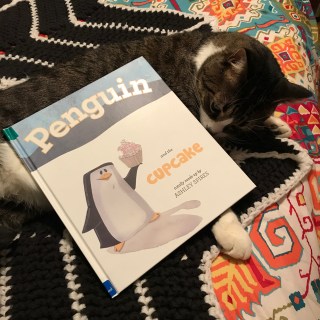
img_9324Book: Penguin and the Cupcake by Ashley Spires
At the risk of seeming unfairly biased toward books about penguins, I present to you this lovely new discovery of mine. Penguin has grown tired of his regular penguin diet. He has heard stories of a wonderful food that he must investigate for himself– cupcakes. Penguin sets off on a search for a cupcake. There are none at the South Pole where he lives, so he heads north. Perhaps a bit too far north.

In addition to a cute story, there are quite a few “extras” woven into the book that I very much enjoyed. Most of these start as informational asides, but also include a little laugh for adults reading along. For example, Penguin meets a walrus who is on a strict kelp diet. However, it’s noted that walruses do not generally eat kelp. This walrus has some body image issues, and is trying to meet an unrealistic physical ideal.

I see this particular book as a fun read aloud, or perhaps a good book for adults to read with children. It seems it might be more enjoyable as a joint reading, as opposed to something kids may read on their own. The side notes that I enjoyed do include some more difficult words that kids would likely struggle with independently, and there may be some explanations needed.

Boris’s thoughts: “I hope that penguin is willing to share the cupcakes. What do you mean there aren’t any real cupcakes? 1 paw!”

Station Eleven

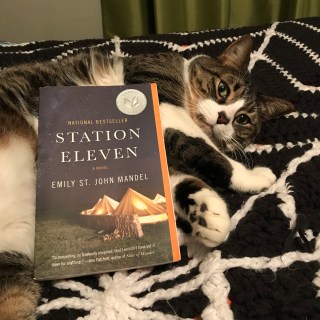
img_9223Book: Station Eleven by Emily St. John Mandel

Date Read: February 15 to 23, 2019

Rating: 5 (of 5) stars

From the beginning, I was completely enthralled by this book. I have read a fair share of dystopian fiction, but this had a different feel to it that I immediately loved. Rather than a long view into the future, we enter the new world just 20 years from the world as we know it. I love that we get to see the before, after, and during the fall of civilization. The mix of characters in the Traveling Symphony adds another interesting aspect– we have a group varied enough in age that there are those who were adults and children at the time of the fall, and then also a few characters who have known no other world than their present.

While the plot is not exactly full of action, it was gripping enough that I constantly wanted to find out what was going to happen next. There is a bit of perspective jumping, which I sometimes find annoying as a reader, but was done very well in this case. As I mentioned, there are three different timelines running through the book– before, after, and during the outbreak of an epidemic illness. In addition, there are several characters that carry over from each of these time periods, each with somewhat overlapping narratives. Each time the perspective or time changed, I found myself feeling two things: disappointed to be leaving the current perspective, but excited to find out what the next character had been up to while I had been otherwise occupied.

One thing that I personally found interesting here was the setting– in particular the geography. A fair amount of time is spent describing the route taken by the Traveling Symphony, including the names of cities that we recognize, as well as a few “new” cities that were recreated after the collapse. I loved that there were some concrete locations that I know for certain, and just enough clues to piece together a real picture of the area that they are traveling. I admit I may be a bit biased– I am fairly convinced that much of the action in the “after” portion of the novel occurs right in my own backyard (so to speak). Based on the information included, I am quite certain that the “Severn City” mentioned as a destination must be Grand Rapids, MI. It’s not an exact fit, but too close to be anything else either.

Moving a bit away from the actual story, while I was reading this book I also heard a new song on the radio, and the two will now forever be linked in my mind: Come Along by Cosmo Sheldrake (you can hear it here). Something about the style and story of the song fits so well with Station Eleven. Even though they are certainly a more classical group, I can imagine the Traveling Symphony playing and sing as they move from town to town. Of course, it is not an exact fit (much less of a fit than my conclusions on geography), but something about this link just seems right to me. Each time I heard it on the radio, it made me want to rush home to read a bit more!

Boris’s thoughts: “This all sounds rather complicated. I’m glad you enjoyed it though. 3 paws.”

Educated

img_9128Book: Educated by Tara Westover

Date Read: February 2 to 15, 2019

Rating: 5 (of 5) stars

Educated was my book for February’s prompt from The Unread Shelf Project: a book that was gifted to me. I received this for Christmas from a friend who also works in education. While I had seen the book many times before then, I really did not know much about it. It was described to me as a book by a woman who did not have any formal education until she was 17.

That description hits on the general premise, but there is much more here than I had expected. Although it centers on the theme of education, the scope of this book goes well beyond that. I think what stands out the most here is actually the overcoming of a traumatic and abusive past. It’s interesting to see Tara’s own view of her past, her struggling in how to view her own place in the world– is she part of her family, or is she part of the rest of the world? One of the things that seemed most striking to me, was actually fairly subtle. As Tara reflects back on many of the obviously traumatic ordeals from her childhood, she does not often overtly refer to her experiences as abuse.

Tara does much reflection on the fact of her pursuit of education creating the rift between her and her past. She makes many efforts to minimize the growing distance between her and the remainder of her family. Along the way, she catches herself hanging on to pieces that she really no longer believes– such as when she realizes that even though she is accepting of modern medicine, she has not gone to get her vaccinations. However, I found it interesting that throughout her education, she still hangs on to the original tenants of her Mormonism. While she relaxes some of the extremes in her personal practices, she retains the basis of her religion, and even extends this into her educational pursuits.

Boris’s thoughts: “Long stretches of reading means long stretches of naps for me, so 3 paws here!”

Cannery Row

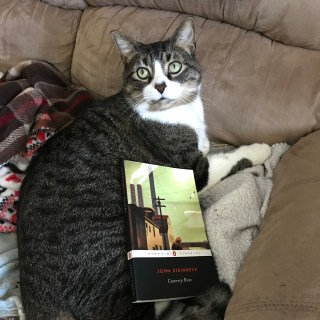
img_8918Book: Cannery Row by John Steinbeck

Date Read: January 20 to February 2, 2019

Rating: 5 (of 5) stars

Cannery Row is not so much a novel, as a capturing of a moment in time. Light on plot, but heavy in description, it features dozens of characters that each play a part (however small) in the central story. Although there’s a long and winding road to get there, the main story centers on the planning of a party for Doc, orchestrated by Mack and the boys, a group of homeless men who have taken over an old warehouse. Their initial plan is ill conceived and leads to minor disaster, but eventually circles around through the community for a happier ending.

Taking place in a relatively quiet California coastal town during the Great Depression, the story is told through a series of vignettes of various length. There are some clearly driving the plot, and others that link to the main story in ways that are not obvious as you are reading. The style gives the book a inextricable feeling of community. The small details of each moment, the strings of each life in Monterey interwoven.

Part of what is interesting to me, is that each character seems to know their place and their part in the scheme of their own world. Most are destitute, but content where they are. Mack and the boys certainly know what they need to do to improve their situation, but are content to get by with life as it is. They have a roof over their heads, the little dog Darling to care for, and just enough niceties to make the Palace Flophouse home. Another character I found interesting was the woman who loves to throw parties, but cannot afford to actually put on a party herself. When she’s not able to help in planning for others, she contents herself with tea parties with the neighborhood cats. Well, why not?

Boris’s thoughts: “I am concerned with the collecting of cats for Doc… but would really enjoy a tea party, so I’ll even it out: 2 paws.”