The Immortalists

img_0238The Immortalists by Chloe Benjamin

Date Read: April 16 to April 29, 2019

Rating: 5 (of 5) stars

Would you want to know the day that you are going to die? This story is built around a fairly simple premise, but unwinds into an intricate and complex tale of family and relationships. As children, four siblings, Varya, Daniel, Klara, and Simon, visit a woman that people say can tell your future—specifically the day that you will die. Over the course of the novel, the following 40-ish years, we get to know each of the siblings a bit better in their own rite, as well as in relation to their family.

While reading, I loved and hated each one of the siblings. I adored their individuality, I cursed their faults, and I grieved each of their subsequent deaths. There were so many points that I could not put it down, even when I had a sinking feeling of what was coming. The story of each sibling is vibrant and emotional; despite the huge differences in how they chose to live in the time they were told they had remaining. The obvious discussion, which is even mentioned on the back cover, is the intertwining of fate and choice. Would Simon have lived so recklessly if he had not anticipated dying young– would he have lived longer if he had played it safe? How did knowledge of a death date play into Klara’s obvious mental illness, and would she have met the same end without it? Even Daniel, who claims to not believe the prophecy, is driven by the knowledge to actions that seem spectacularly out of character. While there could certainly be much said here, I thought the sibling relationship aspect was even more interesting, in the context of the impending dates.

After each death, we get a glimpse of that character from the view of the next, with trails of these through each sibling’s story. In each case, the surviving siblings carry with them some perceived responsibility for those before them. Is Klara responsible for Simon because she encouraged him to live his life? Is Daniel responsible for any of this by convincing his siblings to see the woman in the first place? What about Varya, who was oldest and should have known to put a stop to it? In her meeting with the woman, Varya asks, “what if I change?” Was her destiny determined before she asked, or was it the knowledge of her death date that changed her?

As expected, the novel overwhelmingly centers on death. However, it is also full of life—the richness of each story is intriguing and compelling. I loved the ending, which I thought contrasted with the first sections, but fit perfectly in the context of the full story. In a novel about death, we end on a note of life and hope for the future.

Boris’s thoughts: “After all of that… no, I don’t think I want to know the day I will die. I would, however, like to take a nap. 2 paws.”
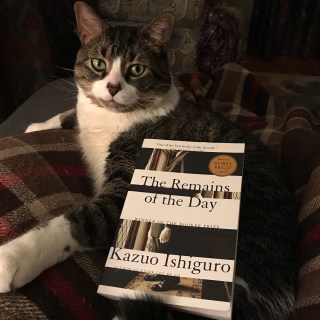
The Remains of the Day

img_0221The Remains of the Day by Kazuo Ishiguro

Date Read: March 18 to April 16, 2019

Rating: 4 (of 5) stars

Although it took me a painfully long time to get through this one, I actually quite enjoyed it. The story unfolds slowly, with the past and present interspersed. The narrative is a sort of stream of consciousness, a trail through present circumstances and reflections on the past as our narrator, Stevens, drives himself through the countryside. It is beautifully written, and the style was striking to me– the type of mind wandering is very much like the train of thought that I often find myself in when driving alone for a length of time.

Stevens is intriguing as a narrator, in that he is both extremely reliable, and completely unreliable. He recounts events themselves with extreme precision, but with no acknowledgment of emotion. He talks at length of dignity, but never truly defines it for himself. His definition, it seems, is that dignity means detachment. He separates himself from reality, making himself into what he believes his employer wants him to be. As he gets closer to his meeting with Miss Kenton, we start to see some small cracks in this shell. Although he does not yet admit it, he denies his connection to his former employer. While he will defend Lord Darlington to readers, he will not do so publicly. He begins to admit that perhaps he was misleading himself to believe Miss Kenton wants to return to Darlington Hall with him.

The ending we get is both tragic and hopeful. While his reunion with Miss Kenton is heartbreaking (he even admits this himself!), he seems to get some closure he was lacking. At that moment, Stevens becomes a bit more understandable as a character. His conversation with a stranger on the pier gives us a little hope for his future– perhaps he will seize upon the remains of his day, even if it is simply in his mastering of bantering with his new employer.

Boris’s thoughts: “You need to start reading some happier books. 2 paws.”

Brave New World

img_9303Book: Brave New World by Aldous Huxley

Date Read: March 3 to 18, 2019

Rating: 4 (of 5) stars

Third time is the charm, so to speak. After starting this book on two other occasions, I finally made it all the way through!

I had a bit of difficulty with March’s prompt from The Unread Shelf Project: the book that has been on your shelf the longest. Here’s the thing– I have about 60 books that have been on my shelf the longest (the books that I added within the first two days of starting my Goodreads account 8 years ago). Part of the reason that I chose this one over the others is that I had started it before, but never made it very far in. A friend of mine also lists this as one of her favorites, so I thought it would be worth powering through! (It was.)

I am not sure that you can get more “classic dystopia” than Brave New World. While I think we can all agree why the society is problematic from any viewpoint, there is an interesting balance struck. Society is functional, as it balances productivity with consumption, and meets human needs on a very basic level (really, what more do we need than food, sex, and entertainment?). To top it off, everyone is trained from birth to know what they want and to be happy with their place.

While I was not really crazy about the writing style (a bit dry, matter of fact, like I would expect in a textbook), I did like the way that the society was initially set up for us. We get a basis of how the society is built by its introduction to the students touring the hatchery, and then the details are filled in from three perspectives: Lenina, who is wholly satisfied in this world; Bernard, who knows enough to be critical, but is content enough to do little more than push boundaries; and finally the Savage, a complete outsider who is horrified by what he sees happening around him.

One other piece to this that I found interesting, is that this is a problematic society that recognizes that it is problematic. Those at the top realize the monotony of life for the individual, but choose to maintain it as is. Being “in the know” gives them to freedom to think and even criticize society, but this must be kept secret from the masses. This puts quite a spin on the punishment of being transferred to an island– the islands are the only place where people can live and think freely! Even the Director admits at the end, it would be a sort of unknown luxury to live on an island. Perhaps I should see about being transferred to Iceland.

Boris’s thoughts: “Any society that does not include CATS is not worth considering. 1 paw.”

Station Eleven

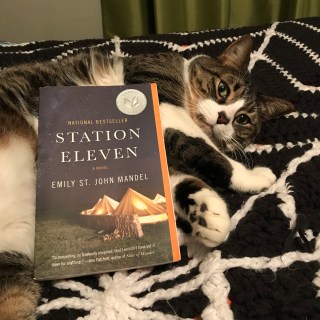
img_9223Book: Station Eleven by Emily St. John Mandel
Date Read: February 15 to 23, 2019

Rating: 5 (of 5) stars

From the beginning, I was completely enthralled by this book. I have read a fair share of dystopian fiction, but this had a different feel to it that I immediately loved. Rather than a long view into the future, we enter the new world just 20 years from the world as we know it. I love that we get to see the before, after, and during the fall of civilization. The mix of characters in the Traveling Symphony adds another interesting aspect– we have a group varied enough in age that there are those who were adults and children at the time of the fall, and then also a few characters who have known no other world than their present.

While the plot is not exactly full of action, it was gripping enough that I constantly wanted to find out what was going to happen next. There is a bit of perspective jumping, which I sometimes find annoying as a reader, but was done very well in this case. As I mentioned, there are three different timelines running through the book– before, after, and during the outbreak of an epidemic illness. In addition, there are several characters that carry over from each of these time periods, each with somewhat overlapping narratives. Each time the perspective or time changed, I found myself feeling two things: disappointed to be leaving the current perspective, but excited to find out what the next character had been up to while I had been otherwise occupied.

One thing that I personally found interesting here was the setting– in particular the geography. A fair amount of time is spent describing the route taken by the Traveling Symphony, including the names of cities that we recognize, as well as a few “new” cities that were recreated after the collapse. I loved that there were some concrete locations that I know for certain, and just enough clues to piece together a real picture of the area that they are traveling. I admit I may be a bit biased– I am fairly convinced that much of the action in the “after” portion of the novel occurs right in my own backyard (so to speak). Based on the information included, I am quite certain that the “Severn City” mentioned as a destination must be Grand Rapids, MI. It’s not an exact fit, but too close to be anything else either.

Moving a bit away from the actual story, while I was reading this book I also heard a new song on the radio, and the two will now forever be linked in my mind: Come Along by Cosmo Sheldrake (you can hear it here). Something about the style and story of the song fits so well with Station Eleven. Even though they are certainly a more classical group, I can imagine the Traveling Symphony playing and sing as they move from town to town. Of course, it is not an exact fit (much less of a fit than my conclusions on geography), but something about this link just seems right to me. Each time I heard it on the radio, it made me want to rush home to read a bit more!

Boris’s thoughts: “This all sounds rather complicated. I’m glad you enjoyed it though. 3 paws.”

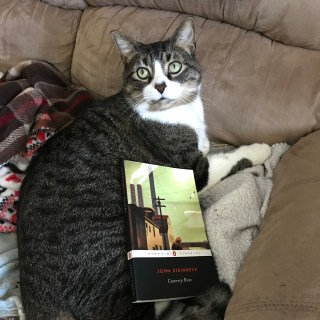
Cannery Row

img_8918Book: Cannery Row by John Steinbeck

Date Read: January 20 to February 2, 2019

Rating: 5 (of 5) stars

Cannery Row is not so much a novel, as a capturing of a moment in time. Light on plot, but heavy in description, it features dozens of characters that each play a part (however small) in the central story. Although there’s a long and winding road to get there, the main story centers on the planning of a party for Doc, orchestrated by Mack and the boys, a group of homeless men who have taken over an old warehouse. Their initial plan is ill conceived and leads to minor disaster, but eventually circles around through the community for a happier ending.

Taking place in a relatively quiet California coastal town during the Great Depression, the story is told through a series of vignettes of various length. There are some clearly driving the plot, and others that link to the main story in ways that are not obvious as you are reading. The style gives the book a inextricable feeling of community. The small details of each moment, the strings of each life in Monterey interwoven.

Part of what is interesting to me, is that each character seems to know their place and their part in the scheme of their own world. Most are destitute, but content where they are. Mack and the boys certainly know what they need to do to improve their situation, but are content to get by with life as it is. They have a roof over their heads, the little dog Darling to care for, and just enough niceties to make the Palace Flophouse home. Another character I found interesting was the woman who loves to throw parties, but cannot afford to actually put on a party herself. When she’s not able to help in planning for others, she contents herself with tea parties with the neighborhood cats. Well, why not?

Boris’s thoughts: “I am concerned with the collecting of cats for Doc… but would really enjoy a tea party, so I’ll even it out: 2 paws.”


The Marvels

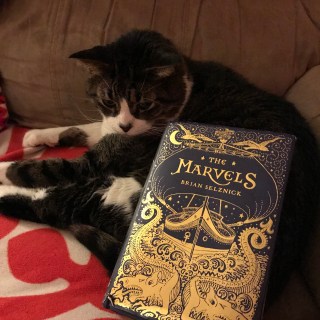
Book: The Marvels by Brian Selznick

Date Read: December 29, 2018 to January 3, 2019img_8825

Rating: 5 (of 5) stars

I am completely fascinated by the work of Brian Selznik. The way he perfectly intertwines illustration and narrative to tell a story is incredible. The concept he used in this particular book is unique even for him, and was done spectacularly.

The Marvels tells two stories– the first completely through illustration in the first 400-ish pages, the second in a traditional novel format. The whole time I was reading, I was trying to solve the mystery of how the stories would come together in the end. I was constantly making guesses as to where things were going, and constantly being surprised. When the stories began to overlap, I thought it was a clever twist that the novel turned to do the same thing that I was doing as a reader– putting words to the original illustrated story, and then trying to solve the mystery as well.

This book was beautifully put together. The illustrations beautiful, and the stories compelling. While perhaps geared more toward a younger demographic, there is much here to enjoy for readers of all ages. I was also thrilled to discover, as I came to the end, that this story was based, in part, on real events. While the story is completely fictional, the idea behind the story is based on an actual person and museum in London. I have definitely found somewhere that I will need to add to my travel wish list.

Boris’s thoughts: “This book is heavy, and I’m kind of over it. 2 paws.”

The Ocean at the End of the Lane

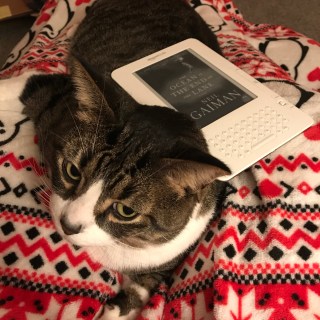
img_8777Book: The Ocean at the End of the Lane by Neil Gaiman

Date Read: December 3 to 29, 2018

Rating: 4 (of 5) stars

I have unintentionally done something that I generally try to avoid: writing about the same author twice in a row. At least there was a week off in between? Previously, I wrote about Cinnamon, a picture book by Neil Gaiman. I realized shortly after posting, that another work by Gaiman was up next on my novel reading list. While I suppose it is not ideal, here we are.

Despite the length of time it took me to read this relatively short book, I did quite enjoy it. In a way, it is a book about nostalgia and magic. But at the same time, it is itself nostalgia and magic. I love the idea Gaiman has here of magical places in the world, stuck in time: we go to them to remember things that happened there, but when we leave we start to forget. Forget the memories, forget the magic that we have experienced.

The main plot of the story is primarily a fantasy adventure, although I would say that it is “fantasy lite.” The magical creatures, both good and evil, are there, but the story primarily takes place in our world. In fact, the main point of the adventure aspect is to protect our world from things that are trying to sneak into it. For me, it really was the perfect amount and taste of fantasy: I do enjoy elements of magic, but get overwhelmed by the lengthy and often complicated works that dominate the true fantasy genre.

Boris’s thoughts: “The real important message in this story is the importance of the cat. Shame on that boy for forgetting his kitten. 2 paws.”

Beauty and the Beast

img_8589Book: Beauty and the Beast by Jeanne-Marie Leprince de Beaumont

Date Read: November 26, 2018

Rating: 4 (of 5) stars

This is not the story of Belle and the Beast that you think you know. It is, of course, a translated and somewhat adapted version of the original tale by Jeanne-Marie Leprince de Beaumont. Although, I am under the impression that the version I read is at least close to the original. Interestingly, this is also not quite the typical original fairy tale vs. popular story scenario either.

To start, our heroine’s name is never actually mentioned, she is just referred to as Beauty by everyone because she is beautiful. She is not the only child of an eccentric inventor, but is one of 6 children of a wealthy merchant who has lost everything and moved to the country. She adjusts a bit better to the new lifestyle than her sisters, who constantly complain about being poor and bored, but also refuse to do anything to help around the house. Beauty’s father does stumble upon an enchanted castle, where he is well treated. The Beast appears only when he has decided to steal a rose from the garden to take home for Beauty. However, the Beast is not the jerk that you suspect him to be. He is, from the beginning, a generally decent guy. Beauty’s father pleads his case to return to his family to at least say his goodbyes, and leaves in the agreement that either he or one of his daughters will return. Upon learning that it was her request for a Rose that caused this problem for her father, Beauty returns to the castle despite her father’s protests.

The next bit of the story proceeds without much incident or discrepancy from the more popular version. Beauty has a generally pleasant time at the castle, her and Beast get along well from the beginning. She does become homesick, and Beast agrees to allow her to return to visit her family, after she gives her word that she will return after a week. This is where we depart from the popular version of the story, to one that is a bit less dramatic. There is no jealous suitor after Beauty, there is no mob with torches and pitchforks. Beauty returns to visit her family, and her sisters continue to spite her for her new life living in a castle. As the end of her week draws near, they convince her to stay longer– not because they have missed her, but because they hope that she will be punished by the Beast for breaking her word.

Beauty stays, but after an additional week decides that she must return to the castle. We return to the castle to find, not a dramatic battle for the love of Beauty, but a heartbroken Beast. When Beauty did not returned as promised, he was devastated by the loss of her and is in a deep depression. Feeling guilty for the pain she has caused him, Beauty apologizes and declares her love, thereby breaking the spell. Beauty lives happily ever after with the prince, and her sisters are punished for their evil and selfish ways. Although the ending is quite similar, it actually a much friendlier seeming version than the one that we all know from Disney.

Boris’s thoughts: “Day reads make nice snuggle times. I approve. 4 paws.”

All the Ugly and Wonderful Things

img_8460-1Book: All the Ugly and Wonderful Things by Bryn Greenwood
Dates Read: October 30 to November 25, 2018

Rating: 3 (of 5) stars

The last couple months have been a bit crazy for me, and so it has been quite awhile since I have done a normal review. This is one that I struggled with quite a bit. On the one hand, this is a beautifully written and compelling story. On the other, the subject matter is a bit… should I say, problematic? I think perhaps the author hit the nail on the head with the title.

When I first read the description of this book, I thought it sounded potentially interesting. Of course, it’s impossible to ignore that it is definitely polarizing. The main plot is the development of a relationship between a young man and a female child. When they first encounter each other, I believe they are 19 and 8 years old, respectively. The situation that Wavy is living in is quite horrific. Her father is a meth dealer, her mother was recently released from prison and is obviously mentally ill, and she ends up as the primary caregiver to her infant brother as well as her mother. Enter Kellen, a “business associate” of her father, after he crashes his motorcycle on his way up their driveway. After recovering from the accident, he takes an interest in the children at the house. This seems partially due to a perceived debt to Wavy for saving him, as well as some genuine concern for how they are living (really, the first thing he does when he goes to the house is to clean up). Things become much more complicated from here, especially when 11 year old Wavy begins referring to Kellen as her boyfriend, and wondering what she needs to do to get his attention away from other women. This all leading to an increasingly inappropriate relationship developed between Wavy and Kellen over the next several years, with the novel spanning over two decades.

In some ways, it is difficult to deny that Wavy’s relationship with Kellen is in many ways the most functional and healthy relationship that she has with anyone. Does that make this relationship okay? No. It doesn’t. However, I think most of the commentary I have seen about this book ignores what I think might be the most important piece of this: where do we draw the line? I don’t think there are many people who would try to argue that any type of sexual relationship between a 13 year old girl and a 25 year old man is normal. Kellen himself is quick to point this out, and is very clear about the fact that he will not have sex with her. However, there are certainly lines crossed into the territory of sexual impropriety and even sexual abuse (no, it does not matter that she was a willing participant– she was a child, and encouraged his sexual interest in her because she thought it was what she had to do for him to love her).

However, if we look back to the beginning of the relationship, when did it become inappropriate? I think there are some definite places where we can see crossed lines, but many of them are a bit blurred. Was Kellen bringing food to the house, and helping care for the children wrong? Should he have not gotten involved when Wavy’s father was physically abusive? Was the line crossed when he knew that Wavy had a crush on him, but continued to come to the house? What about pretending to be her father for a parent teacher conference, or lying on the forms so that she could be enrolled in school when her parents would not? When Wavy told her Aunt and cousins that she had a boyfriend? Was laying next to her on a blanket in the field wrong, or was it not wrong until she tried to kiss him, or when they started to go out on dates? When Kellen realized he loved her, or told her he loved her? When he gave her a ring?

Doubling back for a second, does any of this make the abusive factor of the relationship okay? Still no. My point though, is that Kellen is not exactly a sexual predator or even a definitive pedophile (he did not have a sexual preference for children; he had no interest in other young girls, just Wavy). Perhaps this is something we should take as food for thought, consider it in how we view other people in the real world. Does it justify their actions? No, but it can help us to understand how lines are blurred for certain people in certain situations.

Boris’s thoughts: “This is complicated. Can we try some light reading next time? 2 paws.”

Gone, Part 3

Book: Gone (Series) by Michael Grant

Date Read: June 13 to October 26, 2018

Rating: 4 (of 5) stars

Fearimg_7940

There is a bit of a jump from the end of Plague to the beginning of this one, so it allows for a bit of time for things to settle. It is a time of relative calm, with separate settlements at the Lake with Sam and Caine reigning as the self-proclaimed King of Perdido Beach. Diana separates herself from Caine at the end of Plague, and Astrid has gone off the grid. It’s good to see Astrid on her own, relying on her own intelligence to survive rather than looking for someone to “save” her. It was also nice to see life outside of the FAYZ.

This was a pretty eventful book, which did keep it interesting and moving along, although I found some of the middle sections a tad overwhelming. There was so much going on simultaneously, with shifts in perspective, which sometimes made it a bit hard to follow. I liked the new perspective gained with Little Pete as still alive, but without physical presence.

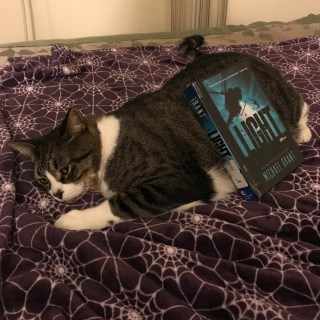
img_8184Light

Unlike most of the other books, there is a minimal time gap going into Light. The FAYZ has gone clear, giving the children of the FAYZ their first glimpse into the outside world– and, of course, the world’s first glimpse into the horror of the FAYZ. I thought this was good in putting the whole arch of the story into perspective. Obviously after being cut off from the world for over a year, the mindset of those inside has changed dramatically. Normal life in the FAYZ is far from normal. This is, of course, an obvious observation. However, five books into a series that technically takes place in the “real world,” it’s nice to get that reminder. Grant does well in imagining how this change will play out in the minds of different characters– Brianna, who is younger, takes this as an opportunity for notoriety, bragging about her heroic deeds that horrify the outside world; some of the older characters– Sam, Caine, Astrid– are a bit more realistic about the consequences they may face with an end to the FAYZ.

Overall, I would say this is a solid wrap up to the series. The “end game” unfolds bit by bit, we get to see the demise and redemption of the main characters from throughout the series. My only complaint here would be that the final battle scene was a bit anticlimactic– we certainly have a big build up to this point, but the actual battle is over within about a paragraph. The only real surprise here is the revelation of who Little Pete has chosen to battle with. I also liked that there wasn’t a simple wrap up with the FAYZ wall coming down– there is a fallout, and we get to see how this plays out for most of the main characters.

Series

As a whole, this was a well written and well developed series. There is a good mix of action and the sometimes dull reality between, which helps to build the world of the phase. My only real issue with the series as a whole, is what I addressed specifically in the first book– the content seems a bit mismatched with the Fourth Grade reading level of the books. I can certainly see children that age enjoying parts of these novels, but there are some pretty graphic descriptions of the horrors of the FAYZ, as well as some elements that I would be a difficult discussion with that age group. I don’t just mean violence (although there is plenty of that)– I mean description of intense violence including mass murder, cannibalism, people being eaten alive from the inside by parasites, and issues related to sexuality, suicide, and religion. While I would agree that all of these fit in and have a place in the story (remember, we are focused on a group of children forced into adult roles by the situation), it just seems to be aimed at a bit more mature of a group than the reading level would suggest. I would consider this more appropriately as a young adult read than a novel for the middle grades.

Date Read: June 2018 to October 2018

My rating: 4 (of 5 stars)

Boris’s thoughts: “This is all a bit too intense for me. I think I need a nap. 2 paws.”