The Memory Keeper’s Daughter

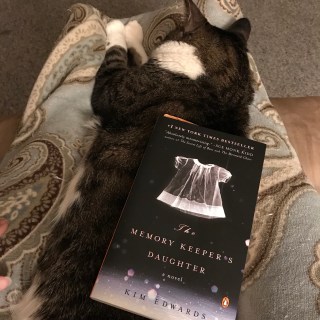
Book: The Memory Keeper’s Daughter by Kim Edwards

Date Read: May 14 to June 10, 2018img_6170
Rating: 4 (of 5) stars

I’m still a bit torn in how I feel about this one. In many ways, I did quite like this book, but much of it also does not feel quite right for me. I debated between 3 and 4 stars on this one, and decided on 4 based on some things in the structure of the novel that I felt were interesting.

I like the premise of the novel, but the plot was rather plodding. There seemed to be so much going on individually with each character, but really, not much happens in terms of actual plot development. The same goes with characters. While I do think there was some personal growth for each of the family members, I think it was pretty minuscule considering the span of a lifetime. At the same time, I think this works for the novel on some levels. Isn’t that kind of how life works sometimes? Every person has struggles and triumphs, but if we were to lay them out as a dramatic timeline, most of us would find our lives to be rather dull. In the moment, events seem big, but often they do not turn out to be as monumental as we presume. At the same time, big is not the same as consequential. Everything, to some degree, is consequential. And then contrasting this (or perhaps complementing it?), is Caroline’s “big moment” of realization when she simply looks at her small family through the window of their home.

This leads in to what I mentioned earlier about the structure of the novel. The story spans approximately 25 years in around 400 pages. There are time jumps, several of them rather significant. In each case, these occur at the climax of a dramatic event, leaving no direct resolution. Everything is resolved (or not) behind the scenes, and we learn how each of these played out based on characters’ reflections on the past. While I could see this as something that could annoy many readers, it’s not something that I have seen done before, and I thought it was an interesting choice on the part of the author.

There is, of course, one major lacking: Phoebe’s perspective. While the novel does not take a first person view from any character, we do get to see life from the perspective of the main characters: David, Norah, Paul, and Caroline, but never Phoebe. We learn that she likes cats and music, knows how to weave, and has a boyfriend that she wants to marry. But that’s really about it. That’s a huge discredit, especially for the title character. I think it’s unfortunate that in a novel that very much promotes that idea that she should be viewed as a person and not a disability, we do not get the opportunity to see the world from her eyes.

This is going to seem nit-picky, but I feel like I need to mention it since I am still thinking about it. I feel like there was a lack of attention to detail on the part of the author. For example, the book refers to Van Gogh’s Starry Night being viewed at the Louvre. However, Starry Night is not (nor has ever been) at the Louvre. In fact, there are no Van Gogh paintings in the Louvre at all. There are also some inaccuracies related to the times and distances traveled in a few places in the novel. While these are admittedly not major faults, they are things that irk me a bit. I knew immediately that these things could not be correct just from my general knowledge. I feel like these were errors that could have very easily been avoided with just a little fact checking.

Boris’s thoughts: “Phoebe likes cats? Well then I like Phoebe. 4 paws.”

Don’t Let the Pigeon Drive the Bus

img_6152Book: Don’t Let the Pigeon Drive the Bus by Mo Willems

Oh, the Pigeon. I totally understand why people do not like the Pigeon. He is loud. He is obnoxious. He is persistent. He is whiny. He is annoying. But oh, I must admit, I kind of love the Pigeon. This one is not actually my favorite of the Pigeon books, but I thought it would be the most appropriate for a review, as it is the original. As usual though, most of what I have to say about this can be applied to the other books in the series as well. (I think my favorite is probably The Pigeon Needs a Bath, or perhaps, Don’t Let the Pigeon Stay Up Late.)

I love the set up of this book. It’s somewhere between a picture book and a comic book. The story is shown through pictures and dialogue. What I find most interesting is that the dialogue is one sided– the Pigeon is talking directly to the reader. Imploring, begging the reader to just, please, LET ME DRIVE THE BUS! I think this gives the (adult) reader options. This could be read as a monologue, or an interactive read aloud with children. Sure, there is not much variation in the children’s response to the Pigeon, but I think this makes it great for younger kids. (And certainly allows for the possibility of some fun!) This could also be a great choice for early readers, or for older children to read with younger. The illustrations are very simple, but are still able to portray the action of the pigeon in his plight to drive the bus.

You may notice that Boris is not alone in his picture with this book. A friend of mine told me that the Pigeon reminds her of me. At first I wondered if I should be offended, but she assured me, that it’s not that I am actually like him, but that he seems like “my kind of character.” Well, I suppose I do have to agree with that. For my birthday a few years ago, she gifted me a Pigeon. But not just a Pigeon, a TALKING Pigeon.

In the true spirit of the whiny, obnoxious, persistent Pigeon, he is only able to say one thing: LET ME DRIVE THE BUS. He generally hangs out in my office at work, where he is a big hit. A warning to parents though: he’s awfully cute, but you definitely don’t want your child walking around with a noise making toy that can only say one thing. Boris was not a huge fan. Our little photo shoot was a bit of a struggle, and I’m still not sure if he was annoyed or afraid of the Pigeon.

Boris’s thoughts: “If you put that thing near me again, I will destroy it……..which might be fun. 3 paws.”

Politically Correct Ultimate Storybook

Book: The Politically Correct Ultimate Storybook by James Finn Garner

Date Read: January 17 to 18, 2016img_6291

Rating: 2 (of 5) stars

This book was a gift. Admittedly, one that I likely would not have picked out myself. Nonetheless, I had some high hopes for it. I like fairy tales and those sorts of stories, and thought that the “politically correct” twist on it had the potential for hilarity. I was sadly disappointed.

By no means do I want to imply that there were not some good moments. There were some stories that made me laugh. I especially loved Sleeping Beauty (or, of course, The Sleeping Person of Better Than Average Attractiveness) being cursed to have unrealistic expectations of her future relationships. Honestly though, I thought that some of the story titles were funnier than the stories themselves. I feel like there was some good potential here, it just fell short for me.

I realize that part of the point of this book was to “go overboard” on political correctness. Or, at least, I think that was the point. I just felt that much of it just ended up being dumb, not funny. I also think that much of it really had nothing to do with political correctness. The best examples for this come from the selection of Holiday stories. Santa portrayed in a villainous way for being overweight? What’s politically correct about that? If politically correct was the goal, then I would think coming up with neutral seeming language would have been more appropriate. Then, there is the faux pas of the party host, who raises a holiday toast with his guests– forgetting that he has served eggnog, and one of his guests is vegan. The error is, of course, corrected. Again, where is the political correctness here? Having an alternative for a vegan friend is not “being PC,” its just being considerate.

Boris’s thoughts: “You didn’t like this one? You like everything. 1 paw.”

Bloodsucking Fiends

img_6096Book: Bloodsucking Fiends by Christopher Moore
Date Read: Various

Rating: 5 (of 5) stars

So I’m doing it again. It has been quite some time since I’ve read this book, but have come back to it several times. So, I will start with a story.

I discovered Christopher Moore when I was in college. There was a Borders Books near campus, which was where I often spent my long breaks between afternoon and evening classes, browsing and adding to my to read list rather than working on homework or reading for class. Borders liked to do these weekly table sales: buy 2 get one free, or buy one get one half off. It was like I had to find more than one to add to my ongoing collection. (Incidentally, I consider this a primary contributing factor to my now out-of-control to read list of 260+ books.) Anyways: it was on one of these tables that I found “You Suck: A Love Story.” I’m not generally a big fan of romance novels, so I was obviously intrigued. Upon discovering it was the follow up to a novel called “Bloodsucking Fiends” (also a love story), I knew I had to read them both.

Within a few pages, I knew I was hooked on Christopher Moore. His novels are well thought out, a bit ridiculous, and hurt your stomach laughing out loud funny. I love that he takes on subjects and characters that are well known, but then makes them his own. These are not the same vampires you know from Bram Stoker and Anne Rice, but that doesn’t stop them from researching themselves in the source materials.

Speaking of research, despite the zaniness of it all, it is clear the Moore does his homework before embarking on a novel. He shows a clear understanding of the material from which his characters grow, and masterfully guides them into new life. That’s right, I just described a guy who incorporates fart and penis jokes into all his writing as “masterful.” Really though, how else can you describe someone who can perfectly meld pure ridiculous with well known mythology? Somehow, you end up with a novel that makes you think, but also makes you laugh.

As a final comment on Christopher Moore, I think it’s important to note that he does not just draw on classic material, but also on his own. Although I would not consider them to be in any way a series, his novels all take place in the same world. This ranges from brief cameos to full on character borrowing. It’s not unusual to suddenly realize that a character is familiar because they were introduced through a minor part in a previously read book. While I suppose some might find annoying, I appreciate that Moore is able to make this feel natural. I have not yet encountered an issue with story continuity, nor have I felt that I didn’t get “enough” about a character in an individual novel.

Boris’s thoughts: “You know you’re never going to finish that to read list if you keep rereading books. Whatever. 3 paws.”

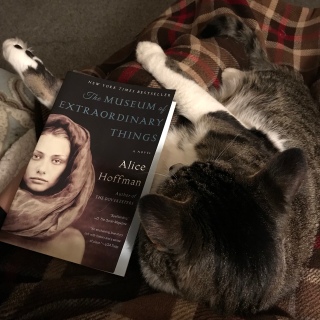
The Museum of Extraordinary Things

img_6038Book: The Museum of Extraordinary Things by Alice Hoffman

Date Read: April 11 to May 13, 2018

Rating: 5 (of 5) stars

This book was not what I was expecting. To be honest, I’m not 100% sure what I was expecting when I picked this one up. It came highly recommended by a friend, although I feel like our taste in books does not always have a huge overlap. It’s not that I was expecting it to be bad– I was just expecting something different than what I got.

While this novel could be called a romance, there is much more to it than that. Honestly, the romance aspect of the story was the least interesting part to me. There are several layers to the story– romance, mystery, perhaps even adventure. I particularly liked the historical aspect, tying in the events of the city in 1911, and touching on the labor movement. I knew the setting was historical, but thought the history aspect ended there. I was pleasantly surprised with the inclusion of historic events, and how they were intertwined with the characters. The firsthand depiction of the fire at the Triangle Factory was fascinating, albeit horrific. I appreciated Eddie’s perspective on the world, and how different it was from Coralie’s. Seeing the developments and changes in each of them through the novel was interesting.

After saying that, I feel that I should emphasize the word “appreciated.” There was quite a bit about Eddie that I did not like, but I do think his character is redeemable. He is cynical and selfish, and there was much in his behavior that just sort of irked me. However, his ability to view the world differently through his photography and his impulse to seek justice for the Weiss family create an appealing contrast to the other aspects of his character. I always have a greater appreciation of an author who can create a character that I do not quite like, but still want to root for.


Boris’s thoughts: “Too many dogs. More interested in the fish. 2 paws.”

Dragon’s Fat Cat

img_6116Book: Dragon’s Fat Cat by Dav Pilkey

Dav Pilkey has become quite popular with several of his characters (Captain Underpants, Dog Man, etc.), but I don’t think there will ever be one that I love quite as much as Dragon.

This is one of five books chronicling the (mis)adventures of Dragon. Whether he is learning how to take care of a new pet, celebrating a holiday, or just trying to get by in his daily life, Dragon has a way of getting things a bit mixed up. He is a little too easily spooked for Halloween, buys too much food at the grocery store to fit into his car, and is really not sure what can be done about the smelly yellow puddle problem that comes along with having a pet. However, he always knows where to turn to get a little help with his problems, and things end up working out for him in the end. He is a fun, silly character that has a few laughs for both kids and the adults that are reading with them.

Of course, I may be biased because we are both obviously cat people.

These are great for early readers–they have the feel of a chapter book, but the fun of a picture book. Each book is also broken up into shorter stories, but text is lower level and there are tons of great illustrations. I love the little “extras” that get added in to the story through the pictures.

As is my habit, I realize that I have again reviewed a whole series rather than an individual book. However, I’m going to stand by this as fair. As children’s books, these all go together fairly seamlessly. I certainly would have a hard time recommending one over the others. While I could probably narrow down a favorite story in each book, differentiating from there would be difficult. The four books that I have read each have a specific focus (Dragon’s Fat Cat, Dragon Gets By, Dragon’s Halloween, and Dragon’s Christmas), and each of the four books that I have read fit so well with their unique subject.

Boris’s Thoughts: “Are you trying to imply something? I’m not fat, I’m big boned! I’ll give a little credit though, since I guess that one cat does look a bit like me. 2 paws.”

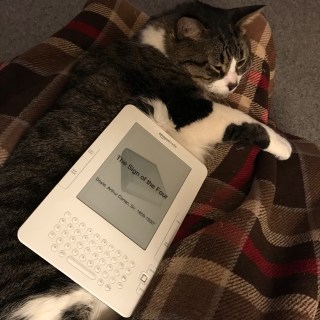
The Sign of the Four

img_5999Book: The Sign of the Four by Sir Arthur Conan Doyle
Date Read: April 4 to April 10, 2018

Rating: 4 (of 5) stars

Despite the relatively high rating that I gave this book, I struggle with it a bit. I tend to be more of a crime TV watcher than a crime novel reader. It usually frustrates me to spend so long reading a book to find the resolution of this type of story line, but I find the Sherlock Holmes stories I have read to be an appropriate length to keep my attention. The problem is… Sherlock Holmes.

I like the idea of Sherlock Holmes, but I have to be honest, I really do not like him as a character. He is arrogant, obnoxious, and talks down to everyone, even those for whom he purports to have some level of respect. Every day life is just too mundane, and a murder isn’t really worth solving unless there’s something complicated about it. Sure, he’s a brilliant detective, but who has the patience to read a novel where the main character is constantly taunting: “I know the answer, but I’m not going to tell it to you because the pieces don’t fit perfectly yet… can’t you figure it out on your own?”

That all being said, I love Watson as narrator. He is able to convey the excitement and suspense of the case, with just enough impatience for Holmes antics that it makes the reader not feel so bad for disliking him. While certainly not the detective that Holmes is, Watson is intelligent enough to be a few steps ahead of the police in following Holmes’ breadcrumbs toward the resolution. Watson is the balance that is needed to make these stories enjoyable for me.

Perhaps so far I have cheated you a bit in this being a book review. I have mostly commented on Sherlock Holmes in general, rather than specifics to this book. With such a well known character/series, it’s hard to talk about a single story in isolation, and I feel a bit at a disadvantage as this is only the second of these stories that I have read. From what I have read from others, this particular story seems to be considered fairly mediocre in the grand scheme of Sherlock Holmes. Seems fair enough. While I enjoyed the book, I do have a hard time imagining Holmes to become the sensation that he was if all of the stories were like this. However, in comparing this to the other that I have read (A Study in Scarlet), I think I slightly prefer the balance obtained in this story. A Study in Scarlet was too disjointed– the story of Holmes solving the mystery, and the explanation of the mystery, were entirely separate. The backstory to the mystery of The Sign of the Four was much better integrated.

Boris’s thoughts: “This review has taken you much too long to write, it’s cutting into my lap time. 1 paw.”

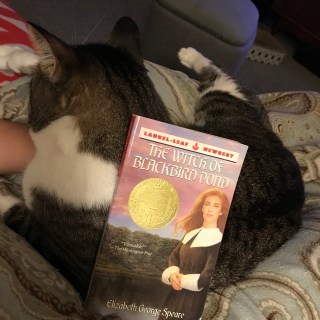
The Witch of Blackbird Pond

Book: The Witch of Blackbird Pond by Elizabeth George Speare

Date Read: November 12 to November 24, 2015img_5711-1

Rating: 5 (of 5) stars

This is a book from my childhood, and yet, not something that I would quite consider a childhood memory. Okay, okay, I realize that makes no sense.

I know the cover of this book from my childhood. I remember talking about the events of the first chapter of this book some time in middle school. But when I decided to revisit it a few years ago, I had absolutely no recollection of anything that happened in the rest of the book. I knew the basic premise of the book, but the story was completely unfamiliar to me. I have chosen to attribute that to me not finishing it back then, as I really do not think I could have forgotten a story that I now love so much.

The story covers a huge range of topics, while painting a fair picture of life in Puritan New England. Kit is the perfect hero for the target age range for this book– she is fierce and independent, but learns that her own priorities require her to balance this with her family and her friendships. And of course, what is there that you could not love about about Hannah? She is perhaps quirky, but warm and loyal. She bakes for her friends, and will not abandon those who depend on her (even if it is her cat).

While perhaps a minor point in the story, there is a moment that resonates for me, and touches upon my love for the fall season. Having lived all of her life in the tropics, Kit is at first taken aback by the weather of dreary New England. However, one morning she awakes to an unexpected sight: the world has become awash with brilliant reds, oranges, and gold. She realizes as she gazes over the landscape, “in October, any wonderful unexpected thing might be possible.”

Boris’s thoughts: “You started this on the day you met me, AND someone goes back to rescue a cat? 4 paws!”

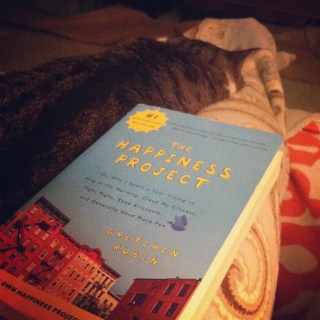
The Happiness Project

img_4325Book: The Happiness Project by Gretchen Rubin

Date Read: February 19, 2017 to March 15, 2017

Rating: 5 (of 5) stars

For some reason, this seems to be a fairly polarizing book. There are tons of people who love it, and tons of people who seem to take issue with the premise. I actually understand the reasoning of why people take issue with this, although I definitely fall into the “love it” category. Immediately upon finishing this book, I felt compelled to share it with someone else. I lent my copy to a friend just a few days later. She also loved it. Just this past Christmas I bought it as a gift for my Secret Santa at work. Although the book does not necessarily call it by name, one of the primary topics is a huge area of interest for me: Positive Psychology.

Honestly, I think the Positive Psychology aspect of this is what most people have a problem with. While not quite revolutionary, it’s a non-traditional approach to wellbeing. Happiness is not the opposite of depression. You do not have to be unhappy to want to improve your happiness. You could even potentially argue that you can improve your happiness even if you are depressed, but it is not the same as curing depression. I think the general idea of this perspective on happiness makes people uncomfortable. I also think it’s a bit contrary to what people think of as “happy.”

Many of the approaches to happiness that are explored in the book do seem to be small, novel, or even indulgent. But, well, that’s kind of the point. You do not have to move mountains to improve your satisfaction with your life, you just need to find what works for you and work with it. Do you. If something that makes you truly happy seems silly to other people, who cares? Perhaps it seems selfish, but your attitude and emotions impact so much of your life– taking time to put yourself in a positive frame of mind, while being “for you” in the moment, can lead to more positive results for everyone you interact with on a day to day basis.

I feel like I have so much to say, but also that I’ve hit upon the things that I feel are the core of what I enjoyed about this book. I love the balance between narrative/personal stories, and the research of Happiness (often termed in research as “subjective wellbeing”). I would highly recommend it to anyone willing to read with an open mind.

Boris’s thoughts: “Spending time with me makes you happy, right? 4 paws.”

No Country for Old Men

img_5897Book: No Country for Old Men by Cormac McCarthy

Date Read: March 9, 2018 to April 1, 2018

Rating: 4 (of 5) stars

Anyone who does not believe that there is a sort of beauty in destruction and decay has clearly never read anything by Cormac McCarthy. This is the third of his books that I have read, and I do intend to read more. There is an internal struggle every time I go to my shelf to choose my next book, and my eyes fall upon the McCarthy section. I had finished reading “The Road” shortly before I heard some terrible news– my favorite bookstore, Borders Books, was going out of business. After I recovered from the shock, there was a more pleasant realization: closing stores means discount books. Once prices reached 80-90% off, I bought every McCarthy book the store still had available (among many others). As a result, I have relatively large collection from this author that hangs out on my “to read” list. I want to read them so badly, but I know they will devastate me.

As expected, No Country for Old Men was no exception to this. It was beautiful, and it was horrifying. While it could be said that the first bit of the book moves a little slowly, I love how the setting is built up slowly, bit by bit. This then eventually leads into a whirlwind of gruesome activity. Throughout the book, there are moments of unexpected calm, a short but compelling description of innocuous detail that is quickly disrupted by gunfire. My eyes moved easily over the words, devouring them, but my mind often forced me to close the book even at moments I was dying to know where the next turn would lead.

I very much enjoyed the dynamic between Bell and Chigurh. Although there is no direct interaction between them, they are essential to the existence of the other character. I try not to put too much time into perceived symbolism in my reading– while I feel that there is sometimes some obvious link, I think much of what we discover in literature is what we want to find there. Bell is interesting in the obligation that he feels to his community. Even when he realizes how much of the situation is outside of his control, he continues to search for meaning. He is not willing to accept that the unfolding events are just simply events, with no meaning beyond their immediate consequences. I have seen Chigurh compared to Death, but I think this is too simple. While he presents his actions as the inevitable, he is also self-preserving and elusive. He could be fate, or he could be random chance. Or perhaps he is neither, and both of these possibilities are just what we choose them to be.

Boris’s thoughts: “This all seems too complicated for me. Can you just pick up the book, or put the book down? 2 paws.”